Below normal rainfall expected for norther Greater Horn of Africa
The Greater Horn of Africa Climate Outlook Forum (GHACOF) predicts a high likelihood of below-normal rainfall across much of the northern Greater Horn of Africa during the critical June–September rainy season, particularly in South Sudan, Uganda, Ethiopia, Djibouti, much of Eritrea, Sudan and western and coastal Kenya.

This outlook was issued by the IGAD Climate Prediction and Applications Centre (ICPAC), a designated WMO regional Climate centre (RCC), as part of the network of WMO regional climate outlook forums which support National Meteorological and Hydrological Services in providing tailored climate information for decision-making.
GHACOF brings together weather and climate experts as well as users in climate sensitive sectors like agriculture, health, water and disaster management. The information provided is vital in – for example planning health campaigns against malaria and water-borne diseases; in crop planting and irrigation decisions; as well as advance planning for weather, climate and water-related hazards.
June to September is a vital rainy season for countries in the northern and western parts of the Greater Horn of Africa, accounting for over 50% of annual rainfall and more than 80% in most parts of Sudan.
This makes the seasonal prediction particularly significant for early action and climate-informed planning. The forecast below-normal rainfall may have implications, particularly across key sectors with likely impacts on rainfed agriculture, water availability, livestock systems, hydropower generation, food security, and public health.
The evolving 2026 climate conditions closely resemble those experienced during the strong El Niño years of 1997 and 2023, when several parts of Ethiopia, South Sudan, Uganda, and western Kenya recorded below-normal rainfall during the June–September season.
“These past years provide useful guidance for preparedness and anticipatory action; however, this seasonal forecast remains the main reference for planning and decision-making,” said ICPAC, which is a WMO regional climate centre.
WMO will issue an Update on the forecast El Niño at the start of June.
Rainfall Outlook
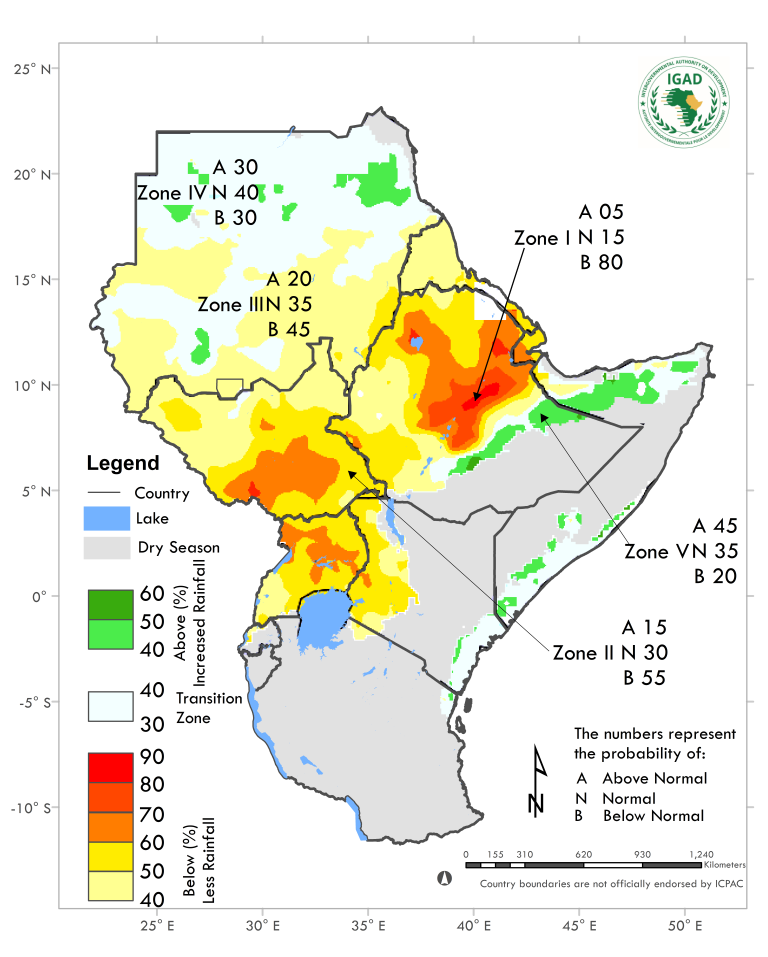
- The highest likelihood of below-normal rainfall is projected over central, northeastern and northwestern Ethiopia, southern Sudan, and northern Uganda, where probabilities exceed 60%, with peaks reaching up to 80% in northeastern Ethiopia.
- In contrast, isolated areas in northern Sudan, southeastern Ethiopia, and southern and northern Somalia are expected to receive enhanced rainfall.
- Areas of northern Sudan, southern coastal Somalia and Kenya are expected to receive near-normal rainfall.
- The forecast indicates an enhanced likelihood of a late onset in parts of South Sudan, Ethiopia and southern Sudan. In contrast, a few localised areas, particularly over north-central Ethiopia and parts of central Sudan, are expected to experience near normal to earlier-than-normal onset.
Temperature Outlook
- The temperature outlook indicates a higher likelihood of above-normal temperatures across most parts of the Greater Horn of Africa. The highest probabilities of warmer-than-normal conditions are indicated over northern Sudan, most parts of South Sudan, and Ethiopia.
ICPAC will continue to provide regular regional updates, while NMHSs will issue detailed country-specific forecasts and advisories.
GHACOF took place on 18-19 May, 2026. The Forum was attended by representatives from the 11 Member States of the Greater Horn of Africa region (Burundi, Djibouti, Eritrea, Ethiopia, Kenya, Rwanda, Somalia, South Sudan, Sudan, Tanzania, and Uganda), alongside national representatives from key sectors (agriculture and food security, livestock, water resources, health, disaster risk management, conflict, climate change and media), NGOs, humanitarian agencies, media, and development partners.
- Region:
- Region I: Africa