
IMO Prize winner Xu Jianmin pays tribute to the collective effort behind China’s weather satellites
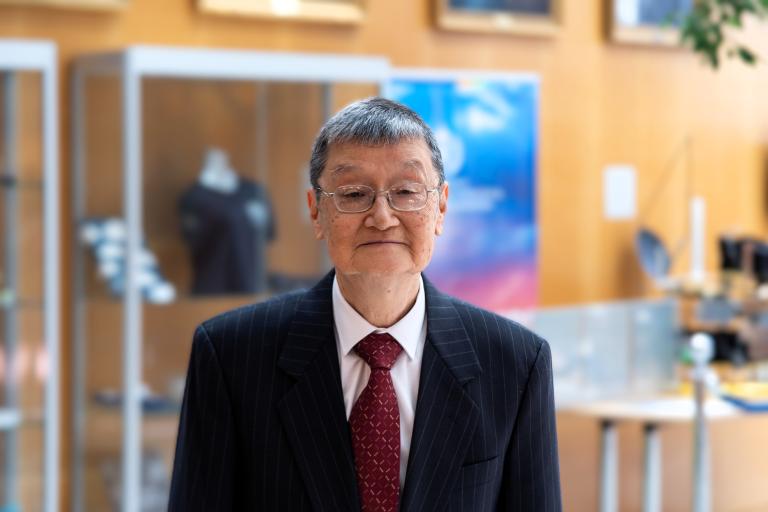
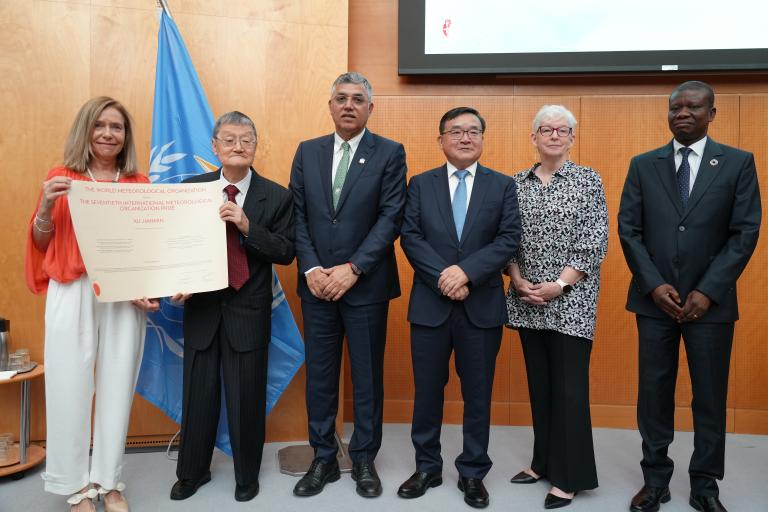
“This honour does not belong to me alone. It belongs to all the contributors who have devoted themselves to China’s meteorological satellite cause over the previous half-century”, said Prof. Xu Jianmin, the recipient of the Seventieth International Meteorological Organization (IMO) Prize.
“It has been my great privilege to play a role as a participant and a facilitator in this remarkable journey”, he said in his prize lecture to the WMO Executive Council.
In his lecture, “Evolution of China’s Feng Yun Meteorological Satellites”, Prof. Xu traced the programme’s development from its origins in the late 1960s to an operational constellation supporting weather forecasting, climate monitoring and disaster response around the world.
WMO President Dr Abdulla Al Mandous said Professor Xu’s forward-looking designs had revolutionized global weather forecasting and provided “critical, irreplaceable observations that bridge vital gaps in global climate and disaster monitoring networks”.
“Today, we honour a scientist whose work has helped transform the way we observe our planet from space”, said WMO Secretary-General Prof. Celeste Saulo.
Established in 1955, the IMO Prize is the highest scientific distinction awarded by WMO. Named after the predecessor of WMO, it recognizes exceptional contributions to meteorology, hydrology and international cooperation, and is widely regarded as the field’s equivalent of a Nobel Prize.
From first images to an operational system
China’s meteorological satellite programme began after a severe episode of freezing rain and snow struck much of the country in early 1969, disrupting transport and communications. Although China could receive cloud images from foreign meteorological satellites, it lacked access to the underlying data needed to derive meteorological information and make full operational use of the observations. The disaster exposed this critical gap and prompted Premier Zhou Enlai to call for China to develop its own meteorological satellites.
Nearly two decades later, in 1988, China launched Fengyun-1A, its first domestically developed polar-orbiting meteorological satellite. Less than two hours after launch, it transmitted its first visible-light cloud image. The name Fengyun means “wind and cloud”.
Since then, China has launched 23 Fengyun satellites across two generations. Ten are currently operational, providing polar-orbiting and geostationary observations for forecasting, climate services and environmental monitoring.
Prof. Xu played a central role in transforming the programme from a scientific ambition into an operational system.
Born in August 1944, he graduated from Nanjing Meteorological College in 1965 and began his career at the Meteorological Research Institute of the China Meteorological Administration (CMA). He later worked in operational forecasting and spent two years as a visiting scientist at Colorado State University in the United States.
He became Deputy Director of the National Meteorological Center in 1983 and Director-General of the National Satellite Meteorological Center (NSMC) in 1986. He subsequently served as Engineer General and was elected an Academician of the Chinese Academy of Engineering in 1997.
His work focused on the ground segment of the Fengyun programme, including mission planning, data reception and processing, product generation, distribution, research and operational applications.
The programme advanced gradually, beginning with achievable objectives and moving towards more complex systems. Prof. Xu led the repositioning of the Fengyun-2H geostationary satellite to 79° east longitude, filling a critical gap in operational coverage over the Indian Ocean.
He also championed the development of Fengyun-3E, the first operational meteorological satellite in an early-morning orbit. It helped address observational gaps within the six-hour data assimilation window used in global numerical weather prediction, improving the accuracy and timeliness of forecasts.
Satellite data serving society
Fengyun satellites now provide around 90 products covering the atmosphere, oceans, land, snow and ice, clouds, radiation, ecosystems and space weather.
They monitor tropical cyclones, precipitation, wildfires, sand and dust storms, atmospheric composition and the ozone layer. They also provide information on sea surface temperature, soil moisture, vegetation, snow cover and greenhouse gases.
Fengyun data are assimilated into China’s numerical weather prediction systems and used by international forecasting centres. The observations are shared in real time through the WMO Integrated Global Observing System.
Professor Xu emphasized throughout his career that satellite observations must be translated into practical services.
In 1987, satellite monitoring supported the response to a major forest fire in north-east China. In 1991, images were used to assess flooding across 87 counties, helping the authorities allocate disaster relief. Satellite observations were later used to monitor cyanobacteria in Taihu Lake and support efforts to tackle water pollution.
Fengyun satellite services now benefit more than 130 countries and territories, supporting the monitoring of extreme weather and disaster risk reduction. The data are made freely available worldwide and contribute to the WMO Early Warnings for All initiative.
Science built through cooperation
“The development of Fengyun satellites cannot be separated from the support and cooperation of the international community”, Prof. Xu said.
Professor Xu promoted international consultation and exchanges, supported the translation of important works on satellite meteorology into Chinese and encouraged Chinese scientists to engage with the global meteorological community. Many of the young scientists he mentored went on to become key members of the Fengyun programme.
“Xu Jianmin was not only a builder of systems. He was a builder of people”, said Prof. Saulo. “The most durable legacy a scientist can leave is not a satellite, but a student who knows how to see”.
A first contribution to a new award
At the end of his lecture, Prof. Xu announced that his prize money would become the first contribution to the CMA Multi-hazard Alert, Zero-gap and Universal (MAZU) Scholarship. The newly established scholarship will recognize meteorological scholars and professionals whose work advances international cooperation, strengthens early warning capacity and supports the wider application of the MAZU initiative.
“It is my sincere wish to donate the full amount of the IMO Prize to the MAZU Scholarship”, Professor Xu said. “This commitment follows the example of how individual action fuels our common global endeavour”.
Looking ahead, Professor Xu said the Fengyun programme would continue to improve the accuracy and application of satellite data, strengthen its contribution to climate action and Early Warnings for All and explore new technologies, including artificial intelligence.
- WMO Member:
- China
- Region:
- Region II: Asia