

The search for bamboo’s carbon removal potential
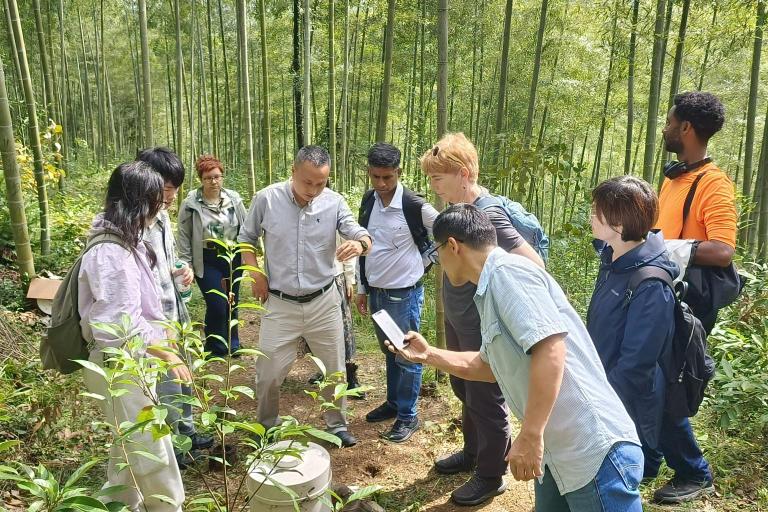
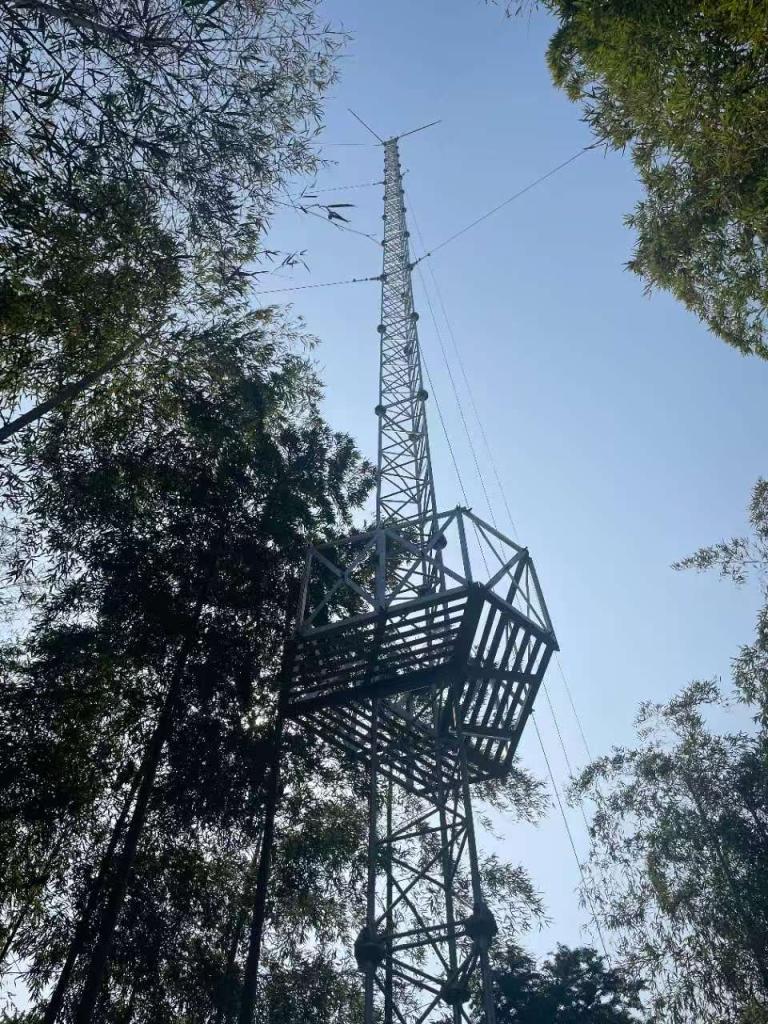
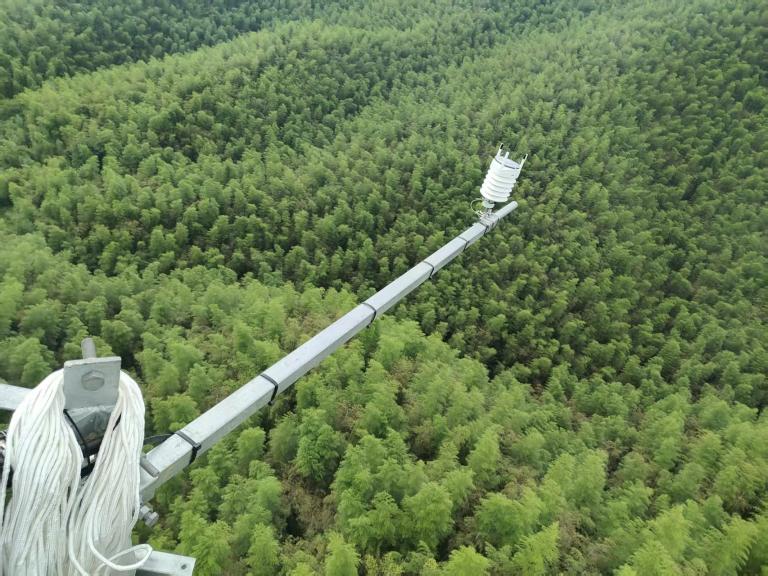
On a hill in Anji county, China, a 40-metre tower rises above the bamboo canopy. At the top, an inlet pulls in air. Nearby, in a temperature-controlled container, a gas analyser measures how much carbon dioxide (CO₂) that air contains.
It sounds simple enough. But for the scientists involved in the Utilization of Atmospheric Measurements to Establish the Carbon Sequestration Capacity of Bamboo Forests project, getting to this point was anything but straightforward.
Led by the World Meteorological Organization (WMO) in collaboration with the Zhejiang University of Technology (ZJUT), International Bamboo and Rattan Organization (INBAR), Earth Sciences New Zealand and China Meteorological Administration, the project is testing whether atmospheric observations can help improve estimates of how much carbon bamboo forests absorb. As countries move to implement the Paris Agreement, improving how carbon sinks are measured is becoming increasingly important. Bamboo is often cited as a promising option, but measuring its uptake accurately remains difficult.
According to Oksana Tarasova, Senior Scientific Officer in the WMO Infrastructure Department, the problem starts with a basic assumption in traditional carbon accounting: that a forest is made up of trees.
“Bamboo is not a tree”, Tarasova says. “It is a grass”.
Why bamboo is difficult to measure
Under the United Nations Framework Convention on Climate Change (UNFCCC), countries generally report emissions and removals using inventory methods. These rely on activity data and emission factors. In forests, scientists typically estimate biomass using variables such as trunk diameter, then calculate how much carbon is stored or removed.
While that approach works to a certain degree for trees, it’s not transferable to bamboo. Because bamboo culms are hollow, their diameter does not correspond to biomass in the same way. Applying forest methods to bamboo can therefore produce misleading results. This is what led INBAR to approach UNFCCC for help and eventually brought WMO into the picture through its work on the Integrated Global Greenhouse Gas Information System (IG3IS). Instead of estimating carbon uptake indirectly from the ground, IG3IS looks at the atmosphere itself.
How the method works
The principle behind the project is this: if a forest absorbs carbon dioxide, the air passing over it should contain less CO₂ than the air entering it.
To capture that difference, the team installed two towers in the study area in Anji County, a large, relatively uniform bamboo forest. One tower measures air upwind of the forest and the other downwind.
The measurements are made using optical gas analysers. Air is pumped into a small chamber and exposed to infrared laser light. CO₂ molecules absorb light in this part of the spectrum, so the amount of light lost in the chamber reveals the concentration of the gas.
Because the distance between measurement sites is small, the resulting CO₂ gradient is very slight, so the instruments must operate under stable conditions. Given the subtropical climate of Anji county, the air has to be dried before analysis, and the equipment is kept in temperature-controlled containers so humidity and temperature changes do not affect the readings.
The measurements are then added to high-resolution inverse models that work backwards from what is measured in the air to estimate how much carbon is being absorbed or released on the ground.
Building towers in a bamboo forest
Getting the instruments into place was one of the project’s first major challenges. The towers had to be built in remote forested terrain, high enough above the canopy to sample air mixed over a larger area.
Materials for the towers had to be carried up the hill by hand, including cement, pipes, iron tubes and water. The work required permits, coordination and a major effort from local partners at ZJUT, including staff and students who supported the construction.
Then there was the weather, with high humidity and frequent rain.
“You can imagine that if you have a tower in the forest which is the highest point, then lightning always strikes the tower”, Tarasova explains.
Proper grounding was therefore essential. Without it, a single strike could destroy the instruments.
Separating bamboo from industry
Once the instruments were running, another challenge became clear: most of the carbon dioxide measured at the site did not come from the bamboo forest.
The study area is part of an industrialized region of China, with significant emissions from human activity. To isolate the forest signal, the team had to distinguish biologically driven CO₂ from fossil fuel related CO₂ already present in the atmosphere.
For this, they measured additional tracers, including radiocarbon. Carbon from fossil fuels contains no radiocarbon, whereas carbon exchanged more recently through biological processes does. This allows scientists to estimate how much of the CO₂ signal comes from fossil fuels and how much is linked to the forest. Additional measurements, including carbon monoxide and soil carbon, complemented the atmospheric observations.
The team also measured carbonyl sulfide, a trace gas associated with photosynthesis, to better understand how much of the observed signal is related to active plant uptake.
Even with these measurements, the task remains difficult. The contribution from human activity proved stronger than expected.
Partnership at the core of the project
The project also depends on close collaboration between partners from Earth Sciences New Zealand who have prior experience with the IG3IS methodology and the dedicated field team from ZJUT in China.
“If something does not work, colleagues reach out and we solve it together”, Tarasova says. “I think this partnership and dedication is what helped move things forward. Otherwise, we would have stopped early, but nobody gives up”.
What comes next
The project has now been extended by one year to focus on analysing the data and refining the modelling needed to link atmospheric measurements with flux estimates. The results are also being compared with traditional estimates of carbon stocks derived from field inventories.
If the method can be improved, it could help bamboo-growing countries better characterize their forests and report their removals more accurately. It could also shed light on whether bamboo can play a larger role in climate mitigation strategies aimed at increasing carbon removal.
For Tarasova, the project is valuable even beyond its final number.
“It is a scientific challenge”, she says.
- WMO Member:
- China
- Region:
- Region II: Asia