

WMO highlights sand and dust storm hotspots, impacts and research
Geneva, Switzerland (WMO) – Some parts of the world, including China and the US-Mexican border, experienced record- breaking sand and dust storms in 2025, impacting health and the environment and disrupting economic activities and transport. However, overall average dust concentrations were similar to 2024, according to a new report from the World Meteorological Organization (WMO).
- Global average dust surface concentrations in 2025 similar to 2024
- North Africa and Middle East heavily impacted
- China had worst dust intrusion in a decade
- Record-breaking dust activity along US/Mexican border
- AI has potential to improve sand and dust forecasts but more research needed
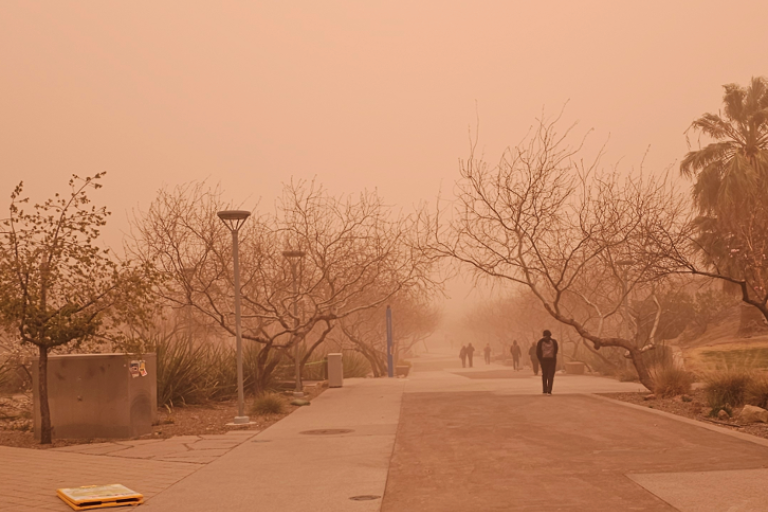
The WMO Airborne Dust Bulletin provides scientific insights to inform policymaking and to improve public safety and well-being. It examines hotspots and reviews advances in research, forecasts and warnings. The 2026 bulletin – the tenth in the annual series - discusses the potential of Artificial Intelligence and satellite technology to improve monitoring and warnings of dust sources and storms.
Every year, around 2,000 million tons of dust enters the atmosphere and can be transported for hundreds of kilometers and even thousands of kilometers, across continents and oceans. The most significant dust sources globally are concentrated in arid and semi-arid regions, particularly major deserts such as the Sahara in Africa, the Gobi in Asia, and the Arabian Desert in the Middle East.
Much of this is a natural process, but poor water and land management, drought and environmental degradation are increasingly to blame. It is a major hazard which affects more than 150 countries worldwide.
“Sand and dust storms affect air quality and human health. They reduce agricultural productivity, disrupt transport and aviation, strain water and energy systems, and damage ecosystems. No country is immune to their impacts,” said WMO Secretary-General Celeste Saulo.
“Because sand and dust storms and droughts do not respect borders, international cooperation is essential. Strengthening shared observations, data exchange, and regional forecasting capacity allows all countries — especially the most vulnerable — to benefit from advances in science and early warning,” she said in a message at an event at the United Nations headquarters in New York on 10 July, ahead of the International Day of Combating Sand and Dust Storms on 12 July.
Through the Sand and Dust Storm Warning Advisory and Assessment System initiative, WMO brings together countries and scientific centres to improve observations, advance dust forecasting, and provide operational early warning services. Great progress has been made – especially through regional collaboration – but more needs to be done.
Major events in 2025
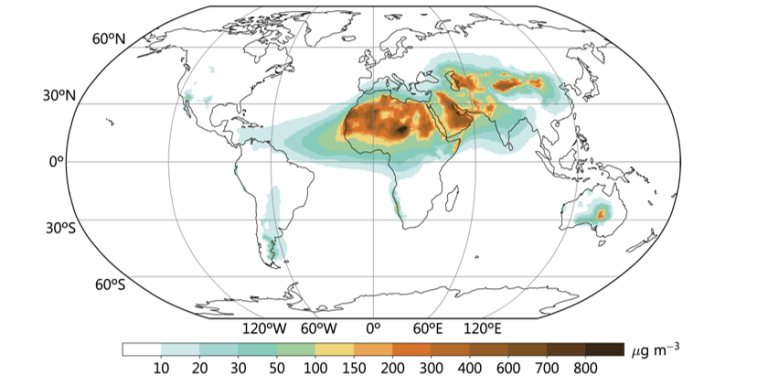
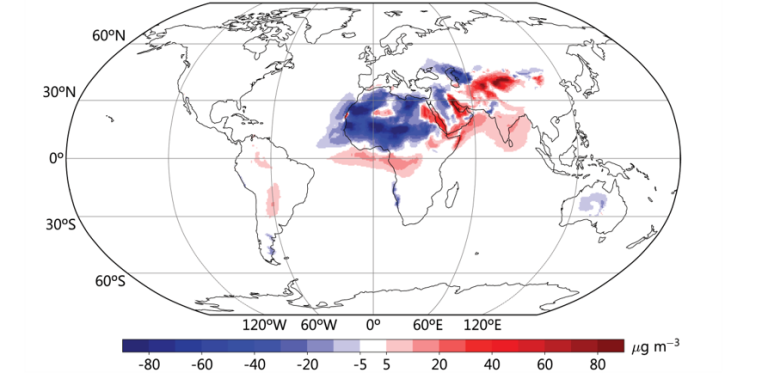
The global average of annual mean dust surface concentrations in 2025 was similar to 2024, with big regional variations, according to the Airborne Dust Bulletin.
The highest annual mean dust concentrations worldwide remained centred in the Bodélé Depression in Chad, one of the world's most active dust source regions.
North Africa and the Middle East were hit by a series of major dust intrusions, which harmed air quality and reduced visibility.
In April 2025, dust swept down from Mongolia into China, resulting in the worst sand and dust storm in China for the past decade – in terms of high intensity, wide influence and long duration.
Hourly concentrations of inhalable particles (PM10) exceeded 1,000 μg/m³ (micrograms or one-millionth of a gram per cubic meter air) in northern parts of China, with some areas reaching as high as 3,000 to 4,000 μg/m³ - many times above the limits recommended by the World Health Organization.
In the desert border region of Mexico and the USA, there were exceptionally frequent, intense and long dust storms. El Paso in Texas experienced 50 days with dust weather in 2025, more than double the annual average. The number of dust storms was the greatest since 1935, during the USA’s protracted “Dust Bowl” disaster.
At the peak, on 18 March, there were more than 6 hours of continuous sand and dust storm conditions, with a daily average PM10 concentration of 2,064 µg m-3, and hourly reported PM10 of 8,142 µg m-3, the highest measured in Texas since hourly PM monitoring began approximately 27 years ago. Schools, highways and airports were closed temporarily, public events were cancelled, and there were multiple fatal highway crashes.
Advances in forecasting and monitoring
Accurate forecasting of dust aerosols remains a major challenge due to the complex interactions between dust life cycles and atmospheric dynamics, as well as the high computational cost of conventional physics based models.
Recent advancements in AI have introduced radically new approaches to weather forecasting. By leveraging extensive data availability, such as decades of satellite-based Earth observations, AI models can infer complex atmospheric phenomena with high precision.
Although the training phase of Machine Learning/AI models can itself be demanding, once trained, these systems require substantially fewer computational resources than traditional numerical models, significantly reducing the cost and time associated with routine predictions.
One emerging approach directly uses AI-generated weather forecasts for dust models. Another major development is the use of large AI systems trained on long records of atmospheric data, such as reanalysis or satellite products. Overall, current results suggest that no single approach performs best for all situations. Some AI systems are better suited for short-lived, rapidly evolving local dust storms, while others perform more consistently for large-scale dust events that develop and travel over several days.
Recent advances in satellite remote sensing in combination with ground information and innovative Machine Learning techniques have significantly improved the identification and mapping of global active dust sources (hotspots). This monitoring is important to help target areas where action is most needed.
WMO activities
WMO’s Sand and Dust Storm Warning Advisory and Assessment System was set up in 2007. It seeks to strengthen global coordination of operational forecasting and warning services for various regions of the world to reduce the impacts of these events on the environment, health, and economies.
At present, there are four active regions that coordinate their activities through their associated regional centres:
- Gulf Cooperation Council region with Regional Center in Jeddah (Saudi Arabia)
- Northern Africa-Middle East-Europe region with Regional Center in Barcelona (Spain)
- Asia with Regional Center in Beijing (China)
- Americas with Regional Center in Bridgetown (Barbados)
The UN Coalition on Combating Sand and Dust Storms seeks to increase global collaboration to tackle the hazards and disruption. WMO plays an active role in this, leading the discussion on forecasting and early warning services.
The United Nations General Assembly proclaimed 12 July as the International Day of Combating Sand and Dust Storms and declared the 2025-2034 Decade on Combating Sand and Dust Storms. This year’s theme is From Source to Impact: Protecting Land and Life from Sand and Dust Storms.
The World Meteorological Organization is the United Nations System’s authoritative voice on Weather, Climate and Water.
For further information, please contact:
- Clare Nullis WMO media officer cnullis@wmo.int +41 79 709 13 97
- Global Communication and Engagement Media Contact media@wmo.int