
New report suggests more global temperature records ahead
Geneva, Switzerland (WMO) - Global average temperatures are likely to continue at or near record levels in the next five years, with Arctic temperature anomalies expected to continue to be higher than the global mean, according to a new report from the World Meteorological Organization (WMO), produced by the UK’s Met Office.
The Global Annual-to-Decadal Update also takes a look at the observed climate over the past five years and gives regional predictions for temperatures and precipitation over the next five years.
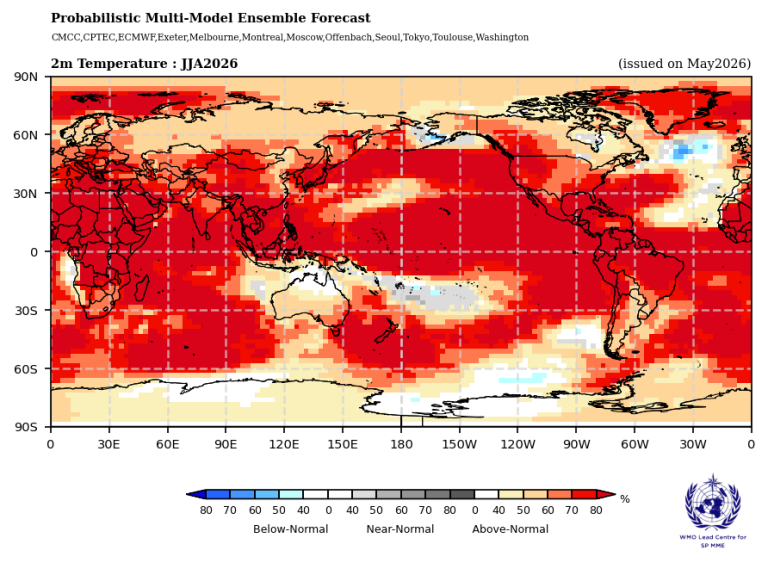
Annual global mean near-surface temperatures during 2026–2030 are predicted to range between 1.3°C and 1.9°C above the 1850-1900 average. It is likely (86% chance) that one year between 2026 and 2030 will surpass 2024 as the warmest year on record, according to the update.
It is very likely (91% chance) that the global mean near-surface temperature will temporarily exceed 1.5°C above the 1850-1900 average levels for at least one year between 2026 and 2030. This level was also temporarily exceeded in 2024, when the global average surface temperature was about 1.55 °C above the pre-industrial baseline.
It is likely (75% chance) that the 2026-2030 five-year mean will exceed 1.5°C above the 1850-1900 average. It is considered exceptionally unlikely (less than 1%) that any single year will exceed 2°C above the 1850-1900 average in the next five years.
The five-year predicted average temperature in the central tropical Pacific (Niño 3.4 region) indicates a tendency towards El Niño conditions, particularly in 2027 and 2028, it says.
Dr Leon Hermanson is the lead author of the report. He said: “There is an El Niño predicted for the end of 2026, which increases the chances of the following year, 2027, being the next record-breaking year.”
The update is produced by the UK’s Met Office in its role as the WMO Lead Centre for Annual to Decadal Climate Prediction. It provides a synthesis of predictions contributed by 13 different institutes, including four Global Producing Centres: Barcelona Supercomputer Centre, Canadian Centre for Climate Modelling and Analysis, Deutscher Wetterdienst, and the Met Office.
Confidence in forecasts of annually averaged global mean near-surface temperature is high since hindcasts show very high skill.
The 1.5°C (and 2.0°C) levels specified in the Paris Agreement refer to long-term warming sustained over an extended period, typically assessed over 20 years. Individual years with annual global mean temperatures exceeding these levels do not mean that the long-term temperature goals of the Paris Agreement are out of reach. Temporary exceedances are expected to occur with increasing frequency as the underlying rise in global temperature approaches these levels.
Other key findings:
- Arctic temperatures over the next five extended northern hemisphere winters (November-March) are predicted to be 2.8°C above average temperatures for 1991-2020, an anomaly more than three and half times that of global mean temperature anomaly over the same period, it says.
- Predictions of Arctic sea-ice for March 2026-2035 suggest further reductions in sea-ice concentration in the Barents Sea, Bering Sea, and Sea of Okhotsk.
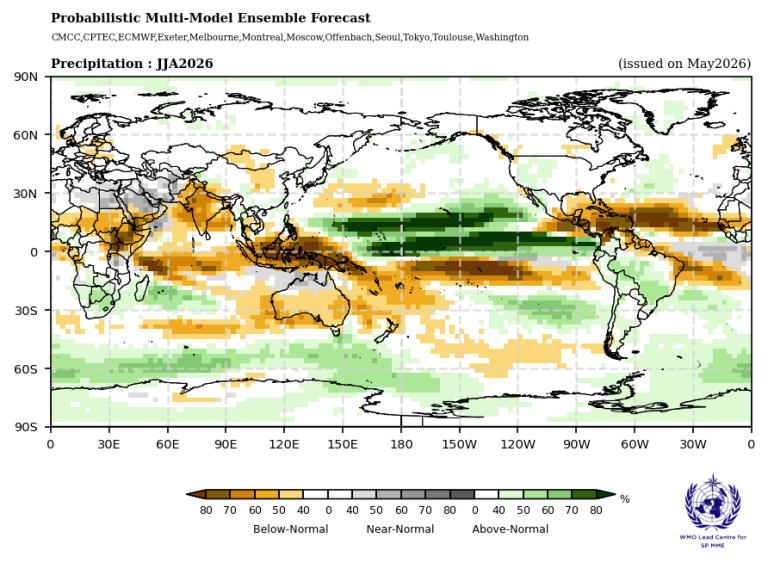
- Precipitation predictions favour wetter than average conditions at high latitudes in the northern hemisphere for the next five extended winter seasons (November to March). The pattern of increased precipitation in the tropics and high latitudes compared to the 1991-2020 reference period, and reduced precipitation in the subtropics, particularly in the southern hemisphere, is consistent with expectations of a warming climate.
- Predicted precipitation patterns for May-September 2026-2030 suggest that wet anomalies in the Sahel, northern Europe, Alaska and Siberia, and dry anomalies over the Amazon, are more likely in this season.
The update provides regional forecasts for all WMO regions, and showcases the example of South-Eastern Europe which experiences great variability in its December to February precipitation. Recent years have been anomalously dry after many years of high precipitation since 2009. The forecast suggests the 2026-2030 period is likely to have anomalously high precipitation – although predictions for this region have low skill.
The forecasts are intended as guidance for Regional Climate Centres, Regional Climate Outlook Forums and National Meteorological and Hydrological Services. The skill of interannual to decadal forecasts is different to that of weather and seasonal timescales and skill may vary considerably with region and season.
For further information contact:
At UK Met Office: Press Office Team, Tel: +44 (0)330 135 0005 Email: pressoffice metoffice [dot] gov [dot] uk (pressoffice[at]metoffice[dot]gov[dot]uk)
The World Meteorological Organization is the United Nations System’s authoritative voice on Weather, Climate and Water.
For further information, please contact:
- Clare Nullis WMO media officer cnullis@wmo.int +41 79 709 13 97
- Global Communication and Engagement Media Contact media@wmo.int