

WMO Regional Climate Centres (RCCs)
Mandate
WMO Regional Climate Centres (RCCs) are centres of excellence mandated to generate high-quality regional-scale climate products to support development and delivery of effective climate services at a national scale for the benefit of WMO Members. RCCs bridge the gap between information available at global and national scales. Their primary mission is to enhance the capacity of National Meteorological and Hydrological Services (NMHSs) to deliver effective climate services at national and local scales.
Definitions
The implementation of RCCs is designed to be flexible to reflect the diverse capacities and institutional arrangements across regions. This can take the form of:
- A single multifunctional centre that performs all the required RCC functions for the entire region.
- An RCC-Network where a group of centres referred to as nodes, collectively carry out climate-related activities to fulfill all the required functions of an RCC. These nodes may be organized based on functional responsibilities, geographical coverage or a combination of both. Nodes may also consist of consortia members in support of their operational activities.
Please refer to the Guidelines for the Establishment and Operation of WMO Regional Climate Centres (WMO-No. 1329)

Functions
While RCC products and services can vary by region, based on the priorities of WMO Members across Regional Associations (RAs), there are essential functions and criteria that all designated WMO RCCs or RCC-Networks must perform and adhere to, to be designated as a WMO RCC/RCC-Network. There are also recommended functions to better address Members requirements. Both mandatory and recommended functions are defined in the Manual on the WMO Integrated Processing and Prediction System (WIPPS) (WMO No. 485) to ensure uniformity of RCCs baseline services around the globe.
Mandatory functions
The mandatory functions include:
- Operational activities for seasonal prediction
- Operational activities for climate monitoring
- Operational data services, to support operational seasonal prediction and climate monitoring
- Training in the use of operational RCC products and services
Recommended functions
RCCs and RCC-Networks are encouraged to perform also recommended functions to address Members needs in their geographical domain, including:
1. Climate prediction and climate projection
2. Non-operational data services
3. Coordination functions
4. Training and capacity-building
5. Research and development
Establishment and Designation
The establishment and designation of an RCC or RCC-Network involve key steps:
- Assessing the regional needs of NMHSs through a survey (Survey template)
- Submitting an expression of intent for hosting an RCC/RCC-Network to the President(s) of the relevant WMO Regional Association(s) (P/RA) (Application template) along with the implementation plan for the demonstration phase
- Upon successful completion of the demonstration phase the candidate(s) will submit a status report to the P/RA for an assessment of compliance with the mandatory functions of a WMO RCC (how to submit a status report).
- Receiving a positive assessment of the appropriate climate coordination group within the RA, the P/RA will contact the WMO SG with a recommendation for formal designation of the candidate(s) as a WMO RCC
- The WMO SG will arrange for appropriate consultations with the P/SERCOM and P/INFCOM to seek a recommendation for the designation as a WMO RCC/RCC-Network
A detailed description of the necessary steps for establishing RCCs can be found here.
Survey template Application template How to submit a status report
Users
RCCs/ RCC-Networks primarily serve the NMHSs in the region of responsibility, enabling them to produce and deliver the full suite of climate services required to meet national needs. In the meantime, RCC and RCC-Networks products and services may also be used by other RCCs and NMHSs in neighboring regions. This fosters collaboration and knowledge exchange among RCCs, enhancing the consistency and quality of climate services across regions. Regional and international organizations can also be served by WMO RCCs/RCC-Networks.
Role of RCCs within Climate Services Information System (CSIS)
RCCs play a central role in the implementation of Climate Services Information System (CSIS) at regional level. In many regions, RCCs are responsible for organizing and/or contributing to WMO Regional Climate Outlook Forums (RCOFs) or Regional Climate Forums (RCFs), typically held prior to key climate seasons. These forums serve as main regional platforms to present, discuss, co-produce and tailor RCC products in collaboration with stakeholders.
Together, RCCs and RCOFs/RCFs constitute critical enablers for the operationalization of CSIS at regional scale to facilitate the generation, interpretation and dissemination of climate information to support decision-making at national level.
Worldwide implementation
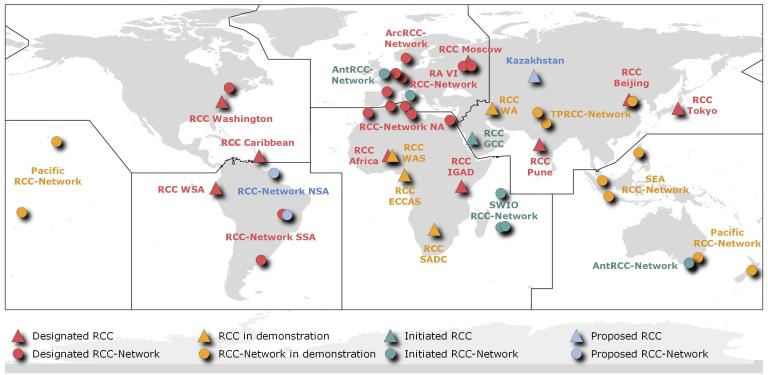
RCCs and RCC-Networks are established and implemented across all six WMO RAs. Moreover, some RCCs are cross-regional (serve multiple RAs), as is the case in the Arctic and Antarctic regions. The status of RCCs and RCC-Networks implementation varies. There are four distinct statuses of implementation:
- Designated: the designated RCC/RCC-Network is formally recognized by WMO as a fully operational entity. It performs at least the minimum set of functions (mandatory functions) detailed in the latest edition of the Manual on WIPPS (WMO‑No. 485) and delivers high-quality products and services operationally in a sustained, and well-coordinated manner. The designation comprises certain steps described in the WMO Guidelines for the Establishment and Operation of RCCs (WMO-No. 1329) and is formally endorsed through a Decision or Resolution of WMO Governing Bodies (Congress or Executive council).
- In demonstration: the RCC or RCC-Network is operationally delivering its products and services on a trial basis to demonstrate its capability and readiness. Through this phase RCC/RCC-Network also refines its products prior to seeking formal designation by WMO.
- Initiated: The RCC implementation process has commenced, but the centre has not yet started delivering services. The development of an implementation plan is still in progress.
- Proposed: The RCC is at the conceptual or planning stage with no substantial implementation steps taken yet. However, there is recognized interest and potential for future development.
| Regional Association | Status of implementation | |
|---|---|---|
| RA | designated | In demonstration phase |
| RA I | RCC Africa RCC-Network NA RCC IGAD | RCC WAS RCC ECCAS RCC SADC |
| RA II | RCC Beijing RCC Tokyo RCC Pune RCC Moscow | TPRCC-Network RCC WA |
| RA III | RCC WSA RCC-Network SSA | - |
| RA IV | RCC Washington RCC Caribbean | - |
| RA V | - | Pacific RCC-Network SEA RCC-Network |
| RA VI | RA VI RCC-Network | - |
| Cross-RA | ArcRCC-Network | - |