WMO Executive Council highlights the power of coordinated partnerships in building resilience
Flights land safely. Farmers plan their harvests. Communities prepare before storms arrive. Behind these everyday decisions lies an interconnected system of observations, data exchange, modelling, forecasting expertise and operational cooperation that spans continents.
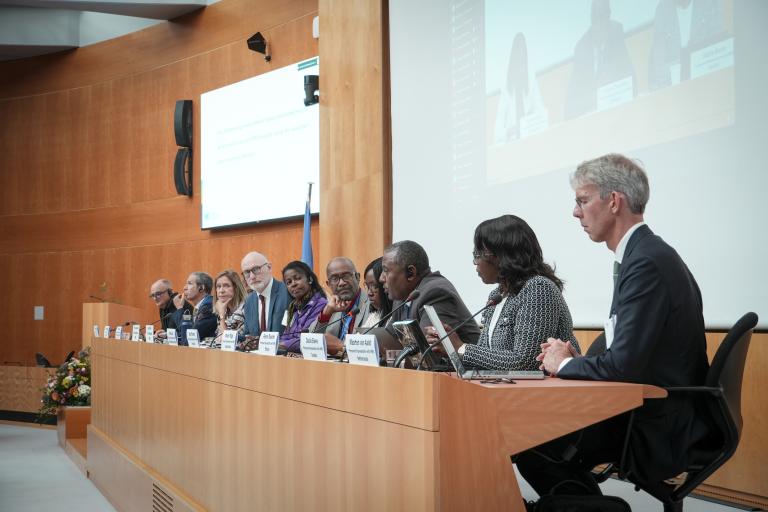
At its eightieth session, the Executive Council of the World Meteorological Organization (WMO) turned its attention to a question of growing strategic importance: how can diverse partnerships and financing mechanisms collaborate effectively together to sustain and strengthen the forecasting and observing systems upon which all countries depend?
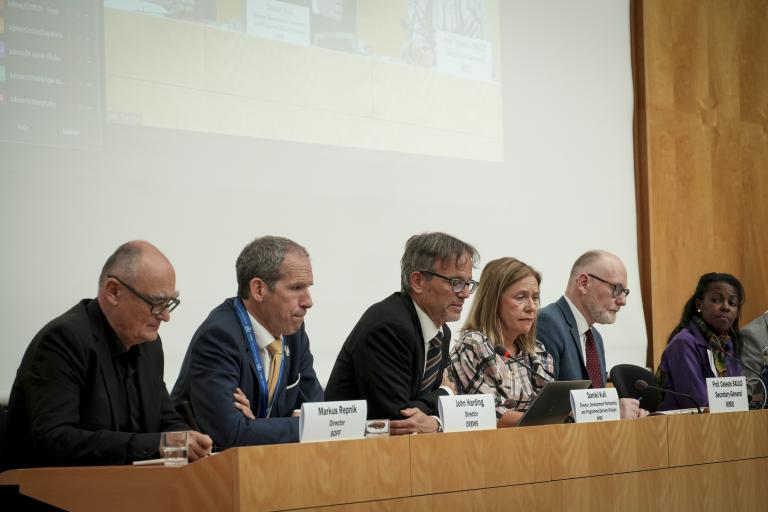
Opening the panel discussion on WMO's Resource Mobilization Strategy and Financing Partnerships, WMO Secretary-General, Prof. Celeste Saulo, emphasized that resilience is built through the coordinated force of many actors. “I encourage you to listen with a specific question in mind: at what point in the value chain did the funding intervention land, at what scale, who governed the decision, and what would have been missed without other funding or partnership mechanisms in place?”
Greater impact through reinforcing investments
A key message emerging from the session was that impact is greatest when investments reinforce one another. Executive Council Members acknowledged how the WMO Commons, the Systematic Observations Financing Facility (SOFF) and the Climate Risk and Early Warning Systems (CREWS) Initiatives fulfil distinct but mutually reinforcing mandates within the global weather, climate and water enterprise.
The WMO Commons helps sustain and modernize the globally mandated backbone and system-enabling functions coordinated by WMO — including globally coordinated observations, data exchange, prediction infrastructure, international standards and global coordination mechanisms that benefit all 193 WMO Member States and Territories.
The Systematic Observations Financing Facility (SOFF) is a UN fund created by WMO, UNDP and UNEP at the request of WMO Members to help close the most critical weather and climate data gaps. Initially focused on Least Developed Countries and Small Island Developing States, SOFF provides financial and technical support to enable countries generate, sustain and share the data required under the Global Basic Observing Network, foundational for every forecast, climate action and early warning.
SOFF is already supporting more than 60 countries, including 26 with ongoing investments. To further scale up its impact, the facility is preparing to launch the Systematic Observation Impact Bond, an innovative mechanism designed to accelerate action by front-loading funding and broadening the funding base.
CREWS addresses the most pressing early warning needs of LDCs and SIDs. Bolstering coherent national systems, CREWS supports essential activities such as national meteorological and hydrological services, digital tools to integrate disaster risk information, alert dissemination, gender-responsive and community engagement, preparedness and anticipatory action, emphasizing coordination across the early warning value chain.
These initiatives address diverse parts of the shared interconnected system while reinforcing one another.
Check the CREWS – SOFF – Commons complementarity map presented at EC-80
Financing and operational impact
Evan Thompson, Permanent Representative of Jamaica and Arlene Laing, Director of the Caribbean Meteorological Organization and Permanent Representative of British Caribbean Territories reflected on how years of sustained investments and technical cooperation helped build capacities that proved critical during recent hurricane response efforts. According to Mr. Thomson “the early warning system was critical during the time of Hurricane Melissa. The population believed what we were saying. They could see the movement of the hurricane through our images and that made it so much more real to them”, For Arlene, cooperation was the key to enable critical funding that enhanced operations “because we're working so well together to help ourselves, we're able to make a more effective case for assistance globally “
Experiences from Africa illustrated how combining support from multiple partners enabled countries to strengthen institutions and advance compliance across the hydrometeorological value chain. “Projects don't need to be overlapping; they are used as a booster. All these projects combined help us to go faster and to move at the same speed as the other big forecasting centers” said, Mariam Tadiga, Permanent Representative of Burkina Faso.
As discussions on strengthening global early warning systems and hydrometeorological services continue, Professor Maarten van Aalst emphasized that the true value of international cooperation lies not in technical compliance alone, but in the real-world benefits it delivers. Reflecting on the role of global standards and partnerships, he noted, "It's not the standards that make our offer attractive. It is that critical role that we play, and then the standards are a means to that end." His remarks underscored the importance of viewing standards as tools that enable trusted forecasts, stronger cooperation, and life-saving services for communities worldwide, rather than as ends in themselves.
As countries work together to strengthen weather, climate, and hydrological services, Cecile Siewe, Permanent Representative of Canada emphasized that international standards serve a purpose far beyond technical compliance. Describing them as a foundation for global cooperation, she remarked that "WMO standards are not just technical benchmarks. They represent a shared global ambition." By establishing common expectations for quality, interoperability, and reliability, these standards enable countries to share data, build trust, and deliver services that communities can depend on. Her comments highlighted how collective commitment to these principles helps create stronger and more resilient early warning systems worldwide.
Stewardship in an interconnected world
A central message emerged from the discussion: resource mobilization is more than securing funding. It is about aligning investments, partnerships and technical expertise to strengthen a shared global system.
WMO's unique role lies in convening Members and partners, aligning technical expertise and ensuring that investments reinforce one another within a globally interoperable system built on common standards.
As the Organization continues to expand its partnership ecosystem, this coordinating function becomes increasingly important.
Weather transcends national borders, and so too must the cooperation, investments and partnerships required to protect lives, livelihoods and the shared systems that underpin resilience worldwide.
For more information visit: