
El Niño/La Niña Update (February 2026)
- Weak La Niña is fading
- Neutral conditions (neither El Niño nor La Niña) are expected until July
- Model forecasts indicate possibility of El Niño
- Spring predictability barrier adds to uncertainty
- Seasonal forecasts support climate sensitive sectors and humanitarian operations
As of mid-February 2026, sea surface temperatures, alongside key atmospheric and oceanic indicators in the tropical Pacific, reveal that the recent weak La Niña conditions are fading and shifting toward ENSO-neutral.
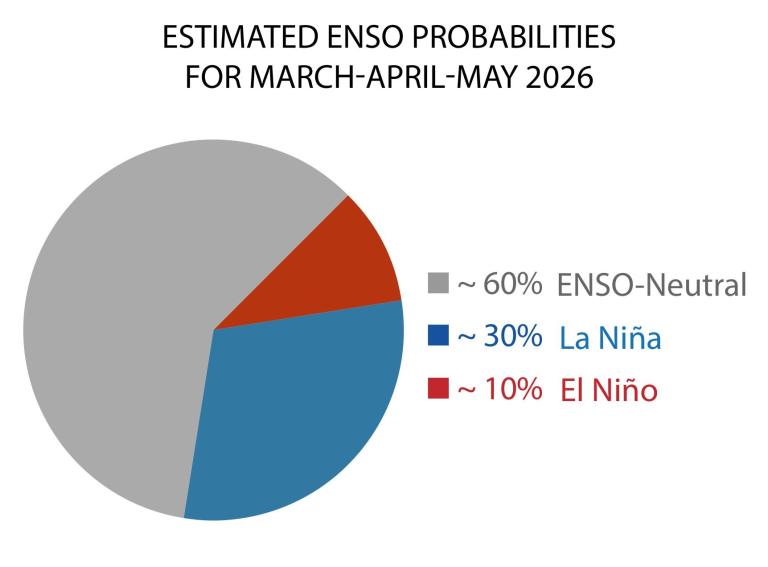
According to the latest WMO Global Producing Centres forecasts, there is a 60% chance of ENSO-neutral conditions during March–May 2026, compared with a 30% probability of La Niña continuing and a 10% chance of El Niño developing.
ENSO-neutral conditions are the most likely outcome during April–June (around 70% chance) and May–July (around 60% chance). The chance of El Niño increases steadily from April–June (around 30%) to May–July (around 40%). The re-development of La Niña remains unlikely in the extended outlook. However, uncertainty is high at longer lead times, and forecasts made at this time of year tend to be less reliable.
Accordingly, these probabilities should be interpreted as guidance and treated with caution, especially in light of the lower predictability characteristic of the boreal spring transition. National Meteorological and Hydrological Services (NMHSs) will closely monitor changes in the state of ENSO over the coming months and provide updated outlooks as needed.
Factsheet: El Niño/La Niña Update (February 2026)
About the El Niño/La Niña Updates series
The El Niño/La Niña Update provides analysis of the current conditions and evolution of the status of the El Niño-Southern Oscillation phenomenon. These include detailed information on sea surface and subsurface temperature anomalies, atmospheric circulation, cloudiness and rainfall patterns. The Update is prepared through a collaborative effort between WMO and the International Research Institute for Climate and Society, with contributions from experts worldwide. The El Niño/La Niña Update is crucial for governments, humanitarian and disaster risk agencies, and policymakers to prepare for climate-related impacts and to provide guidance for meteorologists worldwide to refine regional predictions.