
Ice Memory Foundation inaugurates Sanctuary in Antarctica
WMO Secretary-General Celeste Saulo participated remotely in the Ice Memory Sanctuary official ceremony at the Concordia Station on 14 January, marking the climax of a remarkable international mission to transport of ice cores from mountain glaciers in France and Switzerland on Italian research vessels to Antarctica.
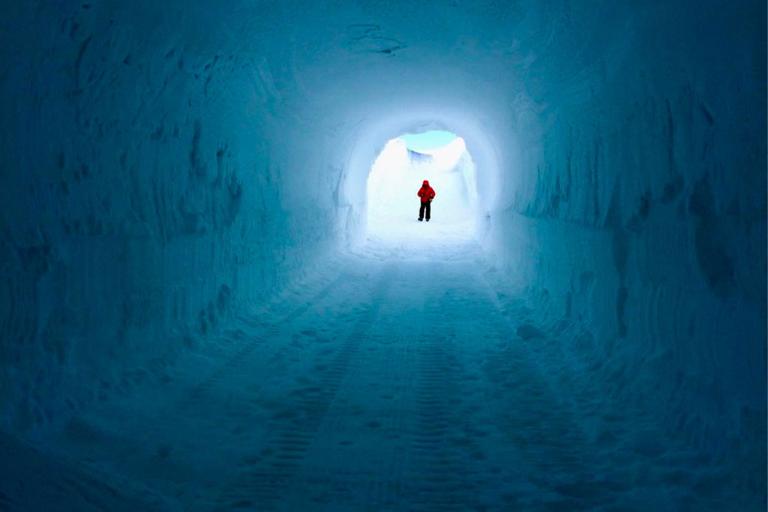
In the form of a cave dug into the snow, the heritage cores will be stored at a stable temperature of - 50°C, that will guarantee a long-term preservation of the samples using 100% “natural” storage with no energy consumption required for refrigeration, thereby protecting the precious samples from any risk of disrupted refrigeration (technical problems, human error, economic crises, conflict, etc.).
Concordia Station, co-managed by the Italian National Antarctic Research Program and the French Polar Institute, will be able to store the cores for centuries, enabling scientists to extract climate and environmental information in the distant future, when many European glaciers will have melted due to rising temperatures.
“What happens here concerns us all, far beyond the Polar regions,” said Prince Albert II Monaco, Honorary President of the Ice Memory Foundation. “Glaciers are not only ice they are pillars of the earth system, they support millions of people far beyond. Glaciers are archives of our climate’s memory.”
“From Antarctica today, let’s send a clear message to the world. The memory of our planet matters and safeguarding it is our common duty and our common responsibilty,” he said.
International Decade of Cryospheric Sciences
This Ice Memory Sanctuary was approved by The Antarctic Treaty System in 2024 and funded by the Prince Albert II Foundation. It is a significant boost for the UN International Decade of Action for Cryospheric Sciences 2025–2034, which is supported by WMO.
The cryosphere is one of WMO’s top priorities and WMO was one of the organizers of the International Year of Glaciers’ Preservation 2025.
In her statement to the ceremony, WMO Secretary-General Saulo invoked the close international research cooperation in Antarctica, and recalled memories of her visit to Marambio station, also in Antarctica as then head of Argentina’s national meteorological services.
“The inauguration of the Ice Memory Sanctuary is more than a scientific milestone. By preserving glacier ice, we extend climate records far beyond the period of instrumental observations and strengthen the scientific foundations of global climate monitoring. Initiatives like Ice Memory complement WMO’s global observing systems and help ensure that critical knowledge of the past remains available to future generations,” she said.
Since 1975, glaciers have lost more than 9,000 billion tonnes of ice—the equivalent of an ice block the size of Germany, 25 metres thick. Every year, 273 billion tonnes of ice are lost - an amount equal to 30 years of global human water consumption. This loss disrupts river flows, food production and ecosystems. It threatens cultural heritage and, ultimately, human security, she said.
“Even under optimistic scenarios, nearly half of the world’s glaciers could disappear by the end of this century. Ice that accumulated over centuries is melting away, taking with it irreplaceable records of past climates—information that, once lost, can never be recovered,” she said.
Celeste Saulo said that observation alone is not enough, and that preservation is essential. She called for action on two priorities:
- First, to strengthen cooperation between science and decision-making.
- Second, to invest in observation systems and protect open, trusted climate and cryosphere data.
The ice cores from Col du Dôme, Mont Blanc (France), and Grand Combin (Switzerland) were drilled between 2016 and 2023. They were transported from the Italian port of Trieste in mid-October on an Italian research icebreaker, RV Laura Bassi. After crossing the Atlantic and sailing to Christchurch, New Zealand, the ice cores reached the Italian Antarctic Station Mario Zucchelli in early December and were then transported by plane to Concordia.
Read the Ice Memory Foundation press release