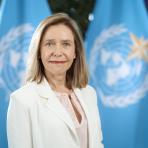

High-Level Session of the Open Consultative Platform during EC-80
Distinguished Members of the Executive Council and representatives off the private sector, colleagues,
Welcome to the Seventh High-Level Session of the Open Consultative Platform (OCP), thank you for taking the time to share this moment of reflection with us, and for the responses you sent in writing, which have served as a valuable initial input to kick off today’s discussions. Let me also thank Dr. Arlene Laing for agreeing to moderate this session.
Six years ago, when WMO convened the first OCP session, the goal was simple: to open a door. To create a space where the public and private sectors could speak honestly about how and where they could work together.
That dialogue has been rich and valuable, but it has not been enough.
Why we are here today
This Session is not just a continuation of our fruitful dialogue but it marks a shift to turn the OCP into an actionable and sustainable platform, useful for both the National Meteorological and Hydrological Services and the rapidly changing private sector.
The objective of today's session — and the process it initiates — is to inform WMO's future approach to public-private engagement, with a view to substantially advancing our vision for the Twentieth Session of the World Meteorological Congress in 2027.
Many of you have already given us an idea of your thoughts through the survey you completed: for example: you all agree that the WMO should be the central platform for discussion on PPE engagement, leveraging its convening power and authoritative voice. For example: you all agree that the WMO should be the central platform for discussion on PPE engagement, leveraging its convening power and authoritative voice.
Colleagues, Why does This Matter? The Stakes Are Real
Global weather, climate and water institutions are changing. The private sector is no longer a peripheral actor in this system. Commercial companies are contributing to observation networks, developing AI-based forecasting tools, and providing services that complement what public institutions deliver. At the same time, almost all business sectors are increasingly integrating weather and climate data into risk management, capital allocation and investment decisions that affect communities and economies worldwide. All this is supported by the same global public infrastructure that WMO coordinates — and that our Members sustain every day.
That infrastructure — the observing networks, data exchange systems, prediction models, standards and coordination mechanisms that WMO has built over 75 years — is the backbone of the global weather enterprise. And it is under strain. Demand is rising. The gap between what the world needs from its weather and climate intelligence systems and what public funding alone can deliver is widening.
The question before us is therefore not whether engagement between the public and private sectors is necessary. The question is how we make that engagement more effective and more impactful.
This is not a problem WMO can solve alone. And it is not a problem the private sector can solve alone. That is why this conversation matters.
What We Are Asking of You Today
This afternoon, you will rotate through 6 World Café tables, each anchored to a question at the heart of how WMO should structure its engagement with the private sector. We are not here to validate a framework that has already been written. We are here to build one together from the ground up.
We hope to leave this room with better understanding of:
- Validated priorities: where is public-private collaboration most needed and most feasible?
- Second: Identified barriers: what prevents effective collaboration — and what can WMO do to address them?
- Third: An initial understanding or vision for a potential WMO instrument for PPE to be finalized during the next WMO Congress in 2027.
The relationships in this room — between governments and the private sector — are among the most important we can build for the future of the global weather enterprise.
I now hand over to Dr. Arlene Laing, who will guide us through the session.
Thank you.
Statement by