

Ahead of the Storm: Tracking Sand and Dust Across Borders
- Author(s):
- Sara Basart (WMO)
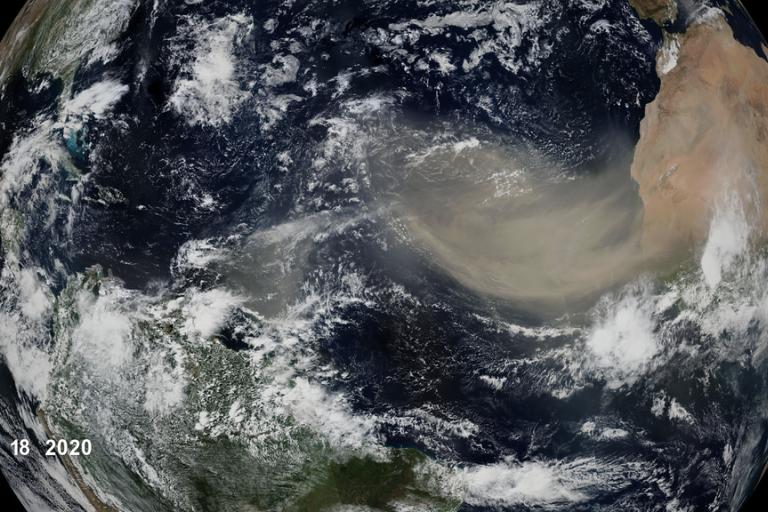
In June 2020, a massive plume of Saharan dust swept across the Atlantic, turning skies hazy from the Caribbean to the southern United States. Air quality reached hazardous levels not seen in 50 years. From Antigua to Trinidad and Tobago, visibility dropped dramatically creating dangerous driving conditions and disrupting air travel. The event was one of the most intense transatlantic dust outbreaks in decades.
Every year, strong winds lift billions of tonnes of dust into the atmosphere, where it can travel across continents and oceans. These particles affect air quality, human health, transport, agriculture, energy production and ecosystems far from their source. They also influence weather and climate by interacting with radiation, clouds and precipitation processes.
As land degradation and drought intensify in many regions, concern over sand and dust storms is growing. In response, countries and international organizations are placing greater emphasis on monitoring, forecasting and early warning systems that can help communities prepare for high-impact events. The United Nations has recognized the urgency of addressing sand and dust storms through the United Nations Coalition on Combating Sand and Dust Storms, established in 2017 to strengthen international cooperation and reduce the adverse effects of sand and dust storms.
Improved forecasting is already helping communities prepare for high-impact events. National authorities can issue public advisories during severe dust episodes, while aviation agencies can adjust flight operations when visibility deteriorates. Farmers, transport operators and energy providers are also increasingly relying on forecasts to reduce disruption and economic losses.
The World Meteorological Organization (WMO) plays a central role in supporting these efforts. Through scientific observations, forecasting systems and international cooperation, WMO works with countries to improve monitoring and early warning services for sand and dust storms and to strengthen preparedness in vulnerable regions.
The science behind sand and dust storms
Sand and dust storms occur when strong winds lift large amounts of sand and dust particles from bare, dry soils into the atmosphere. The main difference between airborne sand and dust is particle size, with sand being larger (>60 µm) than dust.
While natural sources such as deserts and dry lake beds are the main contributors, human activities including deforestation, unsustainable agriculture, unsustainable water use, and urbanization can worsen the problem by stripping vegetation and exposing soil to wind erosion. At the same time, rising temperatures and prolonged droughts linked to climate change are expanding arid regions and creating the conditions that favour sand and dust storms.
More than 80% of the world’s dust emissions originate from the deserts of North Africa and the Middle East, with significant contributions from Asia’s Gobi Desert. Around 25% of global dust emissions are linked to human-related activities, highlighting the importance of sustainable land management practices. Localized sources such as degraded lands in the Americas and Europe also contribute to sand and dust storm activity.
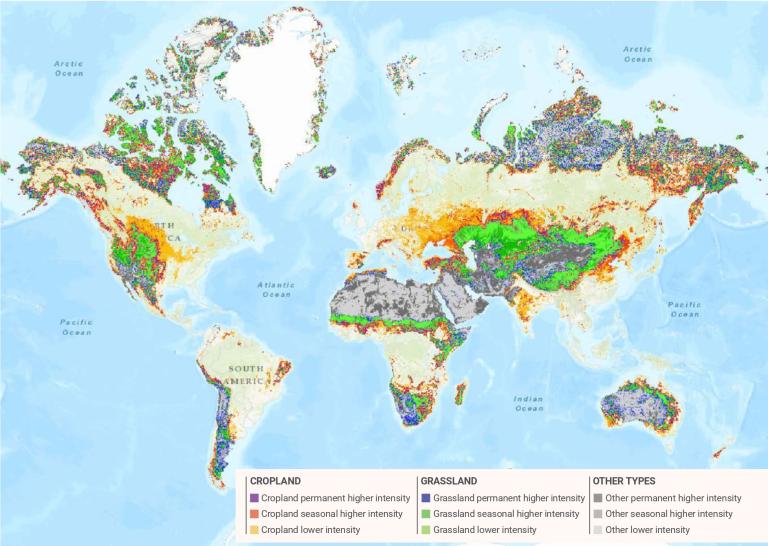
Once airborne, dust can travel thousands of kilometres, linking distant regions through the atmosphere. Dust from one part of the world can therefore affect air quality, weather and climate far beyond its source.
These particles do more than reduce visibility or degrade air quality. They also interact with sunlight and heat in the atmosphere, influencing the Earth’s energy balance and affecting weather and climate processes. Dust can even affect how clouds form and precipitation develop. Because of these complex interactions, accurately representing dust in weather and climate numerical models remains both challenging and essential for reliable forecasting.
A changing climate can further intensify sand and dust storm activity in some regions by altering weather patterns, reducing rainfall and increasing the frequency of droughts. Understanding how these factors interact is therefore important for developing effective responses tailored to regional conditions.
Impacts across sectors
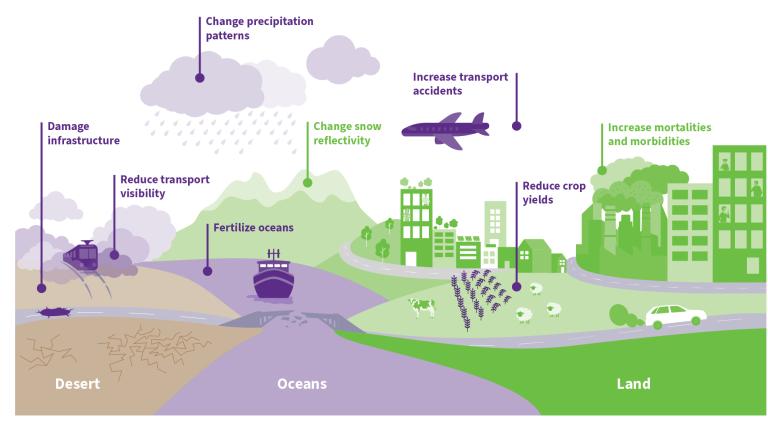
The consequences of sand and dust storms extend across multiple sectors. In countries within or near desert dust sources, they can severely affect livestock, agriculture and human health. Intense storms can also force the closure of roads and airports due to poor visibility, damage infrastructure and disrupt energy production.
In distant regions, dust can also affect solar energy production by reducing the amount of sunlight reaching the ground. At the same time, transported sand and dust can have positive effects. Nutrients contained in the dust can fertilize marine and continental ecosystems, benefiting agriculture and fisheries.
Exposure to high particulate matter (PM) concentrations (that is sand and dust) can cause disease. The World Health Organisation (WHO) Air Quality guidelines provide evidence-based recommendations to limit values of specific air pollutants including fine (PM₂.₅) and coarse particles (PM₁₀) to help countries protect public health. During sand and dust storms, concentrations of both PM₂.₅ and PM₁₀ can rise significantly. In intense events, PM₁₀ can reach as much as 3,000 ug/m3, posing health risks to exposed populations. For PM₁₀, WHO Air Quality Guidelines recommend a 24-hour mean concentration limit of 45 µg/m3.
From source mitigation to impact mitigation
Addressing sand and dust storms requires a clear distinction between two complementary but fundamentally different approaches: source mitigation and impact mitigation.
Source mitigation focuses on reducing the dust generation at its origin. This includes long-term measures such as sustainable land management, restoration of degraded soils, tree planting, improved agricultural practices and better water resource management. By stabilizing soils and increasing vegetation cover, these measures help limit the amount of loose particles that can be carried by wind. Source mitigation can help address the drivers of anthropogenic (human-related) dust emissions while also supporting biodiversity, climate adaptation and sustainable development. However, these measures are often gradual, resource-intensive and dependent on sustained policy support and community engagement.
Impact mitigation, by contrast, focuses on reducing the consequences of sand and dust storms once they occur or are imminent. This is where forecasting and early warning systems play a central role. Timely forecasts enable authorities and communities to take preventive actions: issuing health advisories, closing schools, protecting infrastructure, adjusting transport operations and safeguarding agricultural activities. Impact mitigation does not prevent dust generation, but it can significantly reduce exposure, damage and loss.
These two approaches are complementary and mutually reinforcing. While source mitigation addresses long-term drivers, impact mitigation provides more immediate protection. Given the transboundary nature of sand and dust storms, impact mitigation, particularly through forecasting and early warning systems, remains indispensable even where source control measures are in place.
From observation to action: Early warnings systems
Advances in meteorological science and technology are transforming the way sand and dust storms are monitored and predicted. Satellite observations, ground-based measurements and numerical models now provide unprecedented insight into the sources, transport and evolution of dust events. However, the value of these advances lies not only in improved scientific understanding, but also in their translation into actionable services. Forecasts must be timely, accurate and tailored to user needs.
However, ensuring that all countries benefit from these developments requires sustained investment in capacity development and long-term monitoring, particularly in dust source regions where observational coverage remains limited. To support access to authoritative information, WMO publishes an annual Airborne Dust Bulletin, providing a global overview of dust activity and scientific progress.
WMO promotes the integration of sand and dust storm forecasts into multi-hazard early warning systems. This approach is aligned with the Early Warnings for All initiative, which aims to ensure that everyone on Earth is protected by early warning systems for hazardous weather, water and climate events, including sand and dust storms.
In this context, WMO established the Sand and Dust Storm Warning Advisory and Assessment System (SDS-WAS) in 2007 as a research initiative under the Global Atmosphere Watch (GAW) Programme. SDS-WAS aims to enhance operational forecasting and warning services across affected regions through a globally coordinated framework. The system fosters collaboration among research institutions, operational centres and user communities.
SDS-WAS is a global initiative that implements region-specific activities through a network of regional nodes coordinated by associated WMO Dust Regional Centres. These centres provide access to dust information, including observations from networks and satellites, forecasts and advisory products. They also support capacity development tailored to regional source areas and downwind impacts. As of 2026, SDS-WAS comprises four regional nodes:
- Northern Africa, the Middle East and Europe: Established in 2007 and located in Barcelona, Spain, this Regional Centre is jointly operated by the Spanish State Meteorological Agency (AEMET) and the Barcelona Supercomputing Center (BSC)
- Asia: Established in 2008, this Regional Centre is hosted by the China Meteorological Administration (CMA) in Beijing, China
- Americas: Established in 2012, this Regional Centre is currently coordinated from Bridgetown, Barbados, and hosted by the Caribbean Institute for Meteorology and Hydrology (CIMH)
- Gulf Cooperation Council: Established in 2022, this regional centre, located in Jeddah, Kingdom of Saudi Arabia, is operated by the National Center for Meteorology (NCM)
This coordinated approach supports the exchange of dust-related information across regions. Within this framework, the Regional Specialized Meteorological Centres (RSMCs) serve as the operational backbone, translating coordinated scientific knowledge into routine dust forecasts, advisories and assessments. As of 2026, the Barcelona and Beijing Dust Regional Centers are recognized as RSMCs operating under the WMO Integrated Processing and Prediction System (WIPPS). They generate operational products and provide technical support to National Meteorological and Hydrological Services.
Beijing Regional Center
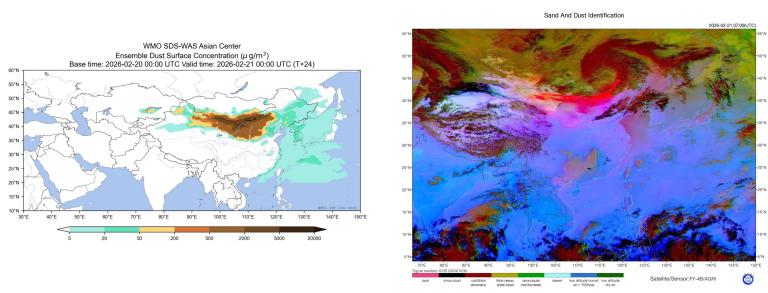
Between 20 and 22 February 2026, a major sand and dust storm engulfed southern Mongolia and northern China, blanketing large areas in dust and bringing strong winds. In some areas, visibility dropped below 200 metres. Transport disruptions affected travel during the Lunar New Year holiday period. Roads and tourist sites were closed; flight were delayed or cancelled.
Satellite products (such as the Infrared Difference Dust Index (IDDI) derived from Fengyun-4A satellite observations) showed that the storm originated from the Gobi Desert and was transported southeast by a Mongolian low-pressure system. The WMO Beijing Dust Regional Center provided accurate and timely forecasts of the process several days in advance and issued sandstorm warning advisories accordingly. The early warning information effectively supported disaster prevention and mitigation efforts by local governments, transportation authorities, and the general public.
Barcelona Dust Regional Center
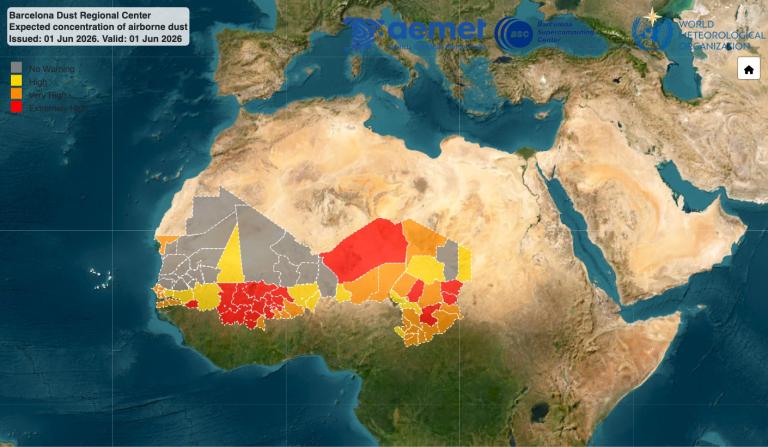
In northern Africa, limited ground-based observations constrain dust monitoring and forecasting, particularly during high-impact events. To address this gap, the WMO Barcelona Dust Regional Center provides simple, colour-coded advisory maps that translate multi-model dust forecasts into clear categories of expected conditions.
Since 2018, this regional centre has issued daily maps for African countries showing dust conditions for the next two days across subregional areas, supporting preparedness in sectors such as transport, agriculture, and public health. The system combines up to 15 regional and global forecast systems with historical dust patterns to ensure consistent and comparable guidance across the region, improving the accessibility and usefulness of early warnings for decision-making.
Strengthening cooperation
Given their transboundary nature, sand and dust storms also call for stronger international cooperation. In recent years, the United Nations has increased attention on the issue through initiatives such as the 2025 – 2034 United Nations Decade on Combating Sand and Dust Storms and the designation of 12 July as the International Day of Combating Sand and Dust Storms.
In this context, the United Nations Coalition on Combating Sand and Dust Storms, which brings together 21 United Nations entities and partners, promotes coordinated, cross-sectoral action, while WMO leads global efforts in monitoring, forecasting, and early warning. As climate variability and human pressures on land systems continue to evolve, sand and dust storms are likely to remain a significant global concern. Emerging technologies, including improved satellite sensors, data assimilation techniques and high-resolution models, offer new opportunities to enhance sand and dust storms prediction to further improve prediction and early warning systems.