Advancing Water Resources Assessment Capacity Among Members
The sixth WMO Global Dynamic Water Resources Assessment Tool (DWAT) workshop, held in Siem Reap, Cambodia, from 12 to 14 November, highlighted its significant potential to strengthen decision-making for water resources allocation and broader water resources management. Country examples demonstrated how the tool is being adapted to meet diverse hydrological needs, highlighting both its flexibility and its growing value in supporting evidence-based planning.
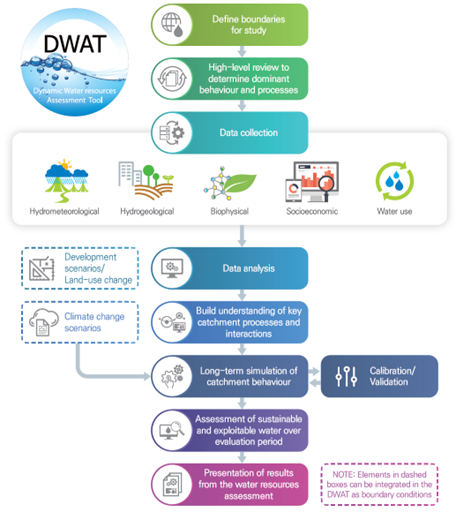
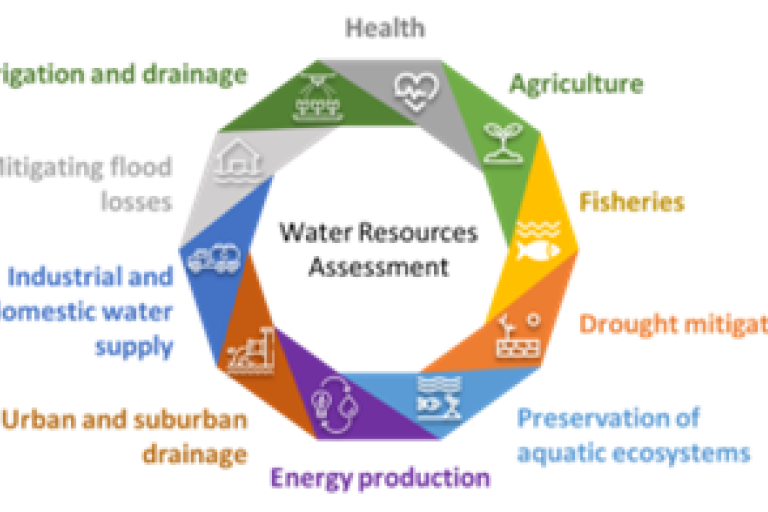
Water resources assessment is essential for effectively and sustainably managing water resources. It involves determining the sources, extent, reliability and quality of water resources as well as understanding the spectrum of human activities that influence them. It also provides a systematic evaluation of current conditions and future trends in water availability, accessibility and demand, and forms a core element of integrated water resources management by providing science-based evidence needed to plan, design, operate and maintain water-related infrastructure and services. Water resources assessments cover many different areas from agriculture, health and energy to industrial and domestic water supply and much more.
DWAT was created in 2012 under the former Working Group on Hydrological Services of WMO Regional Association II (Asia) (RA II), with substantial technical and financial support from the Han River Flood Control Office (HRFCO) of the Ministry of Climate, Energy and Environment (MCEE), Republic of Korea and the Korea Institute of Civil Engineering and Building Technology (KICT). Today, the Standing Committee on Hydrological Services (SC-HYD) of the Commission for Weather, Climate, Hydrological, Marine, and Related Environmental Services and Applications (SERCOM) oversees its further refinement and application with support from KICT. In WMO’s evolving toolkit for Water Resources Assessment, DWAT offer is standardized, basin-scale input to support the WMO Global Hydrological Status and Outlook System (HydroSOS). HydroSOS uses DWAT, together with other monitoring, forecasting and data sharing systems, to deliver harmonized, science-based hydrological status assessments and outlooks at national, basin and global scales.
DWAT enables assessment of land-use changes within a basin and help with understanding the impacts of such changes on water availability under various scenarios, including climate change. In particular, the tool can help policy specialists and water resource managers in identifying the current and future water management challenges and compare those with current and past water resources availability. It accounts for water balance on dynamic (hourly or daily) as well as static (monthly or yearly) bases. This allows for its application to small or midsized basins as well as consideration of both surface and groundwater sources. By classifying a watershed into hydrologically homogeneous subbasins, the runoff characteristics resulting from the geomorphological factors can be objectively represented, and infiltration, evapotranspiration and groundwater flows can be simulated according to soil layers. The ease of extraction of the physical input parameters also makes it easy for the tool to be applied in various hydrological, geophysical and climatic conditions (such as tropical, rural, forest, or newly developed urban areas).
As part of its effort to evaluate and further develop skills and institutional capacity to carry out water resources assessment amongst its Members, WMO regularly organizes DWAT workshops with support from MCEE and KICT. These workshops provide a platform for training, hands-on practice and peer-to-peer learning, ensuring that WMO Members can apply DWAT effectively in diverse hydrological and climatic conditions. Since the first workshop in Bhutan in 2018, which presented the case studies of eight Members, the number of Members that have applied DWAT in pilot studies has grown to 28.
The further development of DWAT has involved the growing number of Members that are applying the tool and continuous improvements to the software itself. With each successive iterations, DWAT has been refined to respond to user feedback and added new functionalities, so that it remains relevant and capable of meeting diverse water assessment needs.
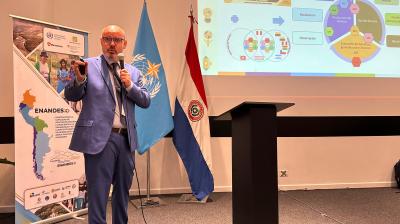
Eight DWAT case studies were featured at the Cambodia workshop. Each demonstrated the diverse applications – from hydropower planning and reservoir operations to broader basin-level water management challenges – for which Members are using DWAT. These examples showed how the tool is being adapted to meet diverse hydrological needs, highlighting both its flexibility and its growing value in supporting evidence-based planning. Members urged WMO to continue to support further development and implementation of DWAT as well as to expand its water resources assessment activities.
The improvement of water resources assessment and management using tools such as DWAT also remains a priority in the services agenda of RA II. In a dedicated two-day session before the workshop, RA II hydrology experts discussed DWAT among the hydrology-related elements for inclusion in the RA II Operating Plan 2025–2027. Outside of these workshops, DWAT has also been operationally implemented in select target basins in countries such as Cambodia and Lao People’s Democratic Republic (PDR), thanks to a project funded by the Climate Risk and Early Warning Systems (CREWS) initiative.
DWAT has been made freely available by MCEE and KICT to anyone who is interested in applying the tool. Click here to download the latest version. A users’ manual and video tutorials with step-by-step instructions can be accessed at Dynamic Water Resources Assessment Tool (DWAT).