WMO Executive Council seeks to balance growing demands for science and services
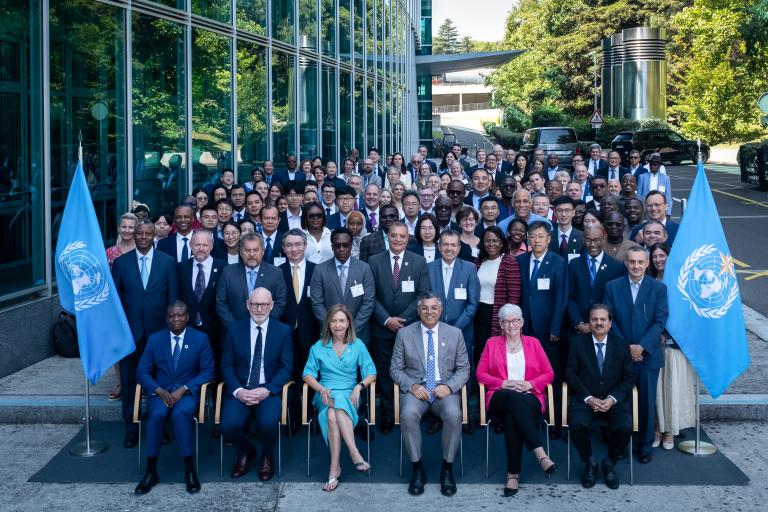
“The demand for what WMO delivers and what National Meteorological and Hydrological Services produce - weather forecasts and warnings, climate data and standards and for scientific cooperation - is growing. Every extreme event makes that clearer,” WMO Secretary-General Celeste Saulo told the opening session.
“We are here to make deliberate choices about how this Organization remains strong, equitable, and scientifically credible through a decade that will test every institution we have built,” she said.
The meeting at WMO’s headquarters in Geneva takes place against the backdrop of a rapidly developing El Niño climate event, which looks to increase extreme weather including intense heat, damaging drought and dangerous rainfall events in many parts of the globe.
Whilst weather, climate and water-related challenges are growing, so are opportunities afforded by sweeping advances in forecasting and predicting skills, satellite technology, supercomputing and Artificial Intelligence.
WMO President Abdulla al Mandous stressed the overriding importance of:
- Investing in the WMO Commons, a global financing mechanism to sustain and modernize our shared weather, climate and water intelligence infrastructure on which every forecast, warning, climate-risk decision, and resilience investment depends;
- Promoting a successful Earth science ecosystem — one that brings together public, private, academic and philanthropic partners to strengthen the observations, data, prediction and services on which every country depends.
The Executive Council will discuss how to align priorities and provide direction to scientific and technical programmes through a modified operating plan. It will focus on advancing WMO governance, strategic planning and financial management and will consider the recommendations on WMO governance from the UN’s Joint Inspection Unit.
Other items on the agenda include long-term monitoring stations, satellite and space policy coordination, ocean observations, resource mobilization, training and capacity development, and engagement with the private sector.
Both the WMO President and Secretary-General warned that funding shortfalls jeopardized progress.
“The WMO, as is the entire UN system, faces an unprecedented financial crisis that directly threatens our long-term sustainability and strategic ambitions – Early Warnings for All, cryosphere and hydrology,” warned the WMO President.
As of May 31, 2026, outstanding assessed contributions to the WMO regular budget stand at CHF 77.8 million.
“The cost of constraint is not only financial. When we defer capacity development in AI, we do not save money neutrally — we widen gaps that take a decade to close,” said Celeste Saulo.
“When we scale back scientific coordination, — we erode the connective tissue of a global system that functions because it is global,” she said.
Details about the Executive Council meeting are here