

“The Atmosphere Is Not Waiting to See Who Has Observations”
- Author(s):
- Maria del Carmen Cazorla Andrade (Institute for Atmospheric Research, Universidad San Francisco de Quito), Andrada Coos (WMO)
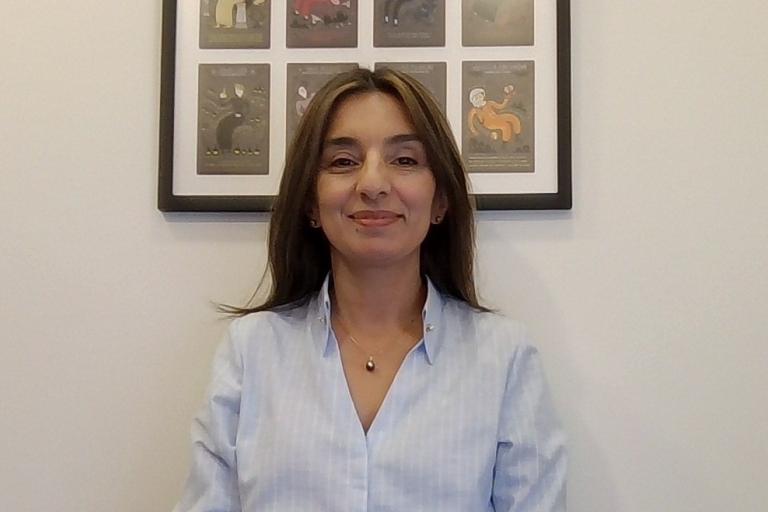
María del Carmen Cazorla Andrade is an atmospheric chemist specializing in ozone, air quality, and atmospheric composition, with a particular focus on tropical and high altitude environments. She is Director of the Institute for Atmospheric Research at the Universidad San Francisco de Quito (USFQ), where she leads long-term atmospheric observations in the Andes and the Galápagos, contributing to global monitoring networks such as the National Aeronautics and Space Administration (NASA) Southern Hemisphere Additional Ozonesondes Network (SHADOZ) and the Aerosol Robotic Network (AERONET).
A Fulbright scholar, she completed her PhD in meteorology at Penn State University and later held a postdoctoral fellowship at the NASA Goddard Space Flight Center. She currently serves as Chair of the Reactive Gases Scientific Advisory Group under the World Meteorological Organization (WMO) Global Atmosphere Watch (GAW) programme and as Co-Chair of the Ozone Research Managers, a technical body that advises the Montreal Protocol.
While attending the GAW Symposium in Geneva in April 2026, Dr Cazorla spoke to me about the importance of in-situ ozone measurements and her determination to fill the gaps in Ecuador’s atmospheric observations.
You started your career as a chemical engineer. What drew you toward specializing in atmospheric science?
When I first graduated in Ecuador, I went to work in the oil sector and saw firsthand the extent of pollution in the Amazon. I felt that, as a chemical engineer, it was my duty to help address it. So I decided to continue my studies with a master’s degree in atmospheric pollution control in the United States. Luckily, I received a Fulbright scholarship to study at Penn State University.
One of the required courses in my master’s programme was atmospheric chemistry and physics, taught by the renowned Professor William Brune, who was also head of the Department of Meteorology. From the very first class, I completely fell in love with the subject.
As I was finishing my master’s, I went back to Professor Brune and told him how passionate I had become about atmospheric chemistry. He accepted me as a PhD student, and that was how I found my vocation.
Can you tell me a bit about your work at the Institute for Atmospheric Research?
I was fortunate to receive strong training in atmospheric measurements, instrument development, and experimental work, both at Penn State University and later during my postdoctoral research at the NASA Goddard Space Flight Center.
When I decided to return to Ecuador and rejoin USFQ, I felt I could apply that expertise at home, even though I had to start from scratch. I proposed the creation of the Institute for Atmospheric Research and secured funding from both external partners and the university, which has been very supportive.
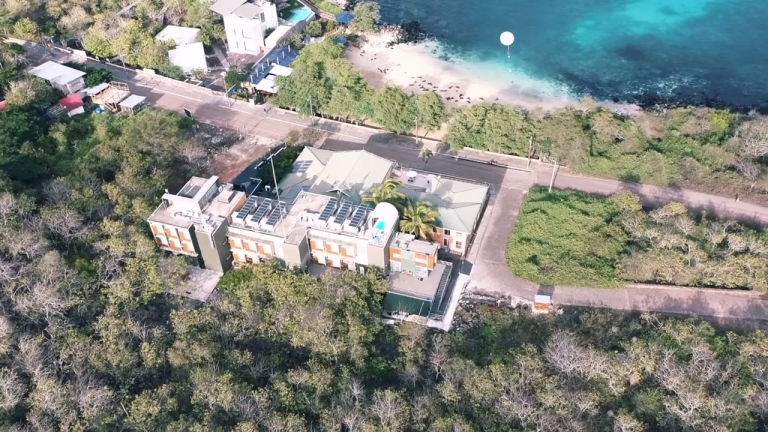
Over the past 14 years, we have gradually built a strong experimental research programme, with laboratories both on the main USFQ campus in Quito and in the Galápagos. We monitor nitrogen oxides (NOx) at the surface and ozone from the surface throughout the atmospheric column, including through ozonesonde launches, which are essential for in-situ ozone observations. Through international collaborations, we also measure aerosols, and our sites in Quito and the Galápagos are part of AERONET.
We also incorporated atmospheric chemistry modelling at our urban site and operate a meteorological station to provide baseline information.
Why is ozone so important to study?
I think first of all, people need to understand that there is good ozone and there is bad ozone. The good ozone is in the stratosphere, roughly from 15 to about 50 kilometres above sea level. That’s the ozone that shields us from ultraviolet (UV) radiation which I think everyone knows is harmful. There, you want a lot of ozone.
Then in the troposphere, which is the part of the atmosphere that matters for air quality and climate, ozone behaves very differently. The air closest to the surface is what we breathe. In this layer, ozone is a very harmful photochemical pollutant. It’s the main component of photochemical smog, and it’s very difficult to control because it’s not directly emitted.
If you have a direct emission from smokestacks, you can act on the source. But ozone forms in the atmosphere through chemistry. There are thousands of chemical compounds in the air and with sunlight, as I like to say, they get “cooked”, and ozone is formed.
However, this chemistry is what we call non-linear, meaning that if you reduce the gases that form ozone, there is no guarantee that ozone production will go down. Sometimes the opposite can happen. If you reduce some emissions, for example from traffic or industry, ozone can actually increase. It’s very complex.
A bit higher up, above one or two kilometres, you have the free troposphere. There, ozone is also problematic because it is a greenhouse gas. It’s actually the third most important greenhouse gas after methane and carbon dioxide.
How do you measure ozone in your experiments?
We have permanent stations, and we launch ozonesondes once a month from Quito and twice a month from the Galápagos. One of the launches is synchronized so we can compare measurements between the two sites.
An ozonesonde is an instrument that uses a chemical reaction to generate an electrical signal proportional to the amount of ozone in the air. It’s connected to a radiosonde, which measures physical parametres like position, pressure, temperature, and humidity, and transmits the data back to the ground station.
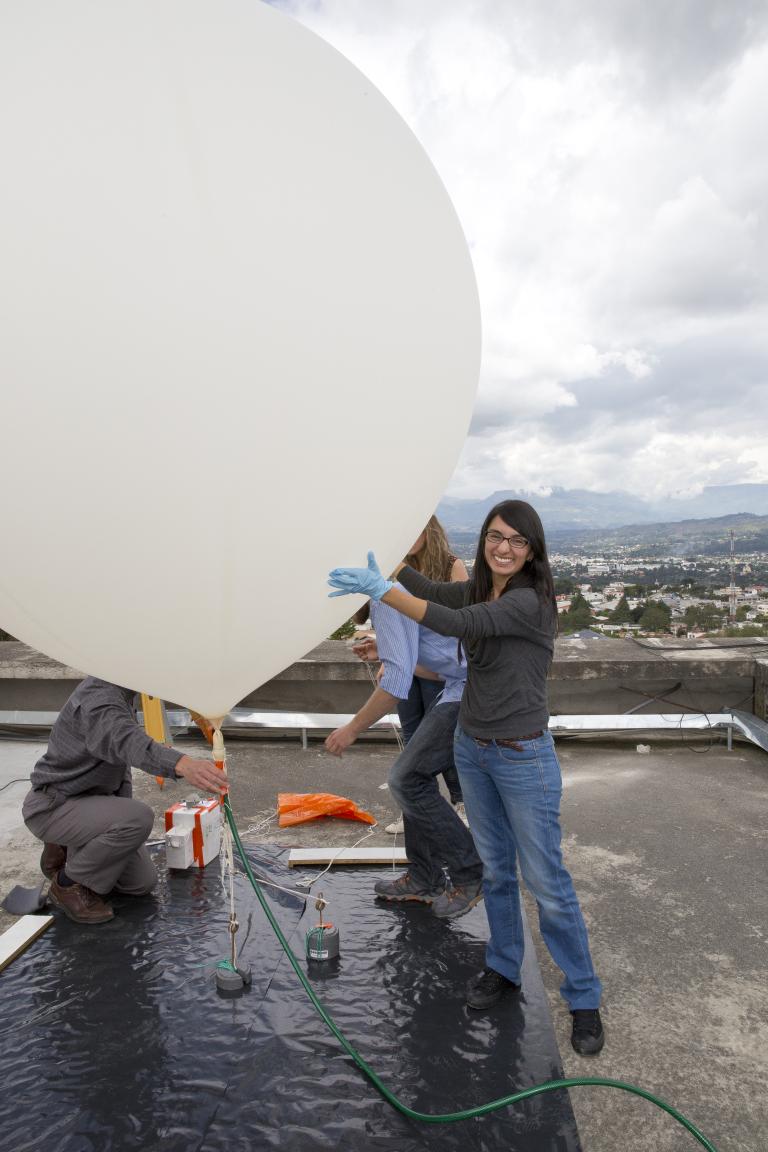
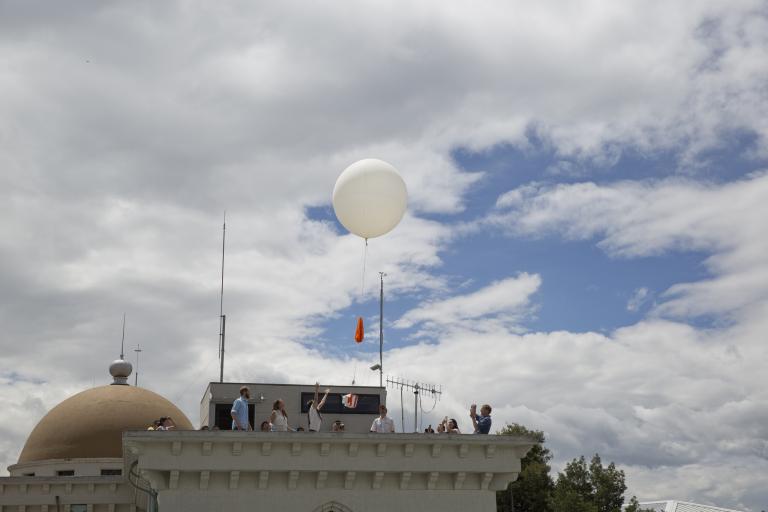
It’s actually a very fun experiment because we then need to inflate a big balloon with helium to take the instruments up. The students love it. Once the balloon is inflated to one and a half metres in diameter, we hook up the devices and launch it.
As the balloon goes up, the pressure drops, the helium expands and the balloon keeps enlarging. By the time it reaches 30 kilometres, it can grow to five-six metres in diameter, and eventually it pops. Once that happens, the instruments are in free fall until a parachute buffers the fall as they reach the troposphere. They can land anywhere, so we often lose them.
But we put a sticker on the box with our address, and we say that this is a scientific experiment. If people find the box, they call us and we get it back. We give them a small reward, and they feel good about it, not just because of the money, but because they feel they are contributing to science.
What do the vertical profiles you get from ozonesondes reveal about the atmosphere?
The measurement we call total column ozone includes all ozone from the surface to the stratosphere, more than 90% of which is stratospheric ozone. By overlapping ozone vertical profiles over time, you can see whether ozone is increasing, remaining stable, or decreasing. Understanding these trends requires long observational records, which is why this science takes significant commitment, effort and funding.
In the free troposphere, where ozone acts both as a pollutant and a greenhouse gas, it’s particularly important to understand whether ozone is increasing globally. In the stratosphere, the focus is on monitoring the ozone layer. Around the 2018 Meeting of the Parties to the Montreal Protocol, scientific findings already showed signs of recovery, and observations since then have continued to confirm that trend. That is why continued monitoring remains so important.
You’ve helped establish long-term atmospheric measurements in Quito and the Galápagos. What does it take in practice to build and sustain observation capacity in a region that historically lacked data?
The NASA SHADOZ network that looks at ozone in the tropics had a station in the Galápagos they used to run with the Institute for Meteorology and Hydrology. However, by the time I moved back to Ecuador in 2012, the collaboration had been paused and they weren’t launching anymore.
At that point, up in the Andes, in our region, there were no measurements. I thought launching from Quito would fill a true gap in observations. My university has internal funding researchers can compete for, which helped me acquire the first batch of ozonesondes and start launching in 2014.
I also started communicating with the National Oceanic and Atmospheric Administration (NOAA). I helped them connect with people at the meteorological service in the Galápagos, and in exchange they would send me a few sondes. The software for launching ozonesondes from NOAA is also open source, and thanks to their collaboration we got good training. That’s why, from the very beginning, our measurements were high quality.
Over the years I conducted more soundings, published papers, presented the work at the American Geophysical Union and the American Meteorological Society conferences. Then in 2020 there was a call from the Parties under the Vienna Convention Trust Fund to my university, they redirected it to me and I submitted a proposal. That was the big breakthrough, because we got important funding.
All the work from before, starting in 2014, really supported that proposal. So we started launching under the objectives of the Montreal Protocol. We increased launches to two per month for that period, got another strong paper, and it became clear that we were the only station in the equatorial Andes doing this.
That’s when the NASA SHADOZ network reached out to me and said we were doing great work, and that they wanted to reactivate Galápagos and have Quito join. That’s when more sustained and larger funding came in, and we managed to build the station at the USFQ campus in the Galápagos where the university already had a research facility.
I think the key was that, year after year, even when I didn’t always have funding to launch, whenever I had data, I would publish. It’s a matter of steady work, building step by step, and not giving up.
How does the lack of tropical observations affect our understanding of atmospheric processes?
When you go to a scientific conference like the GAW symposium and look at the maps and the models, you see a lot of observations in the northern hemisphere and almost nothing in the southern hemisphere, especially in the tropics.
When you see these differences, you have to remember that the atmosphere is not waiting to see who has observations. It mixes. A knowledge gap in one region affects the whole planet, because the atmosphere is an interconnected system. That is why increasing observations and maintaining them in our regions is so important.
What do you feel has been the greatest challenge in your work and across your career?
In places like the US or Europe, researchers are specialized. They can focus on research, with resources concentrated on a specific problem. In universities in South America, it’s very different. We have to do everything ourselves. It’s a lot of work: teaching, researching, raising funds, publishing, attending meetings. Even as we received more funding and support from students and technicians, it’s still a lot.
Institutionally, and as a community, one of the biggest challenges is funding. In many of our countries, we don’t have something like a national science foundation that funds research. Bringing this discussion to society or even to governments is also difficult because there are many more immediate needs. I feel that discussions about air quality and climate are sometimes disconnected from those priorities, even though they are very important.
How do you feel about the future of atmospheric science?
I was thinking about that recently with all the news about the trip to the Moon, which is very exciting. Astronauts look back at Earth and see this beautiful blue marble, and they often speak about unity, about how we are one humanity. I think we also need to turn our attention back to our own planet.
I’m a professor, and I work with young people, so I always try to give this message to my students: get involved in environmental issues, air quality, climate, and atmosphere – biosphere interactions. This is our beautiful planet, we have to study it and take care of it.
- WMO Member:
- Ecuador
- Region:
- Region III: South America