WMO mourns the loss of Divino Moura
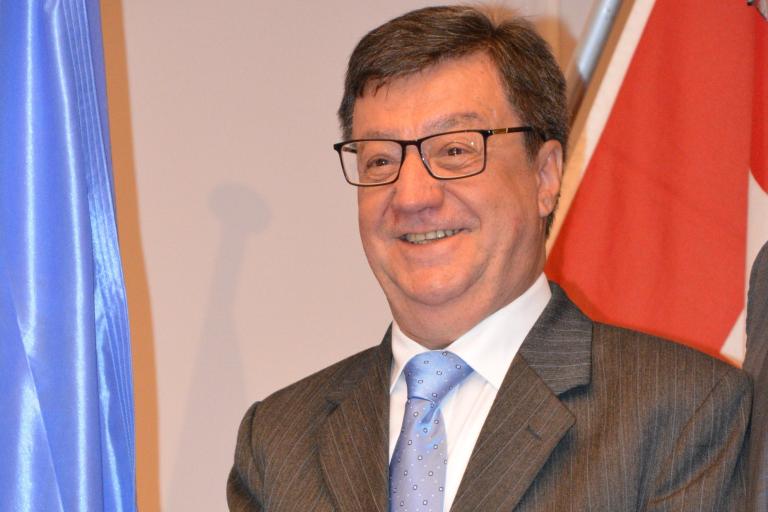
Mr Moura won WMO’s top prize – the IMO Prize – in 2019 for his outstanding contribution to meteorology and climate science, and his commitment to WMO spanned decades. He was Permanent Representative of Brazil with WMO from 2011 to 2016 and was WMO Third Vice-President between 2007 and 2011. He served as head of Brazil’s national meteorological service three times.
Mr Moura made a major scientific contribution towards a better understanding of the role of the Atlantic and El Niño in the regional and global climate, for establishing a framework for climate–society linkages, for his research work and role in modernizing Brazilian meteorology.
WMO Secretary-General Celeste Saulo said she was deeply saddened at to learn of his passing on 16 April, aged 80.
“I had the privilege of knowing Divino well. He was not only internationally recognized in recent years for his role as Vice-President of the World Meteorological Organization, and for his long tenure as Director of the Brazilian Meteorological Service — he was, above all, one of the great scientific leaders who shaped meteorology in Brazil,” she said.
“Divino belonged to a pioneering generation — among the very first group of meteorologists who transformed the discipline in the country. Their work did not stop at national borders. Together, they built strong scientific bridges across neighboring countries, advancing meteorology throughout Latin America and strengthening our regional collaboration,” she said.
At the IMO award ceremony in 2019, Mr Moura said his long career originated with his research into why the Amazon – the world’s biggest tropical rainforest was situated right next to an arid region of Brazil. “That is an anomaly,” he said.
His scientific lecture traced the early development of El Niño/La Niña forecasts and his efforts to inform Brazilian and international policy-makers about this major climate phenomenon, which was poorly understood in the 1980s.
He was a pioneer in developing health applications from climatology and the coupling of rainfall and temperature outlooks with mosquito models in Brazil.
“Malaria and dengue fever are real problems in Brazil and forecasts can help in prevention and management. The climate community provides a public service in doing that. Our predictions help people to improve their living conditions,” he said.
Mr Moura, known affectionately as Totonho, was the founding Director-General of the International Research Institute for Climate and Society at Columbia University in New York from 1996 to 2002, which has the mission to enhance society’s capability to understand, anticipate and manage the impacts of climate on society, including through the regular issuing of El Niño/La Niña forecasts.
Brazil’s national meteorological institute, INMET, said he left an “inestimable legacy.”
“His legacy is not only institutional, but deeply human — rooted in knowledge, dedication, and a shared vision for progress. Today, we remember him with gratitude and respect,” said Celeste Saulo.
WMO extends its heartfelt condolences to his family, colleagues, and all those who had the honor of working alongside him.