

Ocean warming, marine heatwaves and sea-level rise
SINGAPORE/GENEVA, 7 July 2026 (WMO) – The vast ocean expanse in the South-West Pacific is becoming hotter and more acidic, harming local economies and marine ecosystems, whilst rising sea levels threaten vulnerable coastal communities and low-lying island nations, according to a new report from the World Meteorological Organization (WMO).
- 2025 was the 2nd warmest year on record for the South-West Pacific region
- Marine heatwaves disrupted ecosystems and fisheries
- Indonesia's last tropical glacier is just 2% of its 1988 size, may disappear in 2026
- Rare tropical cyclone killed more than 1,200 people in Indonesia and Malaysia
- Early warnings and early action save lives, but critical coordination and capacity gaps remain
The State of the Climate in the South-West Pacific 2025 report documents how the region had its second warmest year on record (behind 2024), with extreme weather causing widespread disruption, economic damage, and loss of life. The deadliest single event was Cyclone Senyar, the first known system to reach tropical cyclone intensity in the Strait of Malacca, which impacted more than 10 million people in Indonesia and Malaysia and killed more than 1 200.
In 2025, the remaining tropical ice cover in Papua, Indonesia, was estimated to be only about 2% of the ice area observed in 1988. The last remaining tropical glacier of the region is expected to disappear by the end of 2026 or early 2027, according to the report.
“For many countries and territories in the South-West Pacific, the ocean is central to livelihoods, economies and resilience. In 2025, the region experienced warming oceans, rising sea levels, marine heatwaves and ocean acidification, alongside tropical cyclones and the continued loss of tropical glacier ice,” said WMO Secretary-General Celeste Saulo.
The State of the Climate in the South-West Pacific 2025 report includes contributions from National Meteorological and Hydrological Services, climate and ocean experts and United Nations and other international partners. It is one of a series of regional reports by WMO to provide scientific support for climate-smart decision-making and disaster risk reduction.
“Across Asia and the Pacific, heat is intensifying multi-hazard risks, intersecting with food systems, public health, infrastructure and oceans, and placing new pressures on health and livelihoods. Early warning and early action save lives when alerts are timely, messages are trusted and last-mile delivery reaches the vulnerable,” said Armida Salsiah Alisjahbana, Executive Secretary of the United Nations Economic and Social Commission for Asia and the Pacific (ESCAP).
The report was released during the Southeast Asia Marine Heatwaves Services Workshop in Singapore, 7-10 July 2026, organized by the Association of Southeast Asian Nations (ASEAN) Specialised Meteorological Centre (ASMC). Marine heatwave forecast products help provide critical early warning and give users weeks to months to prepare for potential impacts.
Temperature
The annual mean surface air temperature averaged over both land and ocean areas in 2025 in the South-West Pacific region ranked as the second highest on record, at about 0.37 °C above the 1991–2020 average.
There were warmer-than-average temperatures in the western Pacific and below-average temperatures over the central tropical Pacific – typical of La Niña conditions.
Ocean heat and sea-surface temperature
Long term ocean warming has led to more frequent, longer lasting and more intense marine heatwaves, with serious consequences for marine ecosystems and the communities and0 industries that depend on them.
In 2025, record high ocean heat content (in the upper 700 m of the ocean) was observed for the area south of Australia and in the southern Tasman Sea, as well in some parts of the tropical North Pacific between the Philippines and Hawaii, and locally south of Sumatra (Indonesia).
La Niña temporarily cooled sea surface temperatures in some parts of the South-West Pacific in 2025 but the average for the whole South-West Pacific region remained high. They were at record levels over a broad area of the tropical western North Pacific (extending from east of the Philippines to Hawaii), around Papua New Guinea, and in Australia region as a whole.
Marine heatwaves are prolonged periods of extreme heat that affect the ocean and have a range of consequences for marine life and dependent communities. They cause widespread coral bleaching, fish deaths, major disruptions to aquaculture operations, kelp forest mortality, shifts in species distributions and harmful algal blooms.
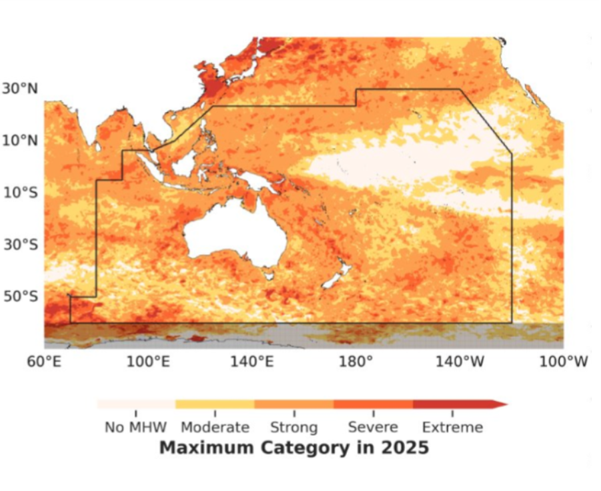
Marine heatwave coverage in 2025 – whilst lower than the previous year - was the most extensive ever recorded in a year without an El Niño event. This is a worrisome sign for 2026, with a potentially strong El Niño event now developing.
The most significant areas with severe and extreme heatwaves in 2025 were between the Maritime Continent and the coast of Australia, and in the western South Pacific in the area between New Zealand, New Caledonia, and Vanuatu.
Specifically, during summer 2024/2025, extensive marine heatwave conditions affected northern Australia, the west coast, the Great Australian Bight and southern waters. This contributed to coral bleaching in both the eastern and western reef systems, the first time this has happened in both systems in the same season, highlighting the escalating risk and the need for effective early warning services.
The report has a special case study on the operational marine heatwave prediction services being rolled out in Australia by he Australian Bureau of Meteorology, in partnership with the Commonwealth Scientific and Industrial Research Organisation (CSIRO). The service was designed to transition marine heatwave research into an operational climate service to support preparedness and risk based decision making for marine sectors.
Sea-level rise
Sea level rises in response to ocean warming (via thermal expansion) and the melting of glaciers, ice caps and ice sheets, thereby affecting the lives and livelihoods of coastal communities and low-lying island nations.
Over the period 1999–2025, sea level rose at an average rate of 3.7 ± 0.03 mm per year in the South-West Pacific region. An elongated pattern of high rates of sea-level rise has been observed from the eastern coast of Australia to about 120°W longitude, encompassing the Coral and Tasman Seas and a large area west of New Zealand.
Ocean acidification
Ocean waters are becoming more acidic as a result of absorbing increasing amounts of carbon dioxide. Ocean acidification, together with ocean warming and deoxygenation, is affecting marine ecosystems, habitats and biodiversity.
Almost the entire South-West Pacific region experienced record low values for surface ocean pH in 2025.
Extreme Weather
As is typical during La Niña conditions, rainfall was above average across much of the Maritime Continent, with many regions recording precipitation within the wettest 10% of years between 1991 and 2020, while much of the western and central equatorial Pacific was drier than average.
Several countries experienced extreme weather and climate events with fatalities and significant economic losses – especially from tropical cyclones.
Cyclone Senyar was the first tropical cyclone on record in the Strait of Malacca since 1886 and made a first made landfall in northern Sumatra on 26 November before recrossing the Strait and making a second landfall over Peninsular Malaysia. The most extreme rainfall was observed in the far north of Sumatra, Indonesia, (more than 400 mm in one day), northern Peninsular Malaysia and southern Thailand.
The report includes a case study on impacts and responses on this cyclone. It shows how early warnings, collaboration, and local grants reduced casualties and aided rapid relief. However, there were gaps in last-mile dissemination of warnings to some coastal populations and fishers.
Cyclone Senyar demonstrated the urgent need for impact-based forecasting of cascading hazards and to prepare for complex scenarios where cyclonic storms combined with monsoon surges trigger simultaneous floods, landslides and debris flows and may even coincide with geophysical hazards such as earthquakes or tsunamis.
Notes to Editors
The State of the Climate in the South-West Pacific 2025 report was produced by WMO in collaboration with National Meteorological and Hydrological Services, international data centres, leading climate research and marine services institutions, and United Nations partners, including ESCAP, the Food and Agriculture Organization of the United Nations, and the World Food Programme.
WMO wishes to thank all contributors and partners, especially Thea Turkington, co-lead author, Meteorological Service Singapore and Blair Trewin, co-lead author, Bureau of Meteorology, Australia.
The World Meteorological Organization is the United Nations System’s authoritative voice on Weather, Climate and Water.
For further information, please contact:
- Clare Nullis WMO media officer cnullis@wmo.int +41 79 709 13 97
- Global Communication and Engagement Media Contact media@wmo.int