

Extreme heat and rainfall, glacier loss and record ocean heat impact Asia in 2025
Paro, Bhutan (WMO) – Dangerous heat, devastating rainfall and flooding, and severe drought affected millions of people across Asia in 2025, exacting a heavy human and economic toll, according to a new report from the World Meteorological Organization (WMO). It highlights the urgency and effectiveness of life-saving early warning services to limit the disruption and damage from increasingly extreme weather.
- Dangerous heat, devastating floods, severe drought and dust storms affect millions
- Extreme weather wreaks heavy economic and human cost
- High Mountain Asian glaciers continue to retreat
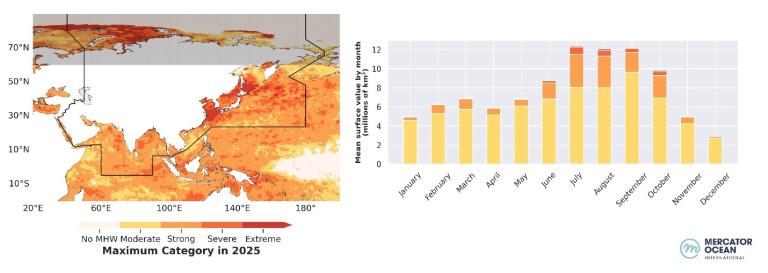
- Ocean heat hits new high, with widespread marine heatwaves
- Early warnings and coordinated action help reduce disaster impacts

The WMO State of the Climate in Asia 2025 reports that ocean heat, which has increased since the 1990s, reached a new record. Marine heatwaves affected almost the entire ocean area of Asia, with over 10 million km2 impacted during July–September – more than the size of People’s Republic of China or the United States of America. Continued ocean warming and acidification pose increasing risks to marine ecosystems and coastal communities.
All 23 monitored glaciers in High-mountain Asia lost mass, driven by above-average temperatures and below-average winter snow. This threatens long-term water security in the world’s most heavily populated region and leads to an upsurge in hazards – with multiple glacial lake outburst floods and glacier collapses being recorded in 2025.
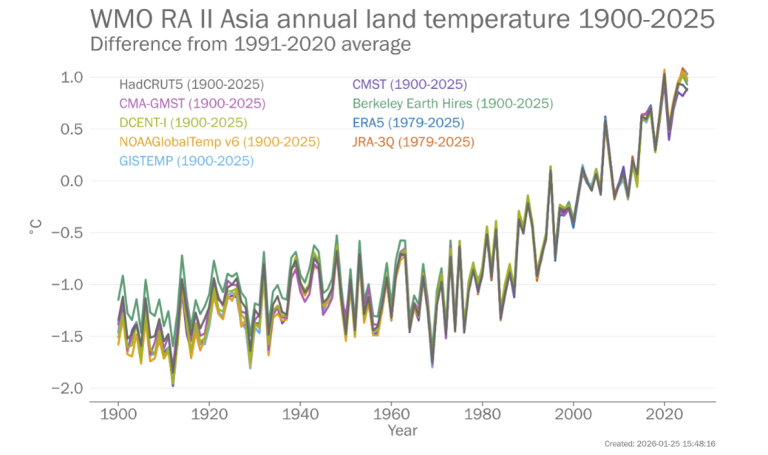
Asia has warmed faster than the global average in recent decades, with the warming trend during 1991–2025 approximately twice that observed during 1961–1990. The year 2025 was between the second and fourth warmest year on record depending on the dataset used.
Extreme heat was a defining feature, with Japan, People’s Republic of China and the Republic of Korea all recording their hottest summer on record. Exceptional monsoon and tropical cyclone-related rainfall caused devastating flooding in many countries, including Pakistan, Sri Lanka and Viet Nam. Stubborn drought hit parts of West Asia, including the Islamic Republic of Iran, as did severe sand and dust storms.
“Asia is impacted by rising temperatures, warming ocean waters, higher sea levels and retreating glaciers. Heavy rainfall, flooding and drought have a heavy economic and human cost, while extreme heat, dust storms and glacial flooding are becoming major hazards. This report highlights the importance of observations, early warning systems and impact-based forecasting to adapt to our changing climate,” said WMO Secretary-General Celeste Saulo.
“Across Asia and the Pacific, heat is intensifying multi-hazard risks, intersecting with food systems, public health, infrastructure and oceans and placing new pressures on health and livelihoods. Early warning and early action save lives when alerts are timely, messages are trusted and last-mile delivery reaches the vulnerable. Resilience is built over time, through a sustained culture of preparedness,” said Armida Salsiah Alisjahbana, Under-Secretary-General of the United Nations and Executive Secretary of the Economic and Social Commission for Asia and the Pacific (ESCAP).
The State of the Climate in Asia 2025 provides authoritative information on key climate indicators, major extreme events, impacts and risks. It includes case studies which demonstrate the scale of the risk and the need to strengthen impact-based forecasting and preparedness on what the weather will DO, rather than simply what it will BE.
The report incorporates input from dozens of experts, National Meteorological and Hydrological Services, climate monitoring centres and United Nations partners. It is one of a series of WMO regional reports to inform decision-making.
Highlights
Temperature
The annual mean temperature over Asia in 2025 was 0.96 °C + 0.08 above the 1991–2020 average and ranked between the second and fourth warmest year on record, depending on the dataset used.
A pronounced warming trend has emerged across Asia since the latter half of the twentieth century. During 1991–2025, Asia warmed more rapidly than the global land-and-ocean average, and the regional warming trend was nearly twice as strong as during 1961–1990.
Extreme heat was a defining feature of 2025 across much of Asia. Japan, China and the Republic of Korea all recorded their hottest summer on record, while prolonged heatwaves affected Central Asia, parts of West Asia and the Arabian Peninsula.
In Kazakhstan, temperatures reached up to 14°C above normal in March, April, June and July. Bahrain recorded ten consecutive days above 40°C. Hot, dry and windy conditions contributed to major wildfires, including the largest known wildfires on record in the Republic of Korea.
Precipitation
The report highlights the significant impact of too much or too little rainfall.
Most of southern Asia received above-average precipitation in 2025, with the monsoon delivering exceptionally heavy rainfall. In Pakistan, monsoon flooding was associated with more than 1,000 deaths and left over 3 million people requiring assistance.
In Viet Nam, prolonged flooding linked to multiple weather systems resulted in at least 200 deaths and economic losses of US$ 1.9 billion.
In South-East Asia, Cyclone Senyar brought exceptional rainfall and severe flooding to parts of Thailand, Malaysia and Indonesia, demonstrating the risks posed by unusual and rapidly evolving tropical cyclone activity.
Conversely, below-average precipitation and prolonged dry conditions affected West and Central Asia. In the Islamic Republic of Iran, long-term drought conditions contributed to water shortages.
Other climate hazards also had major impacts, including a severe dust storm that affected large parts of West Asia in mid-April, highlighting the growing impacts of dust and sand storms on transport, health and economic activity.
Glaciers
The melting of glaciers affects sea level, regional water cycles and the occurrence of local hazards such as glacial lake outburst floods (GLOFs).
The High Mountain Asia region, centred on the Tibetan Plateau, holds the largest ice volume outside the polar regions, with glaciers covering an area of approximately 100 000 km2. Most glaciers across this region have undergone sustained retreat over recent decades , which has accelerated since the mid-1990s.
For the 2025 glaciological year (October 2024–September 2025), all 23 monitored glaciers in the HMA region continued to lose mass. Below-average winter snow accumulation and persistently above-average temperatures from May to September drove substantial mass loss across most glaciers in the Tianshan and Pamir Mountains. Urumqi Glacier No. 1, located in the eastern Tianshan Mountains, suffered an ice loss which was close to the record observed in 2024.
Oceans and Seas
Ocean heat content in the Asia region has increased since the 1990s and reached a new record in 2025.
Sea level in the Asia region also reached its highest level since satellite records began in 1999. Rates of sea-level rise from 1999-2025 along much of the northern Indian Ocean coast exceeded the global average of approximately 3.6 mm per year, reaching around 4.9 mm per year along the Indian coast and more than 6 mm per year in the Kuroshio Current region.
Surface ocean pH continued its long-term decline. Record low pH values were observed in parts of the Arabian Sea, Bay of Bengal and tropical Indian Ocean.
The report also highlights significant changes in the Caspian Sea, the world's largest inland body of water. Water levels fell further in 2025, with the average level in the Kazakh sector 0.23 metres lower than in 2024, extending a long-term decline driven largely by increased evaporation. The decline occurred alongside significant heat anomalies, with 2025 ranking among the five warmest years on record around the Caspian Sea since 1976.
The importance of Early Warnings
The report highlights the growing importance of impact-based forecasting and early action. Tropical Cyclone Ditwah brought extreme rainfall to Sri Lanka, with approximately 10% of the typical annual rainfall total falling within 24 hours. The event resulted in more than 640 deaths, displaced over 200,000 people and with economic losses estimated at around 4% of GDP. The case study demonstrates both the scale of the risk and the need to strengthen impact-based forecasting and preparedness.
In China, heavy rainfall in Liangshan, Sichuan Province, demonstrated the value of timely warnings and coordinated action. Early evacuation helped reduce disaster impacts and save lives.
Notes to Editors
The State of the Climate in Asia 2025 was produced by WMO in collaboration with National Meteorological and Hydrological Services, international data centres, leading climate research institutions and United Nations partners.
WMO thanks all the contributors, especially co-lead authors Sreejith Op (India Meteorological Department) and Peiqun Zhang, (China Meteorological Administration).
The World Meteorological Organization is the United Nations System’s authoritative voice on Weather, Climate and Water.
For further information, please contact:
- Global Communication and Engagement Media Contact media@wmo.int
- Region:
- Region II: Asia