
Strengthening Weather Surveillance in Côte d’Ivoire: New Radar System Becomes Operational under VIGICLIMM Project
Côte d’Ivoire has taken a significant step forward in strengthening its meteorological monitoring and early warning capabilities with the successful Site Acceptance Testing (SAT) and commissioning of a new C-band weather radar under the VIGICLIMM project.
The VIGICLIMM Project is a major meteorological modernization initiative led by the Government of Côte d'Ivoire, financed through a 28 million Euro (EUR) loan from the Agence Française de Développement (AFD). WMO provides Technical Advisory Services to the project, ensuring compliance with global standards and best practices.
The technical mission was conducted in Abidjan on 10 –11 March 2026. It brought together experts from SODEXAM, the implementing partner Météo France International (MFI), and the World Meteorological Organization (WMO) to validate the installation and operational readiness of the system.
From installation to operational readiness
The mission focused on verifying both the physical integrity and the functional performance of the radar system. Detailed inspections were carried out on key infrastructure components, including the 20-metre tower, the radome, grounding systems, and lightning protection mechanisms, ensuring compliance with safety and technical standards.
Functional testing confirmed that the radar is operating within its specified parameters. The system frequency was optimized to eliminate interference, while peak transmission power and overall performance were validated against technical requirements.
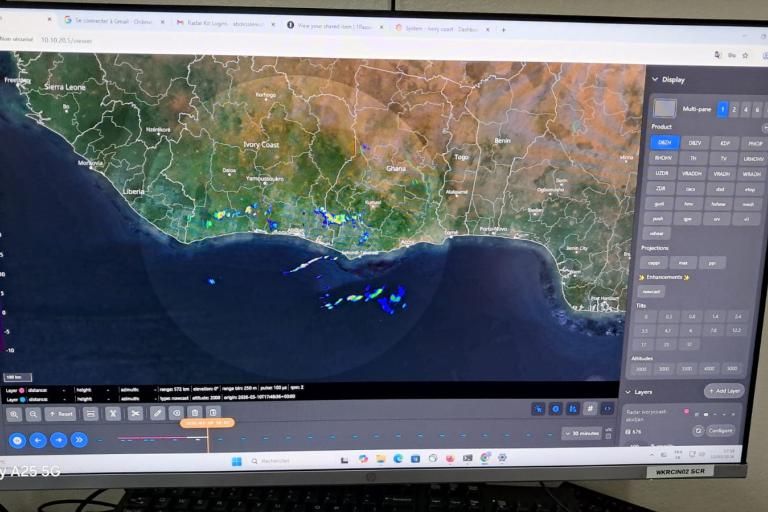
The radar software environment was also successfully tested, demonstrating its ability to continuously generate, process, visualize, and archive essential meteorological data. These include reflectivity, wind velocity, polarimetric parameters, and derived products critical for weather analysis and forecasting.
To ensure reliability, the accuracy of radar data geolocation was verified through comparison with satellite observations, confirming strong consistency with independent data sources.
A key asset for forecasting and early warning
Following the successful completion of the tests, the system was accepted with minor technical observations related to final adjustments, including sealing works, backup power verification, and completion of technical documentation. Despite these minor points, the radar is now fully operational.
With a coverage radius of approximately 500 km, the system significantly enhances the capacity of national forecasters to monitor weather systems in real time, particularly severe weather events such as heavy rainfall, storms, and convective systems.
This new capability represents a major improvement in the detection and tracking of hazardous weather, supporting more accurate forecasts and more timely early warnings for populations and key economic sectors.
Advancing national and regional resilience
The deployment of the radar is part of the broader VIGICLIMM project, which aims to modernize meteorological infrastructure and strengthen climate services in Côte d’Ivoire.
By improving observation and forecasting capabilities, the project contributes directly to enhancing disaster risk reduction, protecting lives and livelihoods, and supporting climate-sensitive sectors such as agriculture, transport, and urban planning.
The successful commissioning of the radar also reinforces regional observation capacity, contributing to improved data availability and collaboration across West Africa.
Looking ahead
With the radar now operational, the focus will shift toward sustained operation, maintenance, and integration into forecasting workflows. Continued capacity development and system optimization will ensure that the full potential of this investment is realized.
The VIGICLIMM project continues to demonstrate how targeted investments in modern meteorological infrastructure can translate into tangible improvements in early warning systems and climate resilience.
- WMO Member:
- Côte d'Ivoire
- Region:
- Region I: Africa