

Five smart ways to reduce wildfire risk before the blaze begins
Wildfires are becoming more frequent and destructive, but disasters are not inevitable.
These five practical strategies can help reduce wildfire risk before the first flames flicker. Drawn from real-world examples, these action-oriented techniques show that effective preparation makes a real difference when wildfire season ignites.
1. Build fire-resilient communities
Urban planning and construction choices matter. In Los Angeles, some homes with fire-resilient design features – such as cleared vegetation, defensible space, and fire-resistant building materials – consistently performed better during the January 2025 firestorms. These measures reduce ignition risk and help slow fire spread under extreme conditions.
Embedding fire-aware planning and building practices into community development can significantly lower the vulnerability of the built environment, preventing costly losses.
According to Swiss Re, the 2025 LA fires were the costliest wildfire event ever globally, with insurance losses estimated at $40 billion.
2. Train and prepare firefighters
Virtual reality and immersive simulation technologies are increasingly being used to help firefighters train for extreme wildfire conditions. By placing firefighters inside realistic fire scenarios – without exposing them to real danger – these tools allow them to practise decision-making, coordination and situational awareness under pressure in realistic conditions. This type of training is particularly valuable for preparing crews to respond to large and complex megafires.
Immersive training improves safety and operational effectiveness, reinforcing firefighters’ wildfire response capacities when they matter most.
3. Use smart technology for early detection
Artificial-intelligence-powered risk mapping, drones and satellite monitoring are transforming how wildfires are detected and anticipated, particularly in remote and hard-to-reach areas. These technologies can identify potential fire ignitions and changing risk conditions more rapidly than traditional methods, giving communities and responders critical extra time to act. Improved modelling tools also enhance our ability to forecast future wildfire behaviour and impactsunder varying climate conditions.
By extending early warning and improving situational awareness, these tools enable faster response, smarter resource allocation, and stronger preparedness.
How AI can help Remote sensing as a saviour
4. Harness traditional knowledge
Prescribed burning and Indigenous land management practices play a key role in reducing fuel loads and mitigating extreme wildfires. Indigenous rangers and local communities have long used controlled fire and landscape stewardship methods that align with seasonal and ecological conditions, helping to prevent the build-up of highly combustible vegetation. By blending modern science and ancestral wisdom, ecosystem health is enhanced and the severity of uncontrolled fire events reduced.
Valuing and integrating traditional knowledge supports more effective, culturally-grounded wildfire resilience strategies.
Learn more from Indigenous knowledge
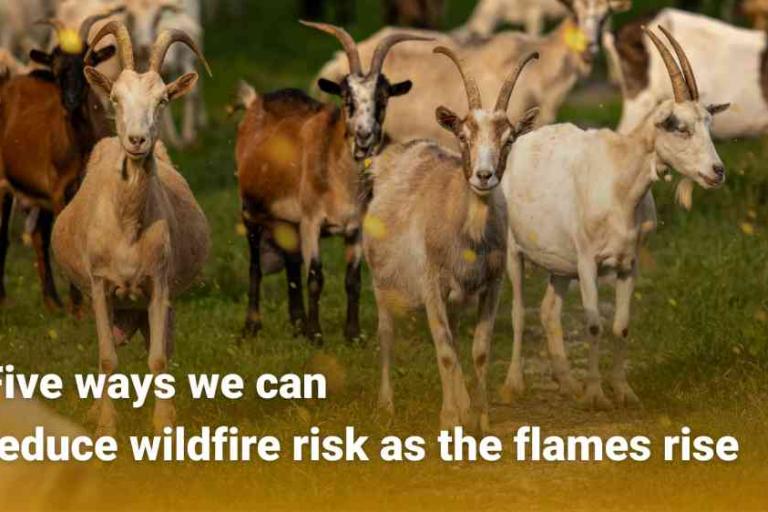
5. Employ goats for firebreaks
Targeted grazing by goats at forest edges and around properties offers a natural and effective way to reduce flammable vegetation. By feeding on grasses and underbrush that can fuel wildfires, goats help create and maintain firebreaks that slow fire spread and protect communities. This low‑tech, low-cost and environmentally friendly approach complements other wildfire risk reduction strategies while supporting local livelihoods.
Using grazing animals as part of landscape management can strengthen preparedness and reduce wildfire vulnerability.
Discover how goats can stop fires from spreading
Did you know that goats can reduce wildfire risk?
In this video and article, we explore 5 smart and proven ways to reduce wildfire risk before fires start
The 2025 California wildfires drew attention to the scale of wildfire risk, as well as demonstrating what is possible when prevention and planning is prioritized. Fire-resilient housing, well-trained firefighters, smart detection technologies, Indigenous land management, and targeted grazing all contribute to safer, more resilient communities.
Combined, these approaches reduce damage, protect lives, and support faster recovery.
We are not powerless against wildfire disaster risk.