From dialogue to delivery: how the EU–LAC MoU is turning political commitment into coordinated action on disaster risk management
News was produced by: UNDRR, ECHO
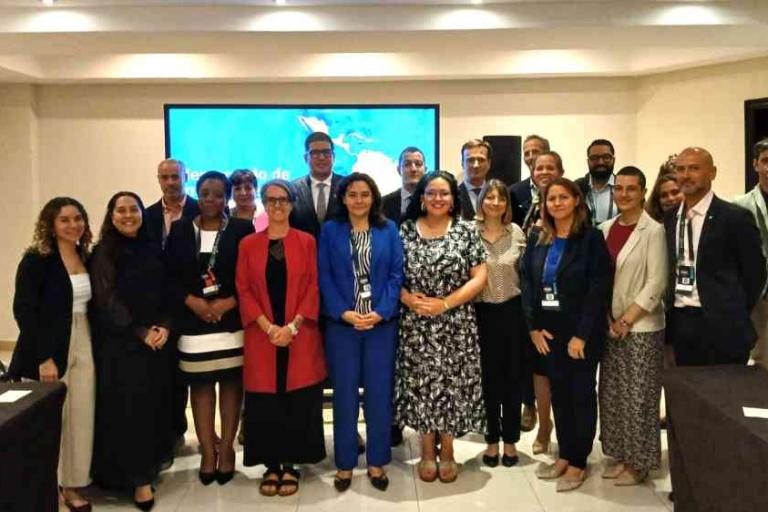
In June 2025, during the UNDRR Global Platform for Disaster Risk Reduction (GP2025) in Geneva, partners from Europe, Latin America and the Caribbean came together for the Second High-Level EU–Latin America and the Caribbean (LAC) Policy Dialogue on Disaster Preparedness and Disaster Risk Management. The meeting served as a milestone for a cooperation framework that has been quietly building momentum over the past year: the Memorandum of Understanding on cooperation in the area of integrated disaster risk management between the European Union and Latin America and the Caribbean.
At GP2025, the dialogue offered a structured moment to review what had been achieved in the MoU’s first year of implementation and to agree on priorities for the next phase. It also highlighted how leadership and strategic articulation by the MOU signatories is being translated into action and impact through the MoU’s coordination set-up: a rotating Technical Secretariat, an implementation plan, and a growing calendar of joint activities.
A cooperation framework shaped by shared risk
Disaster risk is rising across regions, driven by climate change and the accumulation of vulnerabilities. Latin America and the Caribbean is a region with expected annual disaster losses of USD 58 billion, where 1,534 disasters affected around 190 million people between 2000 and 2022, while Europe continues to experience major impacts from climate-driven extremes. In both regions, these realities shape the daily operational burden on national disaster authorities, the demands placed on response systems, and the long-term strain on public budgets and development gains.
Against this backdrop, the EU-LAC MoU was conceived as a platform to strengthen cooperation across the disaster risk management cycle -- linking prevention and preparedness with response capacities, early recovery, resilience and climate adaptation, and reinforcing alignment with the Sendai Framework and the Sustainable Development Goals.
The MoU was signed in Barbados on 15 May 2024 by the European Union, three intergovernmental organizations in the region -- the Caribbean Disaster Emergency Management Agency (CDEMA), the Coordination Center for the Prevention of Disasters in Central America and the Dominican Republic (CEPREDENAC) and the General Secretariat of the Andean Community (SGCAN) -- and by the countries of Chile, Cuba and Mexico, with UNDRR and CELAC as witnesses of honour.
From the outset, the MoU was designed to be practical: an innovative framework that supports regular engagement, facilitates effective identification of shared priorities, and creates a common platform for technical cooperation and knowledge exchange, with the flexibility to connect signatories to opportunities and partnerships as they emerge.
The mechanism behind the message: coordination that sustains momentum
The MoU´s organizational structure has been key for ensuring a seamless transition from agreement to action within a short time frame. A Technical Secretariat, anchored by the European Union and UNDRR and complemented by two rotating members (one intergovernmental organization and one country), supports follow-up across signatories, convenes exchanges, and keeps the implementation plan current as priorities evolve.
In its first year, the rotating Secretariat roles were held by CDEMA and Chile. Currently, co-leadership is held by Cuba and CEPREDENAC -- a transition that reinforces the MoU’s shared leadership model across subregions and helps sustain continuity beyond individual events.
In practical terms, the MoU’s Implementation Plan translates this coordination model into a clear work programme, organized around the MoU´s established areas of cooperation:
- Strengthening response capacities, including civil protection and DRM authorities’ technical capacities and subregional and regional coordination in emergencies;
- Strengthening prevention, preparedness and early recovery capacities, including forecasting, monitoring, and shared tools such as mapping, protocols and contingency planning;
- Exchanging knowledge, experiences and good practices, through conferences, training opportunities, and communication channels that keep cooperation active.
GP2025: what the High-Level Dialogue focused on
The 2nd High-Level Policy Dialogue at GP2025 was designed as a checkpoint with a practical purpose: to take stock of implementation to date, consolidate political backing, and identify concrete pathways to strengthen cooperation.
Discussions centred on three connected strands:
- First, implementation and follow-up. Participants reviewed how the MoU’s implementation plan had already generated a growing calendar of activities and how the Secretariat could keep coordination moving, including through regular plenary exchanges and targeted follow-up on priority themes.
- Second, technical cooperation. The dialogue highlighted opportunities to deepen collaboration on prevention and preparedness, including anticipatory action and early warning, and to expand access to practical tools and capacity-building for signatories and partners.
- Third, financing and partnerships. A recurring theme was how to connect cooperation priorities with actionable financing options and strategic partnerships, including engagement with international financial institutions and regional initiatives that can help scale risk-informed investment.
As outgoing rotating Secretariat members reflected in their remarks, progress in the first year was measured in delivery:
“We are proud to report that this is not a MoU that sits on a shelf,” noted CDEMA and Chile in their joint reflections on the first year of implementation.
Implementation highlights and milestones
When the MoU was signed in Barbados in May 2024, UNDRR and DG ECHO jointly emphasized the need to strengthen cooperation as risks intensify across borders. Since then, the MoU’s implementation plan has helped organize work across prevention, preparedness, response and early recovery, while keeping signatories connected through a shared coordination channel.
The milestones below reflect the trajectory to date, starting with the first year of implementation (May 2024–May 2025) and extending into key developments in late 2025 and early 2026.
1) Early momentum: preparedness priorities and operational coordination (May–June 2024)
In the first months after signature, DG ECHO convened workshops to help define strategies for more effective disaster preparedness and emergency response: one for the Caribbean (16 May 2024) and another for Central America and Mexico (18–19 June 2024). These exchanges helped anchor preparedness priorities early and created clearer follow-up channels with regional and national authorities.
One month later, cooperation was also reinforced through established civil protection spaces. At the EU Civil Protection Forum (4–5 June 2024, Brussels), more than 1,500 stakeholders -- including governments, civil protection authorities, first responders, the scientific community and the private sector -- came together to exchange lessons and strengthen networks relevant to preparedness and response.
2) Turning tools into usable capacity: Copernicus training and follow-up (from July 2024)
A concrete stream of cooperation has focused on strengthening the ability of regional and national authorities to work with Copernicus (the EU’s Earth observation programme) so that satellite-based services can support preparedness, response and recovery planning.
An early milestone was the 8 July 2024 online training with technical contributions from DG ECHO’s Emergency Response Coordination Centre (ERCC), the European Space Agency, and the Joint Research Centre. The focus was practical: not only what services exist, but how they can be activated and used.
This work continued through 2025 as part of a broader training programme. The first in-person training took place in Bogotá (24–28 March 2025) on remote sensing applied to flood risk, with participation from MoU signatories including CEPREDENAC and Mexico, followed by additional planned trainings for the Caribbean and Central America.
3) Wildfire preparedness and mutual learning (2024–2025)
Wildfire risk became a visible cooperation theme in 2024, combining operational response support with shared learning. In 2024, several major wildfire events triggered EU support through the Union Civil Protection Mechanism, including in Guatemala, Ecuador, Bolivia and Chile, illustrating how preparedness and response capacities increasingly rely on interregional support mechanisms when impacts escalate.
Mutual learning also advanced through policy and technical platforms. In November 2024, an Inter-American Development Bank Regional Policy Dialogue in Santiago de Chile convened stakeholders to strengthen alliances and international cooperation to combat forest fires in the context of climate change, including discussions around lessons learned from mutual aid and options to strengthen assistance mechanisms.
4) Aligning priorities through regional forums (October–December 2024)
Cooperation also progressed through established regional DRM platforms. In October 2024, the VII Forum on Integrated Disaster Risk Management Policies (PCGIR) in Central America (Guatemala City, 10–11 October) brought together authorities and partners to discuss implementation in line with the Sendai Framework and the 2024–2030 Regional Plan for Integrated Disaster Risk Management.
In December 2024, a closed side-event for MoU signatories held during the 13th Caribbean Conference on Comprehensive Disaster Management (St. Kitts and Nevis, 2–6 December) served as a practical coordination milestone. Chaired by CDEMA, the session helped validate priority areas for the action plan (early warning systems, resilient infrastructure and wildfire management) and identified concrete follow-up, including technical training and links to initiatives such as Early Warning for All and anticipatory action.
5) Cooperation tested by real events: hurricane impacts and response support (2024–2025)
Hurricanes reinforced why preparedness cooperation matters. During Hurricane Beryl --one of the earliest category 5 hurricanes on record in the Atlantic -- the EU activated Copernicus rapid mapping on 2 July and produced 15 maps to support emergency response, alongside humanitarian assistance measures to address urgent needs. This type of operational support illustrates how technical services and response mechanisms can complement national and regional capacities during major events.
6) A political checkpoint with an implementation purpose: GP2025 (June 2025)
As highlighted earlier, the Second High-Level EU–LAC Policy Dialogue at GP2025 in Geneva provided a milestone moment to review first-year progress and confirm priorities for the next phase. It reinforced the shift from dialogue to delivery, elevating two core threads for the period ahead: stronger technical cooperation on preparedness and anticipatory action, and clearer pathways for partnerships and risk-informed financing.
7) Plenary meeting and strategic partnerships (December 2025)
On 16 December 2025, MoU signatories met in plenary to review progress and align on 2026 priorities, including early warning systems, anticipatory action, financing for integrated disaster risk management, integrated fire management, and coordination mechanisms for humanitarian assistance. The session also brought a concrete partnership and financing perspective into the MoU space: the Inter-American Development Bank (IDB) presented its regional impact programme, Ready and Resilient Americas, outlining areas of alignment with MoU priority themes and potential opportunities for collaboration with signatories.
Priorities and milestones for 2026
As a result of efforts by the current Technical Secretariat co-leads CEPREDENAC and Cuba, the MoU implementation plan has organized the next phase of cooperation and implementation around seven priority workstreams: early warning systems; anticipatory action; loss and damage; financing for integrated disaster risk management; integrated fire management; coordination mechanisms for humanitarian assistance; and management of resources to support implementation. This focalization of themes not only hones in on key regional priorities for signatories, but also facilitates more streamlined coordination and synergies with other strategic actors.
In that regard, on 18 March 2026 an EU LAC MOU dialogue for regional cooperation was held within the broader scope of the CEPREDENAC Consultative Forum of the Central American Policy for Comprehensive Disaster Risk Management (PCGIR), held in Panama. The Forum brought together authorities and partners through a three-day programme combining high-level and technical sessions, and it provided space to connect priority DRM themes for Central America with wider regional cooperation. Beyond the specific dedicated space to advance EU–LAC cooperation under the MoU, signatories participated in various thematic sessions of the PCGIR Forum, in alignment with one of the MoU´s broader objectives of increasing experience and knowledge exchange throughout the region to support increased capacities in disaster preparedness and overall risk reduction.
The specific EU-LAC MOU dialogue on strengthening cooperation provided an opportunity to advocate for increasing direct strategic partnerships around the priority thematic areas. In addition to MOU signatories, participation included nearly 50 high-level and technical representatives from regional and national institutions from Central America and beyond, ECHO partners, the UN System, the Red Cross Movement, donors, international financial institutions and others. With an emphasis on concrete action rather than just process, those in the dialogue identified specific actions underway that could link more directly to MOU implementation, whether by deepening existing initiatives in specific areas or increasing capacity by scaling initiatives to other sub-regions and countries.
Together, the streamlined MOU Implementation Plan and the outcomes of the recent dialogue during the PCGIR Forum will help frame the 2026 calendar: agreeing on what to take forward, coordinating catalytic action on each theme, and advancing the joint activities and partnerships to be pursued during the year.