Third High Level Conference of the Forum on Global Action for Shared Development
Beijing, China, 22 April 2026
Your Excellency Mr. Ding Xuexiang, Vice Premier of the State Council of China (TBC),
Your Excellency Mr. Chen Xiaodong, Chairman of the China International Development Cooperation Agency,
Excellencies,
Distinguished leaders, ladies and gentlemen,
It is an honour to join this important Forum and to join such a distinguished gathering of global leaders. I extend my sincere gratitude to the Government of China and the China International Development Cooperation Agency, for bringing us together at a moment when sustainable development and global cooperation are in great need of renewed purpose and renewed confidence. This Forum sends a strong and timely message on the importance of multilateralism, solidarity, cooperation, and shared progress.
Your Excellencies,
We are living in a world of increasing uncertainty. Extreme weather events are becoming more frequent and intense and climate related disasters are escalating. They are affecting economies, food systems and societies.
So the question is simple:
How do we rebuild trust in a fragmented world?
My answer is equally simple:
We rebuild trust through science.
In that spirit, let me briefly reflect on my recent visit to Chongqing and Shaanxi, and my exchanges with the China Meteorological Administration.
I was encouraged by the strong focus on innovation and on translating advanced technologies into operational services. From AI-driven forecasting and big data platforms to systems such as MAZU, and the delivery of smart climate services, China is demonstrating how digital meteorology can effectively support decision-making and public services, building on strong local expertise. I was also pleased to participate yesterday in a MAZU workshop, which highlighted the continued evolution of the platform across sectors as a flexible and scalable solution. These advances, together with progress in multi-hazard early warnings, highlight the role of meteorology as a first line of defence, echoing President Xi Jinping’s emphasis on safeguarding lives, supporting development, and protecting the environment, and strongly support the Early Warnings for All initiative.
Your Excellencies,
The Global Development Initiative (GDI) represents a most needed vision and philosophy for development, with people at the centre, as well as inclusive and sustainable growth. It provides an important framework for translating ambition into action.
And, so what is WMO’s role in this?
The World Meteorological Organization – or WMO - is the United Nations authoritative voice on weather, climate and water. An organization born from cooperation, sustained by science and driven by evidence and knowledge. We are the weather and climate observer who detects. The hydrologist who monitors. The forecaster who warns.
After 150 years, we have learnt one fundamental lesson: when science and data are shared, trust is built. When trust is built, lives and livelihoods are saved.
Every day, at every hour, real-time Earth observation data are exchanged across borders through the WMO Information System, making weather models around the world more accurate and interoperable.
WMO also develops the technical standards and regulations to ensure the quality, consistency and reliability of weather and climate data and models for service delivery across countries.
We are committed to closing critical earth observation gaps, especially in Least Developed Countries and Small Island Developing States.
And this is not only about data and standards.... It is about safeguarding economies and protecting people. You know this well, as China is one of the countries most severely affected by tropical cyclones and an international standard bearer for early warnings
And this is why WMO’s work and the collaboration of our 193 Members matter.
Because there is no resilience or sustainable development without reliable weather and climate data, information and services.
Remember: A single extreme weather event can erase a significant amount of a country’s GDP overnight.
Your Excellencies,
According to the WMO State of Global Climate Report 2025, between 2015 and 2025, humanity has endured the eleven hottest years on record. When history repeats itself eleven times, it is no longer a coincidence.
Extreme weather events are becoming more frequent and severe, with an intensity that exceeds historical experience.
Extreme weather is becoming the new normal, causing over 200 billion US dollars in losses annually and undermining development gains, particularly in the most vulnerable countries.
However, the death toll has fallen in recent decades. And in this context, the role of the WMO is more critical than ever.
Through Early Warnings for All, we are translating science into action, strengthening resilience, reducing disaster risks, and safeguarding development.
China has demonstrated strong leadership in this area.
Initiatives such as MAZU, working with developing countries across regions and with WMO support, are helping to provide early warning systems as a global public good. These are exactly the types of partnerships we need.
Many countries today lack the capacity to generate data, to interpret it and to act on it.
This must change. We must build a stronger capacity development agenda so that we leave no one behind.
On the positive side, we are witnessing a rapid technological revolution.
In recent years, I have also been encouraged by China’s remarkable achievements in renewable energy, as well as in emerging and frontier technologies such as artificial intelligence and satellite applications. WMO will continue to work closely with China, all other Member States, and stakeholders to harness these innovations while ensuring that all countries can benefit from them. Because multilateral cooperation, when grounded in science, can deliver real results.
Your Excellencies,
Allow me to highlight three priorities:
First, strengthen trust through science-based cooperation. We must build stronger partnerships.
Cooperation requires the collective efforts of governments, the private sector, financial institutions and the scientific community. We must reinforce data sharing and cross-sector collaboration so that we effectively respond to increasingly complex climate risks and extreme events.
At the same time, countries in the Global South hold immense potential for development and resilience. But they need our support, in particular, through capacity development so that they can have the tools, knowledge and systems to act and to protect their communities.
Second, we must scale up and transform financing. WMO is working closely with the CIDCA on a pilot project to advance the Early Warnings for All initiative for our member countries. At the same time, we are launching the WMO Weather, Climate and Water Intelligence Commons, a global pooled financing partnership to strengthen the backbone of observation, data exchange and forecasting. By mobilizing more resources, we will help more to secure critical global public goods, enhance early warning capabilities, and build resilience worldwide.
Third, we must harness digital innovation
Digital innovation, especially artificial intelligence—will transform forecasting, risk analysis and decision-making. Meteorology is one of the most powerful real-world applications of AI. We welcome all partners to engage with us to deepen cooperation.
Your Excellencies,
I began by speaking about extreme events. Today, these are not distant threats, they are our present realities.
Let us build trust and collaboration to strengthen multilateral cooperation. Let us ensure that no warning goes unheard, no country is left behind, and no life is lost for lack of data or preparedness.
As my Chinese friends like to say, “Development holds the master key to solving all problems”.
Thank you.
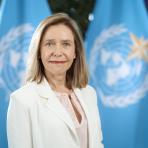
Statement by