

The Weather: What’s the Outlook?
By Michel Béland1, Alan Thorpe2
New sources of atmospheric observations, faster supercomputers and advances in science together revolutionized weather forecasting in the latter part of the 20th century. On the global scale, we can today predict out to five days ahead as accurately as we could do for two days 20 years ago. This means society has much more advance warning of weather hazards than before, permitting people to prepare and, thereby, limit the loss of lives and property. Expectations are high for even greater advances in the years to come.
From 16 to 21 August 2014, the first World Weather Open Science Conference (WWOSC-2014) “The weather: what’s the outlook?” was held in Montreal, Canada. The WMO, Environment Canada, the International Council for Science (ICSU) and the National Research Council of Canada co-organized the event.
As weather science advances, critical questions are arising about the possible sources of predictability on weekly, monthly and longer time-scales; seamless prediction; and the effective use of massively-parallel supercomputers. The science is primed for a step forward and is informed by the realization that there can be predictive power on all space and time-scales arising from currently poorly-understood sources of potential predictability. Consequently, the time was right for a major Open Science Conference to examine the rapidly changing scientific and socio-economic drivers of weather science.
 Mel Shapiro (right), keynote speaker at the World Weather Open Science Conference opening ceremony with Alan Thorpe (left). / © Jacques Lavigne/Amethyste Communications
The first objective of WWOSC-2014 was to review the state of knowledge in weather and weather-prediction science and thereby create a roadmap for the legacy of The Observing System Research and Predictability Experiment (THORPEX), a 10-year programme coordinated by WMO, which ended in 2014. This will also enable an update of the World Weather Research Programme strategic plan (see The World Weather Research Programme: a 10-year vision).
The second objective was to explore the many applications of weather prediction to the natural environment. The Earth System Prediction approach for weather and environmental phenomena is seen as an effective way to better address the socio-economic demands for weather services.
|
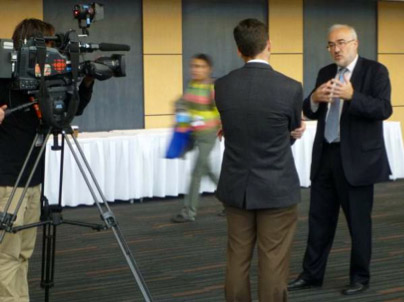
Radio-Canada interviews WMO Secretary-General, Michel Jarraud / © Jacques Lavigne/Amethyste Communications |
The third objective was to encourage a new generation of research scientists who can contribute to new and advanced Earth system prediction models (see Early Career Scientists in Bulletin 63(2) – 2014). The final was to raise the visibility and importance of strong and vibrant world-weather science research that is in harmony with the needs of operational weather services and their public and the private sector stakeholders.
The overarching theme of WWOSC-2014 was “Seamless Prediction of the Earth System: from minutes to months.” The Conference was structured around two programmes: Science and User, and Application and Social Sciences. The role of the programme organizers – Gilbert Brunet, Sarah Jones, and Brian Mills – was substantial; they contributed hugely to the success of the conference. The science presented ranged from the basic research that extends knowledge of processes and methods to the applied research required to put the prediction system together and assess the impacts of weather and climate events. The Science programme had five themes: Data assimilation and observations; Predictability and dynamical/physical/chemical processes; Interactions between sub-systems; Prediction of the Earth system: putting it all together; and Impacts of weather and climate events. The Social Science programme had four session categories on: The goods and services economy; Government organizations and functions; Disaster risk reduction and management; and Communication of weather information through broadcast, print or social media.
Julia Slingo - Toward seamless climate-weather and environmental prediction from wmoweb on Vimeo.