

New report unveils global atmospheric impacts of 2022 Hunga volcano eruption
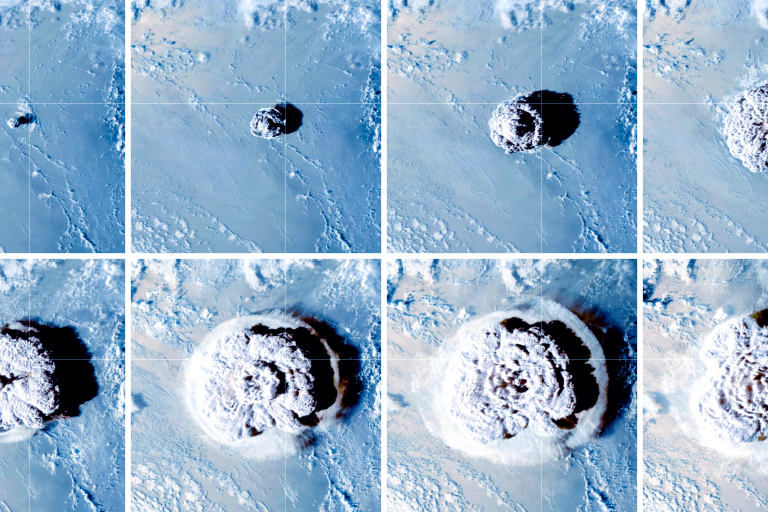
Combining comprehensive satellite, balloon, and ground-based observations with global modeling studies, the report documents the eruption’s far-reaching effects on the stratosphere, climate, and ozone.
The Hunga Volcanic Eruption Atmospheric Impacts Report was released under the Atmospheric Processes and their Role in Climate (APARC) project of the World Climate Research Programme (WCRP), which is co-sponsored by WMO.
“This assessment shows how Hunga’s water-rich plume reshaped the stratosphere in ways not seen before. It underscores the importance of sustained observations and advanced modelling, and the value of international scientific collaboration through WCRP in delivering robust climate insights,” said Tim Naish, Chair of the WCRP’s Joint Scientific Committee.
Key Scientific Findings
The eruption of the Hunga Tonga–Hunga Haʻapai volcano in the South Pacific on 15 January 2022 produced the largest underwater explosion ever recorded by modern scientific instruments. It injected vast quantities of water vapor into the stratosphere, increasing global stratospheric water by about 10%, much of which remains in the atmosphere through 2025.
While the eruption perturbed stratospheric ozone in the Southern Hemisphere in the months following the eruption, its overall effects on the Antarctic ozone hole and surface climate were minor.
The report emphasizes that record-high global temperatures in 2023-2024 were not caused by the eruption. Model simulations indicate that Hunga’s surface cooling influence - about 0.05 K - was indistinguishable from natural climate variability.
Global Scientific Collaboration
The report’s seven chapters synthesize findings from observations, data analyses, and climate model simulations, including contributions from the Hunga Tonga–Hunga Haʻapai Impact Model Observation Comparison (HTHH-MOC) project - an international modeling effort involving more than ten global climate models.
The chapters include basic eruption information, the Hunga cloud evolution on both short (less than 1-month) and multi-year time scales, impacts on atmospheric chemistry and dynamics, the stratospheric ozone layer, upper altitude effects, and surface radiative and temperature effects.
Launched in late 2022, the Hunga assessment report brought together 159 scientists from 21 countries, coordinated by Co-Chairs Yunqian Zhu (University of Colorado, Cooperative Institute for Research in Environmental Sciences/National Oceanic and Atmospheric Administration (NOAA) Chemical Sciences Laboratory), William Randel (National Centre for Atmospheric Research), Graham Mann (University of Leeds), and Paul A. Newman (University of Maryland-Baltimore County).
“The Hunga eruption was unlike anything observed before,” said Yungian Zhu. “It taught us how profoundly water-rich eruptions can affect the stratosphere and how essential global cooperation is in capturing and understanding such rare events.”
The report underscores how decades of international investment in atmospheric observation networks enabled the rapid and detailed tracking of Hunga’s plume. Instruments on international satellites, as well as balloon campaigns and ground networks, captured the evolution of volcanic aerosols, water vapor, and trace gases from minutes after the eruption through subsequent years to the present.
The report warns, however, that future observational gaps - rom potential satellite mission cancellations or aging networks - could severely limit the world’s ability to monitor and understand similar major events.
“This report reflects an extraordinary effort by the global scientific community,” said Graham Mann. “It not only documents the impacts of Hunga but also highlights the importance of maintaining our ability to observe the planet’s atmosphere.”
The supporting datasets, including the HTHH-MOC simulations, will be publicly available through the Centre for Environmental Data Analysis (CEDA).