From scoping to action: Strengthening risk-informed shelter and settlements in North-East Nigeria
News was produced by: UNDRR, Global Shelter Cluster
A crisis of repeated loss
North-East Nigeria continues to face one of the world's most complex humanitarian crises, shaped by over a decade of conflict, mass displacement and increasingly severe climate-related hazards. Across Borno, Adamawa and Yobe (BAY) states, millions of internally displaced persons (IDPs) live in fragile shelters and densely populated sites where infrastructure and livelihood options remain limited.
Entire communities remain acutely vulnerable to hazards such as flooding, fire, storms and extreme heat. A single storm can damage or destroy hundreds of shelters within minutes, leaving families who are already displaced with no option but to rebuild yet again. As one NGO partner explained: "Each time a storm comes, we know shelters will be lost. People cannot keep starting again."
These recurring shocks reflect a broader global reality in which disasters are becoming more frequent and complex, often intersecting with conflict and other compounding pressures. In this context, the need for strengthened disaster risk reduction (DRR) within humanitarian action is becoming increasingly urgent - not only to safeguard lives and shelters but also to help break the cycle of repeated losses.
Embedding DRR into humanitarian coordination
In 2025, the United Nations Office for Disaster Risk Reduction (UNDRR) and the Global Shelter Cluster (GSC) joined forces with the North-East Nigeria CCCM/Shelter/NFI Sector and worked together to embed DRR into humanitarian shelter, settlement and NFI programming.
This initiative is part of a broader UNDRR project supported by the German Federal Foreign Office to strengthen DRR in fragile and humanitarian contexts. The project promotes risk-informed planning and stronger collaboration across humanitarian and development actors, contributing to the implementation of the Sendai Framework for Disaster Risk Reduction.
Participation by the GSC in the North-East Nigeria initiative was further supported through funding from the Swiss Agency for Development and Cooperation (SDC). Rather than creating a stand-alone DRR strategy, partners in the BAY states focused on embedding DRR into existing coordination mechanisms, making resilience a practical, everyday component of humanitarian operations.
The process unfolded in a series of connected steps. It began with a scoping exercise that mapped key risks, gaps and opportunities across the sector, drawing on insights from more than 30 interviews with government representatives, UN agencies and NGOs. This was followed by a multi-stakeholder workshop in Maiduguri, where over 30 participants - including government counterparts, humanitarian actors and local organisations - took part in practical simulations to explore how DRR could be better integrated into ongoing response efforts. The findings were then refined during a sector-wide validation webinar, which helped build shared understanding and agreement on priority actions moving forward.
Throughout the process, national institutions such as NEMA (National Emergency Management Agency), SEMAs (State Emergency Management Agencies) and NiMet (Nigerian Meteorological Agency) were connected more closely with field-level humanitarian coordination structures, helping to bridge the gap between policy and practice.
Learning from the ground up
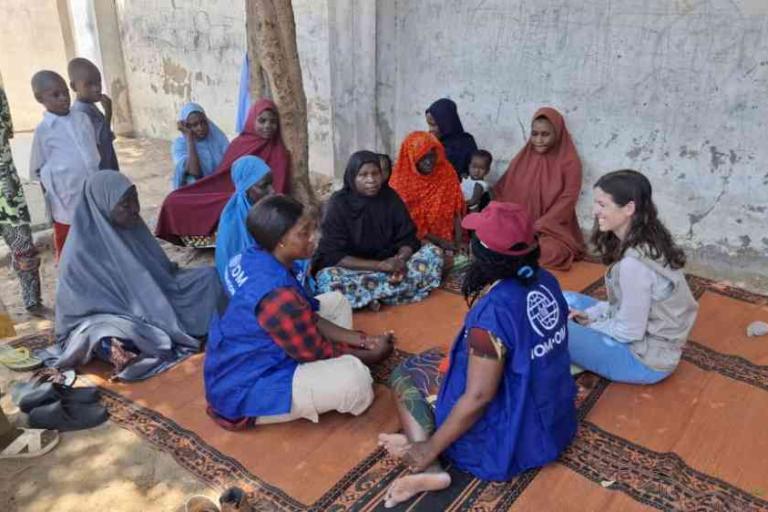
At the community level, access to early warning information is often unreliable, leaving families exposed to hazards they can neither predict nor prepare for. In Yawuri, an informal displacement site within a host community in Maiduguri, one resident captured the difficult trade-offs people face: "We sold our radio to buy food." The message was clear: DRR must be community-driven, inclusive, and grounded in the everyday local realities.
It was against this backdrop that a workshop was held in Maiduguri in September 2025, marking a milestone for the sector. Bringing together primarily local NGOs and community-based entities alongside government and humanitarian partners, it offered many participants their first opportunity to analyse shelter, settlement and NFI risks collectively in a structured way. Through hands-on simulations, they explored how fires, floods, storms and extreme heat could be anticipated and mitigated - testing tools, identifying practical measures and recognising the value of anticipating risks rather than reacting to them.
The work also underscored the crucial role of national and state-level DRR institutions in Nigeria - such as NEMA, SEMAs, and NiMet. While these agencies are key to strengthening resilience, their capacity and effectiveness vary across states, and their link to humanitarian shelter, settlement and NFI programming remains limited - an important gap the initiative seeks to help address.
Turning knowledge into action
By the end of the process, hazard-specific risk management plans had been developed for floods, fires, storms and extreme heat - offering clear, actionable guidance to strengthen preparedness, response and long-term resilience in displacement settings.
The initiative also demonstrated the value of bringing together humanitarian actors, government agencies and local NGOs to strengthen collective responsibility for reducing risk. Technical skills improved as concepts around early warning, anticipatory action and site-level preparedness became more tangible through participatory exercises. The effort was guided by the UNDRR/OCHA Checklist on Scaling up DRR in Humanitarian Action, helping participants to translate global commitments under the Sendai Framework into practical, field-level activities.
Participants agreed that DRR should not exist as a separate agenda but be fully integrated into existing CCCM/Shelter/NFI coordination frameworks. As suggested by partners during the June DRR workshop: "The formation of a Risk Working Group in the BAY states could help sustain these efforts by strengthening coordination, supporting technical guidance, and ensuring continuity of DRR integration across actors and levels."
Looking forward
The process in Maiduguri demonstrated that humanitarian shelter, settlement and NFI support can move beyond short-term fixes to systematically address the risks undermining the dignity and safety of displaced families.
The next challenge is to implement the hazard-specific plans in IDP sites and host communities, mobilise resources, and sustain collaboration among partners. Linking humanitarian and development financing, particularly in climate and environmental programmes, will be critical as Nigeria moves toward longer-term resilience-building.
The foundation is now in place. This initiative has shown how risk-informed, locally grounded humanitarian action can better protect lives, preserve dignity and strengthen resilience in the face of growing climate and conflict pressures. The next step is to implement the hazard-specific plans across IDP sites and host communities, supported by a dedicated DRR working group that will track progress, adapt strategies to emerging risks and maintain momentum. Adequate resources will be essential, and participants underscored the need to draw on both humanitarian and development financing, particularly for climate and environmental programmes, to address underlying vulnerabilities. As disasters become more frequent and intense, embedding DRR within humanitarian action is not just timely but necessary for building safer, more resilient communities.
Learn more about the UNDRR-GSC collaboration.
- WMO Member:
- Nigeria