
Turning aviation research into safer skies

A sudden jolt of turbulence at cruising altitude can injure passengers, damage aircraft, and disrupt global schedules. As air traffic grows and weather patterns become more variable, improving forecasts of severe storms and turbulence is becoming increasingly critical for aviation safety.
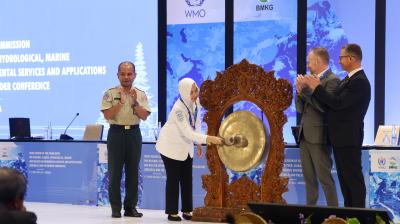
Between 2021 and 2025, the World Meteorological Organization (WMO) addressed this challenge through the second phase of the Aviation Research and Development Project (AvRDP2). Led by the World Weather Research Programme (WWRP), in collaboration with the WMO Services Commission’s Standing Committee on Services for Aviation (SC-AVI) and aviation stakeholders, the project aimed to strengthen both the scientific understanding and operational use of aeronautical meteorology.
Testing forecasts along major flight corridors
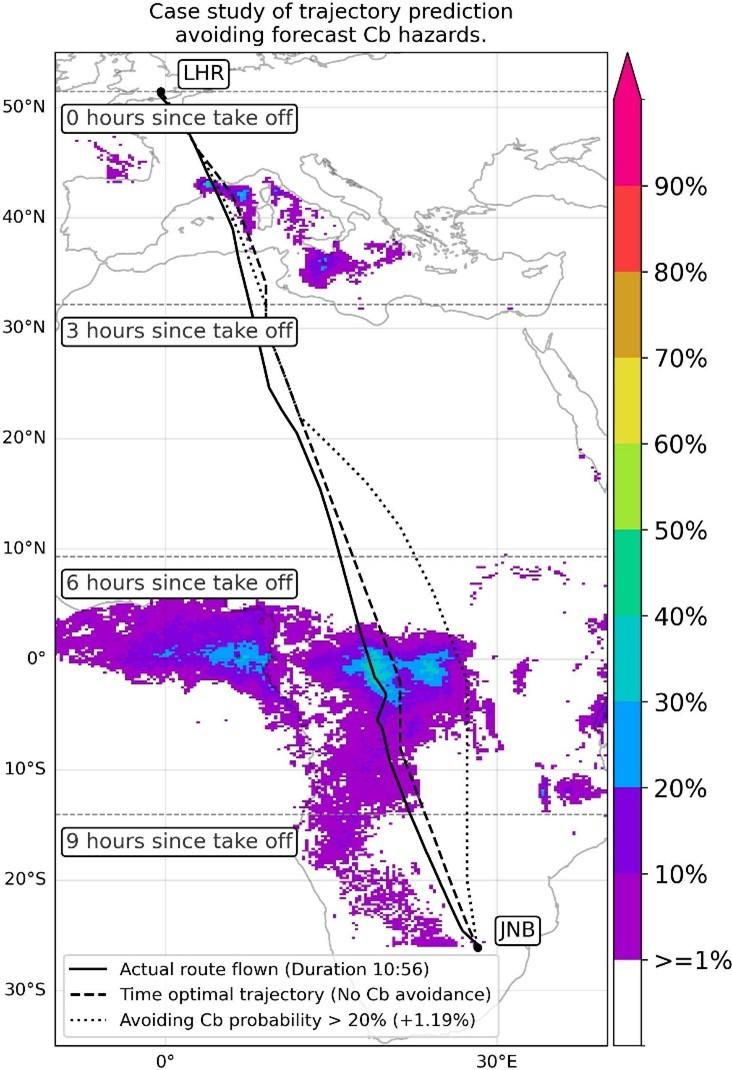
AvRDP2 focused on two demanding flight corridors: Hong Kong – Singapore, where warm rising air often creates powerful tropical storms, a process known as deep convection, and London – Johannesburg, which spans midlatitude, tropical and data-sparse regions.
These routes served as real-world test beds where researchers evaluated several advanced forecasting approaches. These included blended nowcasting systems, which combine observations and models to predict weather in the next few hours, convection-permitting models that can simulate storm systems in greater detail, and ensemble forecasts, which run many model simulations to estimate the likelihood of hazardous conditions affecting flight operations.
One major focus was convection-induced turbulence (CIT), generated by strong vertical air currents within or near convective storms. Unlike clear air turbulence, which is mainly driven by wind shears, CIT is directly linked to thunderstorm dynamics and can extend beyond visible cloud boundaries, making it difficult to detect and forecast.
AvRDP2 developed new techniques to improve the detection of CIT using high-resolution simulations and refined eddy dissipation rate estimation, a measure of the intensity of turbulent air motion experienced by aircraft. This enabled more reliable detection of hazards at flight levels.
Major turbulence events were successfully analysed to test and refine these methods, including the 2022 Hawaiian Airlines incident, in which severe turbulence injured dozens of passengers on a flight from Phoenix to Honolulu, and the 2024 Singapore Airlines SQ321 event, where extreme turbulence over Myanmar caused more than 100 injuries and one fatality.
Improving aviation hazard forecasts
The project also advanced probabilistic forecasting. Instead of relying on a single forecast outcome, ensemble forecasting systems run multiple model simulations to estimate the likelihood of hazardous weather developing. This probability-based guidance helps airlines and air traffic controllers assess levels of risk and consider alternative routing.
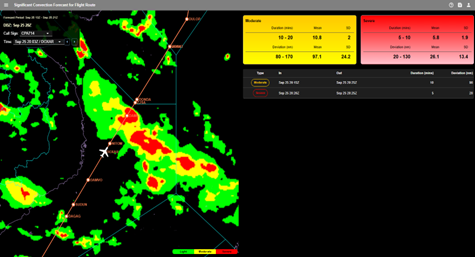
The blended products achieved performance comparable to traditional Significant Meteorological (SIGMET) information products, the official warnings issued for severe weather hazards affecting aviation, while significantly reducing false alarm rates.
Artificial intelligence further strengthened performance. Typically, forecasts of rapidly developing storm systems provide only a few hours of advance warning. Deep learning techniques applied to satellite data extended warning led times to 6 – 8 hours, allowing earlier preparation and more informed flight planning.
AvRDP2 demonstrated that these advanced products can be integrated directly into air traffic control systems and electronic flight bags (the digital cockpit tablets used by pilots for charts, weather information and flight planning), supporting both tactical (0 – 2 hours) and strategic (up to 24 hours) decision-making.
From research to operational aviation services
The project also contributed directly to the demonstration of the new Hazardous Weather Information Service (HWIS) under development by the International Civil Aviation Organization. By blending regional and global forecasts and delivering probabilistic guidance, AvRDP2 provided a scalable model for seamless, gate-to-gate aviation weather information aligned with emerging global standards.
Strong user engagement was central to the project. Pilots, airline operators and air traffic managers helped refine visualization, risk communication and usability, ensuring that the new forecasting tools can be effectively used in real flight operations.
AvRDP2 highlights the need to integrate probabilistic, risk-based services into routine aviation operations, increase update frequency to support short-term decision-making, enhance validation and training, and improve observations over oceans and remote regions. Embedding these advances globally will help aviation better anticipate hazardous weather and keep passengers and crews safer as severe weather risks intensify.