World Tsunami Awareness Day commemorated in Geneva: a call for preparedness, inclusion, and cooperation
News was produced by: UNDRR
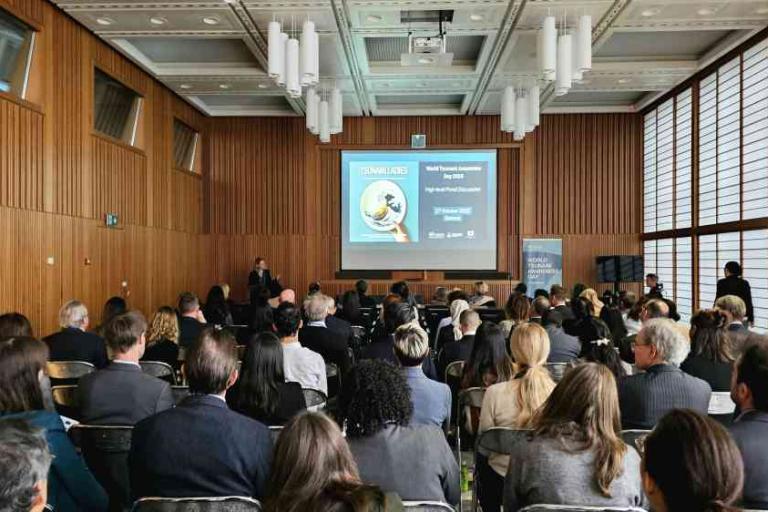
With more people than ever exposed to tsunamis due to urban growth in coastal areas and rising sea levels, diplomats, senior representatives from the United Nations and other international organizations, and private sector innovators gathered at the Permanent Mission of Japan in Geneva to mark a decade of World Tsunami Awareness Day.
Co-hosted on 27 October by Japan and the United Nations Office for Disaster Risk Reduction (UNDRR), the commemoration event brought together nearly 100 participants from more than 50 countries and over a dozen UN agencies in Geneva. Speakers called on countries to invest in preparedness, equity, and innovation before the next tsunami strikes.
The event featured the screening of the documentary film, Tsunami Ladies, which highlighted the stories of tsunami women survivors from Chile and Japan. The screening was followed by a panel discussion on this year’s World Tsunami Awareness Day theme: “Investing in Tsunami Preparedness.”
Japan’s leadership in tsunami preparedness
In 2015, the UN General Assembly designated the 5th of November as World Tsunami Awareness Day, based on a proposal from Japan, a country with a long history of tsunami disasters and an eagerness to help other countries build their disaster resilience.
Noting the significance of this day, Ambassador Atsuyuki Oike, Permanent Representative of Japan to the United Nations Office at Geneva, said: “We have suffered from several tsunamis in our history, so our local communities have long been striving to build resilience against such disasters.”
Japan’s leadership in advancing global tsunami resilience was highlighted by Mr. Kamal Kishore, Special Representative of the UN Secretary-General for Disaster Risk Reduction and Head of UNDRR, who thanked Japan for raising awareness of this rare but devastating hazard, saying “the impact of your support to tsunami awareness is changing people's lives across the world in tsunami-prone areas.”
Strengthening international cooperation
The event underscored the importance of multilateralism in addressing global disaster risks. Mr. Kishore cited the rapid dissemination of early warnings across the Pacific following a major earthquake off the coast of Russia on 30 July 2025 as a testament to the power of international cooperation, saying, “at a time when there are a lot of reservations about multilateral action, this is one example of its success.”
The UN Secretary-General’s message for World Tsunami Awareness Day echoed this sentiment, as he called for continued investment to expand the “Early Warnings for All” initiative, which aims to ensure every person on Earth is protected by multi-hazard early warning systems by 2027.

Ensuring no one is left behind
Another key theme of the event was the need to integrate inclusive and gender-sensitive approaches into disaster risk reduction efforts. The Tsunami Ladies documentary showcased not only the stories of women affected by tsunamis but also their role in supporting community resilience and recovery.
Ambassador Claudia Fuentes Julio, Permanent Representative of Chile in Geneva, emphasised this during the panel discussion: “Chile has learned that preparedness is not only a technical matter, but one that requires a political commitment to equity, inclusion and rights-based governance.”
She also noted the importance of addressing the needs of persons with disabilities, who - alongside women, children, and older persons - are disproportionately impacted by disasters. “Working with the national disability service, tsunami drills now include sign language interpretation, accessible alerts, and community-based support, following the principle of ‘Nothing About Us Without Us,’” she added.
Engaging the private sector
The role of the private sector in advancing tsunami preparedness was also spotlighted. Mr. Satoshi Negoro, Chief Operating Officer of Spectee Inc., a Japanese start-up that aggregates open-source intelligence for disaster and crisis management.
Speaking from Tokyo, he highlighted the role the private sector can play in supporting government-led efforts by providing access to cutting-edge technologies and tools. He also highlighted the important role international cooperation can play in making such tools available to developing countries, sharing the example of how the Japan International Cooperation Agency (JICA) is funding the trial use of his platform in the Philippines.
Additional insights were shared by Ms. Ana Luiza Massot Thompson-Flores, Director of the UNESCO Geneva Liaison Office, and Mr. Emiliano Rodriguez Nuesch, Producer of the Tsunami Ladies film, who invited everyone to watch the film online, which is available in English, Spanish and Japanese.
- WMO Member:
- Japan