

Six real-world disaster risks being tackled with virtual reality
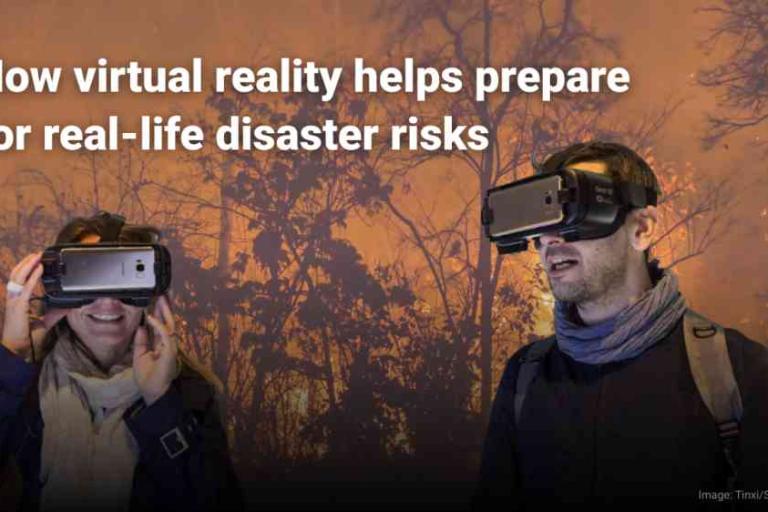
Virtual reality (VR) offers immersive and interactive experiences that bring a multitude of scenarios to life - offering rich possibilities for disaster risk reduction. By simulating hazards like floods, landslides, lightning, and more, VR helps learners, decision-makers and the public to visualise potential impacts, understand appropriate preparedness actions, and build resilience.
VR applications use 360-degree visuals, spatial audio, and interactive elements to replicate the sensory and cognitive experience of being in the midst of a hazard event, allowing users to see, hear, and sometimes interact with the environment as they would in real life.
This experience creates a visceral understanding that can improve awareness and promote behaviour change - thus supporting risk-informed decision-making.
Around the world, VR hazard simulations applications are being used in schools, community programmes, and public awareness initiatives to communicate complex hazards in an engaging and safe way. Explore these six examples below:
1. Landslides
In landslide-prone districts of Nepal, virtual reality tools are helping students understand and prepare for landslide hazards. The experience places learners in simulated environments where they can visualise how landslides occur, the dangers they present, and the appropriate preparedness actions to take.
Experiencing a risk can empower people to take action. By "walking through" a landslide, the learners can safely experience a hazardous situation, so they are better prepared to take appropriate action in an actual event. In this way, VR acts as a practical risk communication and education tool, supporting local disaster risk reduction efforts by enhancing young people's awareness of landslide risks and resilience practices within their communities.
Nepal's schools are bringing dangerous landslides into the classroom.
2. Storm surges
Storm surges remain a highly dangerous and possibly fatal hazard associated with tropical cyclones. Weather the Storm is a virtual reality simulation developed by the University of Georgia in partnership with NOAA and other collaborators to improve public understanding of storm surge impacts.
The tool places users inside a coastal home as surge levels rise, and wind and waves interact, translating complex scientific data into a realistic, experiential learning environment. Such a highly detailed VR experience is more emotional than that of traditional reporting media, and is thus greatly effective in supporting risk awareness and encouraging timely evacuation decisions, particularly in coastal communities exposed to hurricanes.
3. Wildfire
In the driest state of the driest country in the world, bushfires are part of life. To prepare young people to deal with this reality, the University of South Australia has developed an age-appropriate wildfire-response virtual reality programme.
Designed for children aged 10-12 years, the VR experience presents a scenario where children are tasked to look after a friend's dog just before a fire event begins, participating in a series of problem-solving activities to help save and protect themselves... and the dog.
The virtual experience teaches practical safety actions and decision-making skills in an engaging and age-appropriate way, thereby strengthening disaster response in youth.
Can virtual reality teach children to survive wildfires?
4. Sea level rise
In Santa Cruz, California, a 360-degree virtual reality film offers a vivid look at how sea level rise, coastal erosion and extreme storms could reshape beaches and streets as the climate warms.
This experience gives users a chance to explore different future scenarios - including potential adaptation measures such as sea walls and dune restoration - to build awareness of local climate risks and responses.
Surveys show that residents who engaged with the simulation gained a deeper understanding of the hazards their community faces and the actions that can help reduce future vulnerability - building resilient coastal communities.
5. Thunderstorms
A virtual and mixed reality-based game developed at the University of Maryland uses interactive play to teach users how to stay safe through the dangers - and wonders - of thunderstorms.
The game is designed to demonstrates how the "Faraday cage effect", a phenomenon where an enclosed conductive structure shields its interior from external electric fields by redistributing charges and blocking electromagnetic waves, can protect people from lightning during a thunderstorm.
By giving players the experience of taking safety precautions against thunderstorm hazards, the lessons empower users to act quickly in a real disaster to protect themselves and others. Early evaluations indicate that users increase their understanding of lightning risks and appropriate protective behaviours after playing.
6. Flood
The Feel Safe VR Experience, developed by Save the Children Italy, uses virtual reality in flood risk education for children and youth. Through scenario-based challenges, participants learn how to recognise flood dangers and practice appropriate actions during high-pressure emergency situations.
From the start, feedback from students has been incorporated, creating a collaborative process of testing and refinement informed by young people. The aim is to ultimately support schools and community programmes in strengthening flood preparedness and safety awareness.
Dive in here:
How Save the Children Italy is using VR to offer an immersive and engaging way to educate on hazards.
Virtual reality for a safer future
As these immersive tools continue to evolve, they will offer more options for scalable, engaging, and practical ways to strengthen preparedness, build resilience, and empower individuals to take informed steps.
By letting people safely experience hazards, VR tools can help develop awareness and understanding of real risks, boosting preparedness and safety.
- WMO Member:
- United States of America