Mali steps up efforts to reduce flood risks and strengthen community resilience
News was produced by: UNDRR, Global Shelter Cluster
A Growing threat from floods
Mali faces increasingly frequent and severe floods that threaten lives, livelihoods, and essential infrastructure across the country, compounding the challenges faced by communities already living with the impacts of conflict and displacement. Against this difficult backdrop, the Global Shelter Cluster (GSC) with humanitarian and development partners, is working to integrate disaster risk reduction (DRR) into shelter and settlement interventions, aiming to deliver more resilient and sustainable support to vulnerable communities.
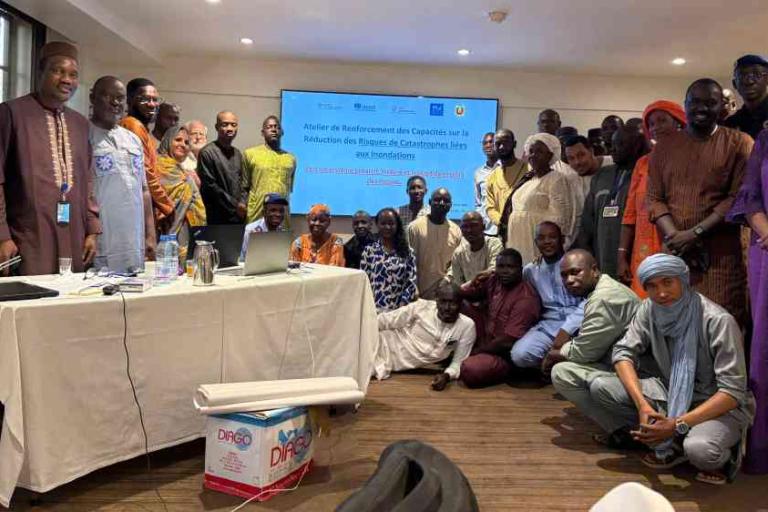
Recognizing this urgent need for stronger preparedness, national and international partners convened a three-day national workshop in Bamako from 24 to 26 September 2025. The event was jointly organized by the GSC, the UN Office for Disaster Risk Reduction (UNDRR), and the Mali Shelter Cluster, with strong support from the Government of Mali - notably the Direction Générale de la Protection Civile (DGPC) and the Direction Nationale du Développement Social (DNDS), bringing together around 40 participants from government institutions, UN agencies, humanitarian actors and community representatives. Global Shelter Cluster participation was funded through a grant from the Swiss Agency for Development and Cooperation.
Through interactive sessions participants discussed flood scenarios, analysed how floods could amplify existing vulnerabilities in conflict-affected zones - including displacement and weakening of social cohesion - and explored practical measures for DRR tailored to these complex settings. The workshop marked a significant step toward making DRR a core element of shelter and settlement programmes in Mali, reinforcing the GSC's broader ambition to shift from reactive responses to anticipatory, risk-informed and more resilient humanitarian action.
A shared vision for a resilient Mali
In his opening remarks, the Coordinator of the National Emergency Operations Center (Centre National des Opérations d'Urgence, CNOU-PC) under the DGPC underscored that building resilience requires collective commitment: "This workshop is part of our national effort to strengthen coordination and the effectiveness of collective action in the face of the multifaceted risks confronting our country. Building capacities in risk management tools and frameworks is essential to transform our commitments into concrete actions and reinforce the resilience of communities."
He commended the strong engagement of institutional, humanitarian and financial partners, noting that inclusive risk governance is key to turning challenges into opportunities for sustainable development.
The workshop also highlighted the leadership of Mali's DRR institutions, including Mali Météo, which plays a key role in early warning and forecasting systems.
Humanitarian partners call for integrated action
The UN Refugee Agency (UNHCR) Representative in Mali highlighted the devastating human toll of recurring floods - which in 2024 affected more than 733,000 people and over 121,000 households - and called for a shift toward long-term, integrated solutions.
"Floods are among the most frequent and destructive disasters in Mali, eroding livelihoods, destroying homes, and taking lives," he said. "We cannot remain passive in the face of such realities. As a humanitarian community and as a society of solidarity, we have a moral and political obligation to find sustainable, resilient solutions."
He reaffirmed UNHCR's commitment to integrating DRR and anticipatory action not only in emergency response, but also in urban planning, sustainable development, and durable solutions for displaced and host communities.
"We must move beyond temporary responses. What we need are stronger national capacities aligned with international standards, prevention and anticipation as guiding principles, and communities placed at the heart of the process-from risk assessment to implementation and monitoring."
Key findings and opportunities
Over three days, participants took part in presentations, technical discussions and hands-on group exercises designed to encourage active learning. Participants welcomed the participatory approach, the mix of national and local stakeholders, and the opportunity to translate technical concepts into real-world applications.
Discussions highlighted both the strengths and the gaps within Mali's current DRR system. Participants noted important strengths, including strong national leadership from the DGPC, an active National DRR Platform, and the critical role of Mali Météo in providing early warning and forecasting. Emerging anticipatory action initiatives - supported by partners such as the World Bank and WFP - are also helping to shift the focus toward more proactive preparedness.
However, key challenges persist. Many communities still lack site-specific flood risk assessments and tailored preparedness plans. Early warning systems remain fragmented, with limited reach to those most exposed, and greater attention is needed to ensure gender, protection and housing, land and property (HLP) considerations are fully integrated into flood risk management.
Despite these gaps, the workshop highlighted several avenues for strengthening DRR efforts. Institutionalizing anticipatory action within the National DRR Strategy presents a significant opportunity to enhance coordination and readiness. Applying established global DRR tools such as UNDRR's DRR Checklist and WWF's Flood Green Guide can further support more systematic risk-informed planning. Participants also emphasised the importance of expanding capacity-building and training for community-level responders, recognising their central role in safeguarding lives and livelihoods when floods occur.
A call to action
In his closing remarks, the CNOU-PC Coordinator reaffirmed a collective commitment to a safer future: "Together, we share the responsibility to build a resilient Mali - one that anticipates, prepares for, and responds effectively to disasters."
Participants concluded the workshop with a shared commitment to translate dialogue into concrete action. Key priorities included strengthening coordination and policy frameworks, building on the leadership of the National DRR Platform and the Mali Shelter Cluster. Participants also identified the need to enhance technical capacity, notably through the development of harmonized early warning tools and the piloting of flood management plans in displacement sites where risks are particularly acute.
In addition, strong emphasis was placed on expanding training opportunities for local authorities, NGOs and community responders, recognising that frontline actors play a crucial role in reducing the impact of floods. Attendees also underscored the importance of fully integrating cross-cutting considerations - such as gender, protection and meaningful community participation - into all flood management plans, ensuring preparedness efforts are inclusive and responsive to local realities.
Next steps
Looking ahead, participants committed to embedding DRR and anticipatory action into national and humanitarian planning frameworks and to strengthening coordination among government, humanitarian, development, and financial partners under DGPC's leadership. They also emphasized the need to mobilize funding for training, awareness campaigns, and pilot flood management projects, and to leverage climate and environmental finance to sustain these efforts.
The workshop succeeded in creating a shared momentum toward resilience - demonstrating that anticipation, prevention, and inclusion can form the cornerstone of humanitarian action in Mali.
Learn more about the UNDRR-GSC collaboration.
- WMO Member:
- Mali