From newsrooms to communities: African SIDS journalists lead the way in risk communication
Small Island Developing States (SIDS) in Africa are particularly vulnerable to natural hazards, especially those intensified by climate change. In these nations, journalists often serve as the primary and trusted source of information for communities. Strengthening media capacity is therefore essential to keeping the public informed and engaged before, during, and after emergencies.
To advance this goal, the United Nations Educational, Scientific and Cultural Organization (UNESCO), the African Union of Broadcasting (AUB), and the United Nations Office for Disaster Risk Reduction (UNDRR) joined forces to support media organisations in four African SIDS - Cabo Verde, Comoros, Mauritius, and São Tomé and Príncipe. A regional workshop, held in Port Louis, Mauritius, from 27 to 29 October 2025, brought together media professionals, government agencies, regulatory bodies, and civil society organisations.

The participating journalists were designated as focal points for the wider project by their media organisations. The workshop aimed to deepen journalists' understanding of disaster risk while fostering cross-sectoral collaboration and peer exchange. Its objectives were twofold: to strengthen the capacity of media professionals in reporting on disaster risks, and to equip them with practical tools and approaches for effective risk communication.
As broadcasters, we hold the power to shape narratives and drive action. Through accurate, compassionate, and solutions-oriented reporting, we can empower communities to prepare, adapt, and thrive in the face of climate and environmental challenges.
Director General of the African Union of Broadcasting, Mr. Gregoire Ndjaka
Participants presented examples of collaborative, cross-border reporting on disaster and climate-related issues. The discussions highlighted the important role of media as active contributors to resilience within a whole-of-society approach - helping communities prepare for and respond to disasters. Participants stated that their interactions with the trainers and with each other helped them understand how to design reliable communication outputs that are humane and tailored to the public's requirements at crucial times.
Fateema Capery, journalist at Défi Media Group in Mauritius, reported:
"The workshop was highly enriching, both at a professional and personal level. It allowed me to better understand the key role that media should take in preventing, preparing and responding to disasters."

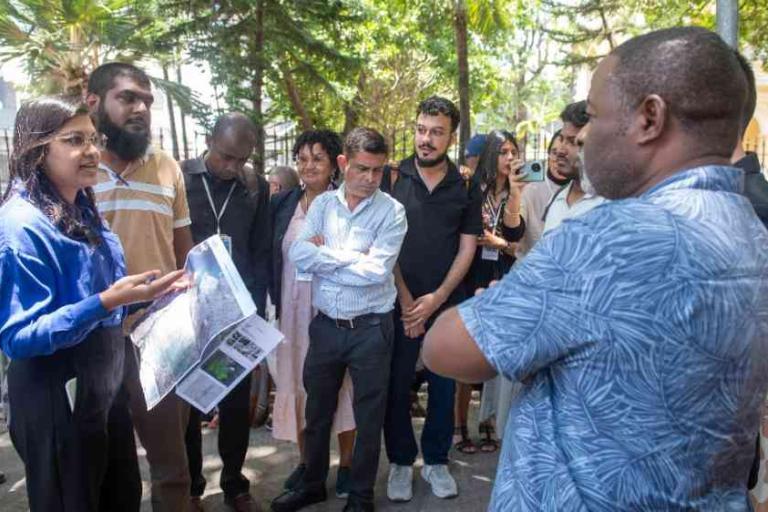
A field visit to urban and peri-urban sites further grounded the workshop content in real-world contexts, offering participants a tangible understanding of how risk is created and evolves within communities.
Framing stories that move people to act
UNDRR led two interactive sessions to strengthen journalists' understanding of how effective risk communication can drive behaviour change.
"I found both the theoretical and, above all, the practical components very valuable - working in a diverse group was very productive."
Nany Vaz, journalist from Cabo Verde

In the first session, participants learned about cognitive biases and reflected on the behavioural drivers that sometimes lead people to ignore early warnings or fail to take protective action. They explored how different types of framing and storytelling -such as emphasising community values, relatable messengers, or local experience- can help address these biases and drive behaviour change. "The integration of gender, young people and vulnerable groups into our communication for disaster reduction was very important", shared Nany Vaz, "because we usually think of a single message for all audiences". Participants stated that the training increased their awareness and motivated them to use a "community-centred" communication.
Building on these insights, they collaborated with professionals from the Mauritius Meteorological Services, the National Disaster Risk Reduction and Management Centre, and the Ministry of Environment to design media products that promote social resilience and encourage timely, informed action. Working and presenting in groups helped journalists consolidate their knowledge and consider different viewpoints on work related to disasters. Participants explored how innovative media formats -including short-form video, podcasts, and interactive radio segments- can be used in times of peace to overcome behavioural barriers and foster a culture of preparedness. Through hands-on exercises, they developed creative prototypes for television and radio formats tailored to different audiences, including youth, older adults, and residents in high-risk areas.
In addition to providing me with practical tools that I can use immediately in my journalism, the session gave me a better understanding of how the media can support resilience.
Fateema Capery
By the close of the workshop, participants had not only gained new technical and editorial skills. They had also co-created a shared vision of the journalist's role as a key enabler of community resilience.
- WMO Member:
- Cabo Verde