Protecting people and development gains: UN Global Assessment Report 2025 (GAR 2025) insights for World Summit on Social Development (WSSD 2025)
As the Second World Summit on Social Development (WSSD) kicks off this week, the message is clear: protecting people and development gains is essential to help countries anticipate, mitigate, and recover from crises while sustaining development progress.
The Global Assessment Report on Risk (GAR 2025) underscores that, despite rising global risks, building resilience is both possible and cost-effective. GAR 2025 outlined that while the direct costs of disasters averaged USD 70–80 billion per year between 1970 and 2000, they rose sharply to USD 180–200 billion per year between 2001 and 2020. And when cascading impacts are included, estimates of the indirect economic costs of disasters climb to approximately 2% of global GDP.
But these consequences are not only financial. Poor households feel the effects for years: households in high-income and upper-middle-income countries recover 36% and 27% faster, respectively, than their counterparts in low-income countries. Disasters also erode access to health, education and basic services, further deepening inequalities. Disaster prevention and smart investments can turn this reality around.

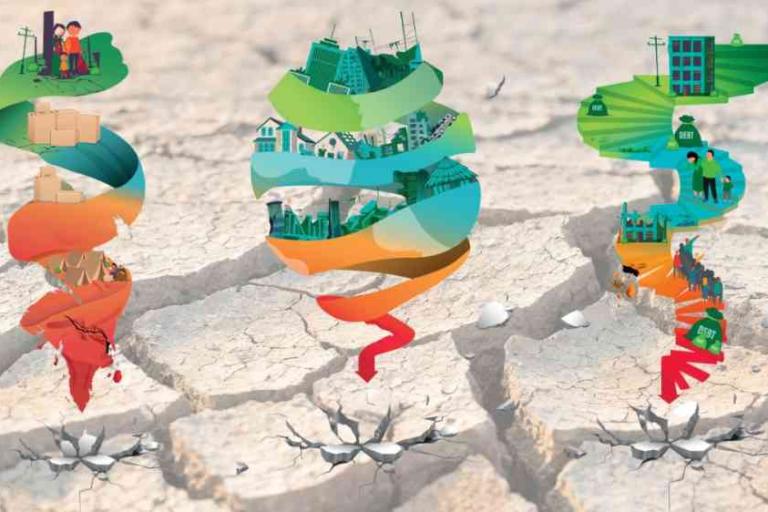
Better Investment pathways can help break the spiral of decreasing income and increasing debt. Source: UNDRR, GAR 2025
Risk reduction works
Since the Sendai Framework was adopted in 2015, many countries have expanded early warning coverage, strengthened disaster laws, and put safety nets in place that have reduced disaster mortality overall. The global average number of disaster-related deaths and missing persons per 100,000 people has halved, from 1.61 in the decade before Sendai (2005–2014) to 0.79 in the following decade (2014–2023). These achievements prove that risk reduction works. But progress is uneven, and WSSD must ensure that no region is left behind. Over 4 billion people still lack access to any form of social protection, leaving the most vulnerable, women, children, older persons, and persons with disabilities, at greatest risk.
Advancing adaptive social protection means protecting poor families who, without adequate safety nets, fall deeper into poverty after every shock. GAR 2025 shows that adaptive systems work. In Manizales, Colombia, innovative risk transfer schemes and strong community–government partnerships have shielded low-income households from disasters while fostering a culture of solidarity and resilience. Risk-informed approaches across sectors such as agriculture, manufacturing, and tourism can safeguard jobs and promote decent work. Scaling up investments in disaster risk reduction is therefore crucial to protecting livelihoods and ensuring sustainable economic growth. Such programs significantly reduce well-being losses across all income groups, with benefit–cost ratios as high as 10 to 1 in low-income countries, as highlighted by the World Bank’s latest Unbreakable 2025 research. These findings echo the WSSD Political Declaration’s call to strengthen adaptive social protection systems and ensure they safeguard those disproportionately affected by natural hazards and disasters.
Early warnings for all
Evidence also shows that early warnings and anticipatory action save lives and reduce costs. When people have time to prepare, losses are smaller, and recovery is faster. The UN’s Early Warnings for All initiative is helping make this a reality worldwide.
It is time to break current spirals of unsustainable development that increase risk, deepen social vulnerability, and drive ever-rising disaster costs. Innovative finance mechanisms, from disaster insurance to anticipatory finance, can help scale these solutions. The WSSD Political Declaration underlines the need to strengthen adaptive social protection systems, promote risk-informed social development, and build resilient health, education, and critical infrastructure. GAR 2025 evidence shows that these commitments are both urgent and cost-effective. With the right strategies and a strong outcome at WSSD, countries can deliver on the declaration’s vision, reversing current trends and bending the curve toward sustainable, inclusive resilience.