
Regional Climate Outlook Forums and Regional Climate Forums
Purpose and scope
RCOFs/RCFs aim to foster collaboration among national, regional and international climate experts, regional institutions, stakeholders and user communities (e.g., government and non-governmental organizations, extension services, policymaking bodies, and others) to enhance the generation of seasonal climate prediction and information and facilitate its application into decision-making and policy processes. This inclusive approach ensures that climate predictions are not only scientifically robust, but also practical and relevant for informed climate-resilient decision-making.
The RCOFs strengthen regional cooperation and build the capacity of National Meteorological and Hydrological Services (NMHSs) to deliver relevant and timely climate services to national stakeholders and users.
The scope of RCOFs/RCFs includes the production and delivery of climate predictions of key climate variables, such as rainfall, surface air temperature and other relevant variables.
RCOFs initially focused on the seasonal time scale, however the concept has evolved into Regional Climate Forums (RCFs) – a broader framework that encompasses the full scope of the Climate Services Information System (CSIS), offering a comprehensive suite of climate products that span across different time scales from historical observations to climate change projections. The forums have also shifted from traditionally subjective approach to an objective forecast-based process for the production of climate outlooks (WMO-No. 1246) while also promoting the co-development of tailored climate products.
Process
The RCOFs/RCFs are recommended to include the following components:
- Training session on seasonal climate prediction to strengthen the capacity of the national and regional climate experts in understanding regional climate processes, accessing and interpreting global and regional climate products and enhancing skills in producing operational seasonal predictions at regional and national scales.
- Technical session of climate experts to interpret real-time seasonal prediction products from Global Producing Centres for Seasonal Prediction (GPC-SP) and RCCs/RCC-Networks, assess skills of prediction systems and collaboratively develop a consensus-based seasonal climate outlook statement for the key season(s) in the region of interest.
- The forum proper, in which both climate scientists and representative of user sectors discuss the seasonal outlook, identify its implications and potential impacts, and formulate appropriate response strategies.
- Outreach and media engagement session to develop effective communications strategies and improve public awareness.

Users
Systematic and sustained multi-way active user engagement is a prerequisite to document and enhance the contributions of RCFs/RCOFs, in particular, and climate services, in general. In many regions, users who benefit from RCOFs/RCFs also actively contribute to their planning and session content, helping to ensure that the forums remain responsive to user needs. These forums typically engage practitioners and decision-makers from climate-sensitive priority sectors such as:
- Agriculture and food security
- Water resources
- Energy production and distribution
- Public health
- Disaster risk reduction and response
Other sectors such as tourism, transportation, and urban planning are increasingly getting involved.
Benefits
RCOFs/RCFs have significantly strengthened regional cooperation and networking, showcasing the value of collaborative approaches to climate services. By fostering close interaction between climate information providers and users, these forums have enhanced awareness, improved understanding of available products and encouraged constructive user feedback. This engagement has been instrumental in co-designing more targeted, user-driven, and impact-oriented climate services. In addition, RCOFs/RCFs regularly review challenges in the effective use of climate information and reflect on experiences and successes with past products. These insights directly inform the development of tailored, sector-specific services, ensuring that climate information remains relevant, usable and responsive to evolving user needs.
RCOFs/RCFs are often followed by National Climate Outlook Forums (NCOFs) or National Climate Forums (NCFs) or equivalent national initiatives to develop detailed national-scale climate outlooks, issue risk information, warnings and advisories and facilitate decision-makers engagement and public communication.
Role of WMO RCCs and RCC-Networks
WMO Regional Climate Centres (RCCs) provide technical guidance and coordination for most RCOFs/RCFs and serve as both technical and institutional anchors. Their contributions include:
- Providing access to climate data
- Producing seasonal outlooks and guidance to interpret them
- Providing training and capacity building activities
- Supporting standardized prediction verification procedures
- Enhancing the scientific credibility of RCOF/RCF outputs
- Facilitating regional collaborations and knowledge exchange
Implementation worldwide
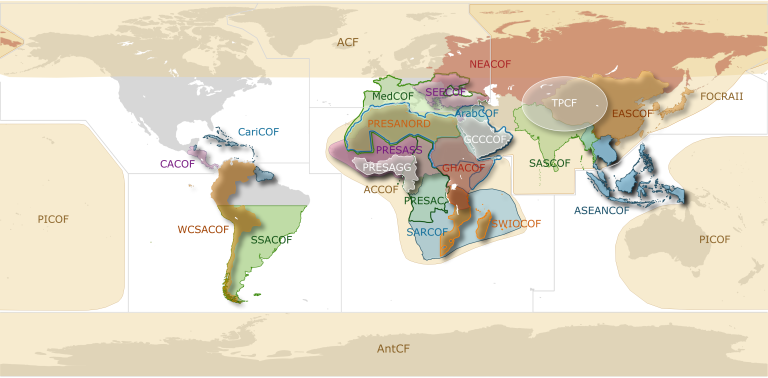
In different regions of the world, the RCOFs have evolved in different ways, based on specific needs and capabilities and tailored to meet the local conditions. Meanwhile, in all regions they constitute reliable and authentic sources of high-quality climate information, developed through a cooperative endeavor and on a sustainable basis.
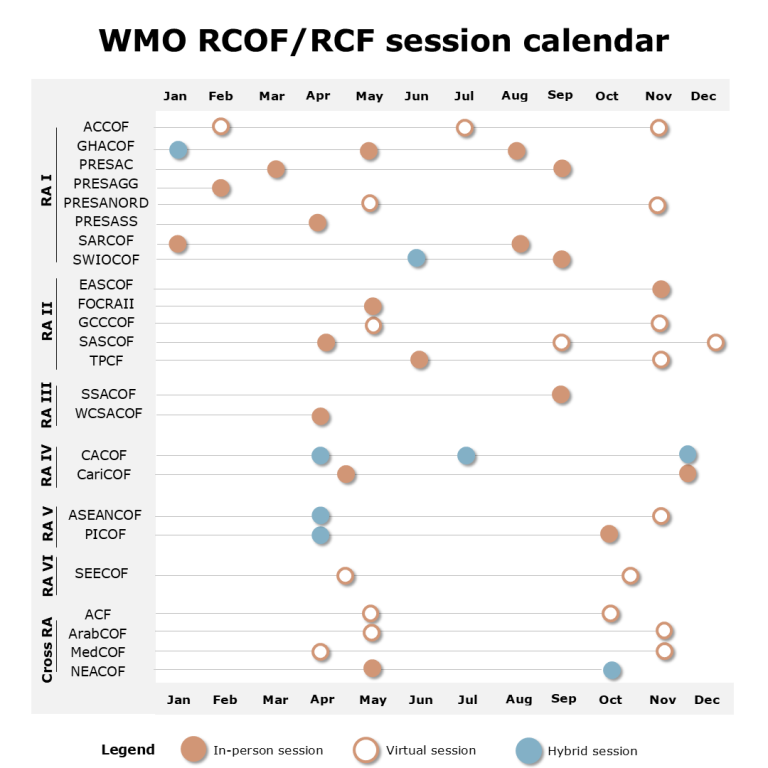
As of 2026, 25 RCOFs are operational across various regions of the world, with the following distribution across WMO RAs:
| WMO RA | RCOFs/RCFs |
|---|---|
| RA I (Africa) | ACCOF GHACOF PRESAC PRESAGG PRESANORD PRESASS SARCOF SWIOCOF |
| RA II (Asia) | EASCOF FOCRAII GCCCOF SASCOF TPCF |
| RA III (South America) | SSACOF WCSACOF |
| RA IV (North America, Central America and the Caribbean) | CACOF CariCOF |
| RA V (South-West Pacific) | ASEANCOF PICOF |
| RA VI (Europe) | SEECOF |
| Cross-RA | ACF ArabCOF MedCOF NEACOF |
| - | AntCF |
Calendar