

Volcanic Ash | Aeronautical Meteorology Programme
Volcanic Tabs
On 24 June 1982, the aviation community and much of the world learned of the drama involving a British Airways B747 aircraft which lost power on all four engines while flying at 11 300 m (37 000 ft) from Kuala Lumpur, Malaysia to Perth, Australia. During the ensuing sixteen minutes, the aircraft descended without power from 11 300 m to 3 650 m (37 000 ft to 12 000 ft), at which point the pilot was able to restart three of the engines and make a successful emergency landing at Jakarta, Indonesia.
Three weeks later when another aircraft, a B747 of Singapore Airways bound for Melbourne, Australia, reported a similar incident. This time power was lost on two engines and the aircraft also diverted successfully to Jakarta. The investigation of these two cases showed clearly that the engines on the aircraft had all stalled due to ingestion of volcanic ash and that a restart had only been achieved because the aircraft, in descending without power, happened to fly out of the high-level volcanic ash cloud into clear air.
The seriousness of these two incidents was not lost on the aviation community. While it was known that aircraft had encountered difficulties in the past when inadvertently flying through volcanic ash cloud, these incidents had generally been restricted to the sand-blasting effect of the ash on cockpit windows and to blocked pitot-static tubes. It was now perfectly clear to all that such ash clouds had the potential to cause a major aircraft accident.
To meet this newly recognized threat, ICAO in cooperation with WMO and other partners developed a set of guidelines and procedures to assist States in the dissemination of information on volcanic ash to pilots and the development of contingency arrangements for the diversion of aircraft around affected areas. This effort evolved into what is today known as the International Airways Volcano Watch (IAVW).
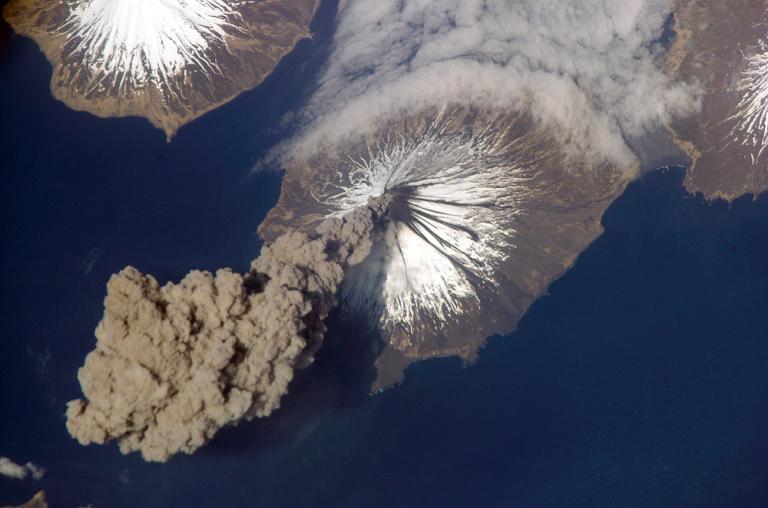
Picture: NASA, Mission: ISS013, Cleveland Volcano Eruption
The International Airways Volcano Watch (IAVW) a a set of international arrangements for monitoring and providing warnings to aircraft of volcanic ash in the atmosphere has been established in the 80s and 90s of the 20th century as a response to the growing number of incidents with jet aircraft encountering volcanic ash. The IAVW is based on the cooperation of aviation and non-aviation operational units using information derived from observing sources and networks that are provided by States. The watch is coordinated by ICAO with the cooperation of other international organizations concerned, such as WMO.
The objective of the IAVW is to keep aircraft in flight and volcanic ash in the atmosphere entirely separate. Nothing can be done to prevent volcanic ash erupting into the atmosphere and being carried by the upper winds across international air routes. The aviation community has the responsibility to ensure, as far as possible, that when this happens, the ash cloud is monitored, pilots concerned are advised and aircraft routed safely around it.
The IAVW consists of two parts, an observing part comprising observation sources, as follows:
-
observations from existing ground-based stations drawn from all known organized international observing networks regardless of their particular specialized function;
-
special air-reports; and
-
observations from satellites (meteorological and non-meteorological);
and an advisory warning part comprising advisory/ warning messages, as follows:
-
NOTAM or ASHTAM initiated by ACCs and issued by AIS units;
-
SIGMETs issued by MWOs; and
-
volcanic ash advisory messages issued by VAACs.
The IAVW organization and procedures are described in detail in:
- Handbook on the International Airways Volcano Watch (IAVW): Operational Procedures (ICAO Doc 9766)
- Manual on Volcanic Ash, Radioactive Material and Toxic Chemical Clouds (ICAO Doc 9691)
The operations and development of the IAVW are coordinated by the Meteorology Panel (METP) established by the ICAO Air Navigation Commission. WMO is a member of the METP.