COP31: Towards early warnings for all in Africa
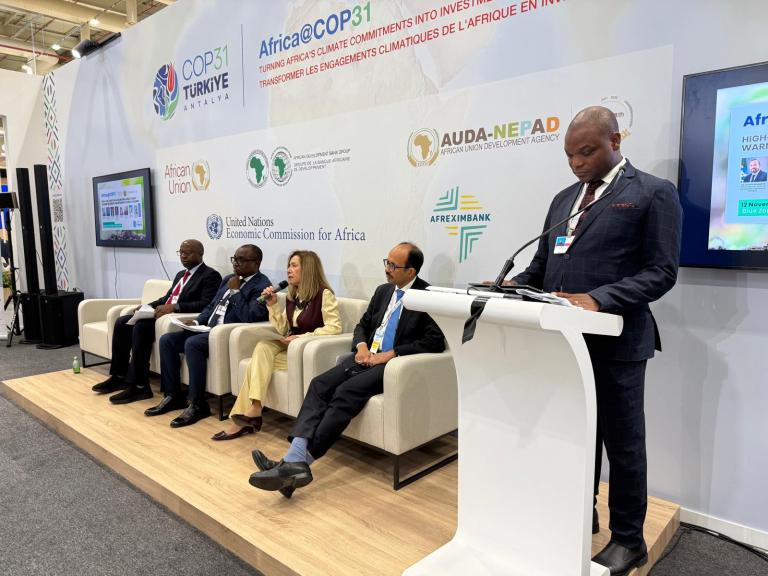
Excellencies, colleagues, friends,
Thank you to the African Union Commission and our co-organisers.
Addis Ababa. Nuku’alofa. Tunis.
In September and October, three regions met in these three cities, each facing their own hazards. And each, in their own words, reached the same conclusion: early warning must be built to last, well beyond 2027.
In forecasting, we run our models many times, each from a slightly different starting point. When the forecasts agree, our confidence grows and we issue the warning.
This year showed how powerful this science is.
Early this year, WMO flagged that El Niño was developing. By September, the forecasts of 13 leading global centres agreed. We announced a 100% probability for El Niño until at least February 2027.
WMO declares El Niño when the tropical Pacific is half a degree warmer than normal. This one is forecast at 3.8 degrees: more than seven times that line. It is the strongest El Niño since 1950.
Many of you are already feeling it. Parts of Africa face devastating floods. In the south, farmers are planting into what is likely to be a hotter, drier season.
But thanks to our collective work, Africa has valuable time to prepare.
Global centres saw the signal. Regional centres turned it into outlooks. National weather services turned it into warnings. Disaster teams and communities turned them into action.
And Africa acted. Within two weeks of our June forecast, the continent’s climate forum met in Lusaka. In July, African Union ministers met in special session. In Madagascar and Zimbabwe, humanitarian funds were released before the drought arrived, using our forecasts.
The global report we launched yesterday with UNDRR shows why. No region has improved its early warning systems more than Africa. On average, Africa now stands level with the Americas.
That progress belongs to the people in this room. And so does the work still ahead.
In Central and West Africa, fewer than half of the people hit by a disaster were warned.
If we’re going to build early warning systems that last, then we must place the national weather services at the heart of this work: the one authoritative voice that people can trust.
And we must fund them as we fund other essential public services. Like hospitals, they must be paid for year after year, not only on the day they open.
These systems must also be owned by the regions themselves: here, through the African Union; in the Pacific, through Weather Ready Pacific; in the Arab region, through the League of Arab States.
And then ensure that they are ready for the climate that is coming. In Addis Ababa, you warned of intensifying extremes and growing exposure. Our measurements confirm it. Heatwaves, tropical cyclones and rainstorms are growing stronger faster than our historical baselines prepared us for.
WMO is playing its part. Through our new Coordination Mechanism, we now put forecasts directly in the hands of more than 100 humanitarian organisations, so that those who act first can act fast.
Excellencies,
Of the three regional calls to action, two were written on African soil. Next year, the whole world comes to Ethiopia for COP32, the African COP. Let’s arrive with three regions speaking as one: early warning, built to last.
I have spent my life in meteorology. And I have learned one thing above all: a forecast only has value when someone uses it.
The same is true of a call to action. Three regions have made theirs. Now it’s time to act.
Thank you.
More information on the Early Warnings for All (EW4All) initiative here.
Statement by