COP31: Making progress towards Early Warnings for All
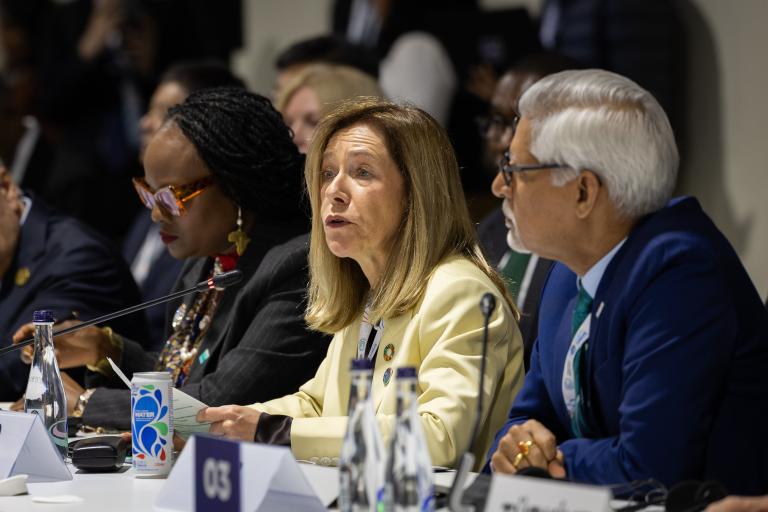
Excellencies, colleagues, friends,
When a warning works, nothing happens. There are no headlines. No tragedies. Nothing to see.
In Trinidad and Tobago, people still remember neighbours stranded on rooftops in the great flood of 2018. Today, with European Union support, a community flood warning system is in place. There are fewer rooftop rescues.
This didn’t make the news. And that is exactly the point.
The report we launch today with UNDRR shows that we are making progress towards Early Warnings for All. But not fast enough.
Four in five people hit by a disaster in the past five years received advance warning. But in more than half of the countries that report, the system still breaks down somewhere between the forecast and the action.
Think of a lighthouse. Its light shines for every ship. But someone has to keep the lights on.
Only 15 in every 100 national weather services have all the technicians they need to run and maintain their systems.
And the hazards we’re facing are changing faster than our systems.
In August, on the border between Nepal and China, rock and ice collapsed into a river. The deadly flood raced at nearly 200 kilometres an hour, faster than a car on a motorway. The system had been built for monsoon floods. Not for this.
And this year, the strongest El Nino since 1950 is testing every system at once.
Early Warnings for All is not just a UN initiative. It is a response to an existential threat to the world. The question is not what we are going to do as a UN system, but what are we going to do collectively as humanity.
So what comes next?
We are making progress but the targets are moving faster than we are. Thirty-five countries now have national roadmaps. These must now be costed and written into national budgets and climate plans, so that early warning becomes, as the UN Secretary-General said, a permanent public service.
Countries are saying this themselves. I thank Azerbaijan, Brazil, Türkiye, and Australia for the Belem Mission to 1.5 report, which counts early warning as one of the most effective, and most cost-effective, ways to adapt.
Delivering on that warnings that travel across borders. Tropical cyclones, sand and dust storms and floods often originate hundreds of kilometers from where they impact. So warnings must travel just as far, through shared data and by more than one route. And we know this: a forecast in Europe, for example, depends on observations in Africa, the oceans and the Pacific.
We need warnings built for the type of hazards that are coming, warnings that say what these hazards will do. Today, only 14 in every 100 weather services can do that.
We need technology that closes the gap.
Some AI forecasting tools now run on modest computers. But 29 national weather services still work with an unstable internet connection. If innovation does not reach them, it will widen the very gaps we are here to close.
And we need our science and our warnings to be the foundation for action.
During 2025, 146 anticipatory action activations reached nearly 10 million people in 54 countries, supported by nearly US$ 120 million in pre-arranged financing.
This shows the effectiveness of early warnings, but we need to refine how we measure success. Because it's not only about whether a warning was sent, but whether people acted on it.
WMO will continue to do its part. In January next year, new WMO Technical Regulations for early warning services come into force, setting the first global standard for these services, agreed by all our Members.
Over the coming months, we will continue to shape the next phase region by region, leading to a global meeting in the middle of next year. These milestones will decide how Early Warnings for All will continue after 2027, as one thing is clear: we are committed to continue with our partners.
So to every government and every partner: champion the next phase.
To development banks and climate funds: invest in the people and the upkeep, not only the equipment.
To businesses and philanthropists that rely on these warnings: be partners who stay.
Early Warnings for All is a promise to protect everyone. Like a lighthouse, that promise does not expire.
So let’s not just keep the lights on. Let’s make them so bright we light up the world.
Thank you.
More information on the Early Warnings for All (EW4All) initiative here.
Statement by