COP31: Intervention on State of the Climate Update at high-level segment of Leaders' Summit
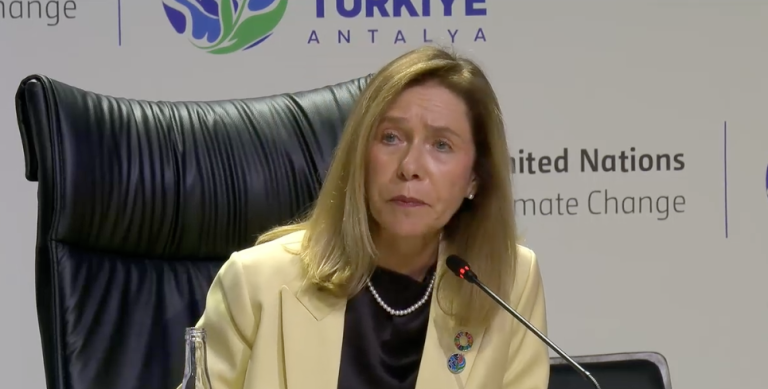
Mr President, Secretary-General, Excellencies,
Since the industrial age, humanity has lived in harmony with the world’s atmosphere, oceans, land, rivers, lakes and ice.
The new WMO State of the Climate Update shows that this harmony is under growing strain.
Let's look at what our measurements are telling us.
Start with the ocean.
The ocean absorbs about 90 per cent of excess heat. This year is on track for a tenth consecutive heat record alongside monthly record highs in sea-surface temperatures.
Warmer water harms vital marine ecosystems and fuels stronger storms. And warmer water expands: sea level is now the highest on record, increasing risk for 900 million people who live on low-lying coasts.
And this ocean warming will continue for hundreds, even thousands of years.
Now the atmosphere.
Carbon dioxide in the air is now more than 50 per cent higher than before the industrial age. Methane has nearly tripled. Nitrous oxide is up by more than a quarter. All three are at new highs and measurements indicate a continuous increase in 2026.
Land and oceans take in about half of what we emit. They cannot keep up.
As a result, the Earth’s energy imbalance is at its highest value since monitoring began in 1960. The planet is taking in far more energy than it gives back, and it is accumulating heat at an increasing rate.
That is why the past 12 years are the 12 warmest on record. From January to September 2026, the global average temperature was about 1.47°C above pre-industrial levels. It will be even higher because El Niño is turning up the heat.
And the ice.
This year, at both poles, sea ice reached one of its lowest winter peaks on record. All the world’s glaciated regions have lost ice for four years in a row.
Ice and snow are part of the water we save for dry years. Those savings are running low.
Water stored on land has been falling and 2025 was one of the driest for the world’s rivers in 35 years.
What does all this mean?
We are supercharging our weather. Heatwaves, storms and heavy rain are intensifying faster than our old baselines prepared us for.
Ice and rock collapse and floods in China and Nepal showed how risk in fragile mountain areas cascades downstream, and across borders.
Now, a very strong El Niño is here: the strongest since at least 1950.
Its effect on global temperature typically peaks the following year. So 2027 is likely to set a new global temperature record.
But WMO’s State of the Climate Update 2026 provides some hope.
The WMO community watches the skies, the oceans and the ice, and shares what it sees. That is how we predicted El Niño months ahead, giving countries time to prepare and protect.
In the last 10 years, the number of countries with early warning systems has more than doubled. Where these systems are strong, deaths from disasters are six times lower.
Excellencies,
At WMO we know that what we measure helps us understand, anticipate, and plan. Every number I have shared today is possible because National Meteorological and Hydrological Services work together through a global observing system. Yet the places with the greatest gaps in observations are often the places hit hardest.
So let us invest in the people and instruments that observe our planet and warn its people. That is how we build a sustainable, resilient and equitable future.
Thank you.
Statement by