COP31: Closing data gaps to protect people
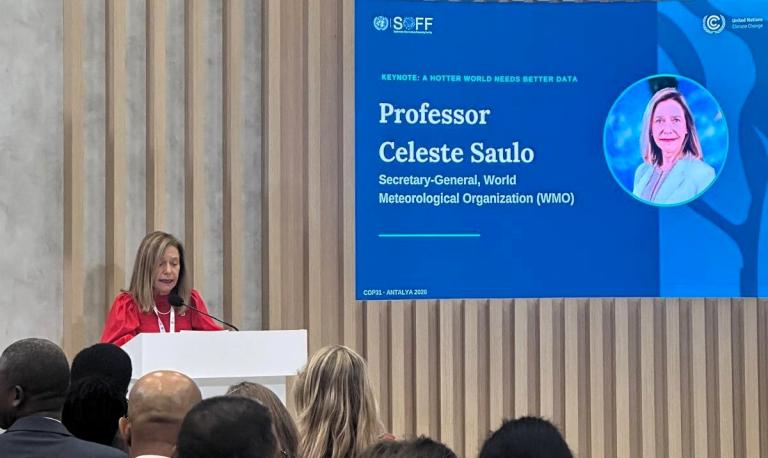
I speak tonight for WMO, and also on behalf of SOFF’s co-founders, UNDP and UNEP.
In Spanish, my language, a weather forecast and a medical doctor's prognosis share one word: pronóstico.
Meteorology and medicine are similar in many ways. A good doctor examines you, tells you what is likely to come, and helps you decide what to do. Weather and climate observations let us do the same for the planet.
First, they help us understand a changing climate. A doctor learns little from one temperature reading. But readings taken the same way, for years, show a trend. That's how we know the climate is changing, not just the weather.
From January to September this year, the world was 1.47 degrees warmer than before the industrial age. The planet is running a fever.
And an average like this hides the extremes. A small rise in the average means many more days of dangerous heat. That’s what we’re seeing in country after country.
And now an extremely strong El Niño is adding heat on top of the warmest ocean we have ever measured.
Second, observations help us see risks coming. No medical doctor can give a prognosis without a diagnosis. So every forecast begins with a picture of the atmosphere right now, built from millions of measurements. Just now a measurement has been taken in Japan...and now another in Chile...and just now, another in Norway.
Computers then move that picture forward, hour by hour, to show what’s coming: a heatwave next week, a storm on Friday.
But if the starting picture has gaps, the errors grow. We can still see tomorrow. But next week becomes a blur. That’s how a country ends up flying blind.
This paper, which I have here with me, was published in Nature Communications. It measures how far ahead countries can see, looking at the accuracy of temperature forecasts around the world from 1985 to 2020.
It finds two things. A big gap. And a gap that isn’t closing.
It shows that a seven-day forecast in a high-income country is, on average, about as accurate as a one-day forecast in a low-income country. In other words, one country gets a week's notice to prepare for extreme weather. The other gets only a day.
Yes, forecasts have improved almost everywhere. But low-income countries are still about 17 years behind. Over the last twenty years of the study, the gap hardly moved.
Part of that is the atmosphere. In the tropics, thunderstorms can build in a few hours, from local heat and moisture. They are hard to predict.
And part of it is about instruments. WMO's data show that in the least developed countries and small island states, fewer than one in ten of the weather stations they need report to international standards.
We know that every new station improves forecasts for the country, for its neighbours and for the rest of the world. One study the paper cites found that one extra weather reading in Africa does as much for global forecasts as seven or eight in Europe.
In Rwanda, the country’s first automatic upper-air station, established with SOFF support, is now sharing data internationally. These observations are crucial in a continent with vast gaps in its observing network: Central Europe’s upper-air data density is 164 times higher than Africa’s.
The ECMWF–SOFF studies presented tonight show what closing these gaps could achieve: better forecasts of upper-air temperature, humidity and wind across the tropics up to seven days ahead. And these benefits reach far beyond the countries providing the observations.
Third, observations inform action. A diagnosis nobody acts on saves no one.
In a heatwave, the days before it arrives are what save lives. That’s when hospitals add staff and cities open cooling centres. Too often, the countries that need that warning most are the ones least likely to get it.
Observations also inform investment. No bank should finance a dam, a port or a power plant without knowing the risks it will face. Observations are how we know what these risks are.
So the path ahead is clear. Invest where stations are fewest. Get existing ones reporting more often. And keep paying to run them so they don’t fall silent.
That’s why SOFF was created by WMO, UNDP and UNEP – engaged co-founders that I am representing here tonight. It invests in the least developed countries and small island states. It helps build the stations. And once they’re running, it will keep supporting them, for as long as their data keep reaching the world. WMO checks that they do.
This year, SOFF approved the framework for long-term support to keep these systems operating, with payments linked to performance independently verified by WMO.
Since 2022 SOFF has been providing initial support to 64 countries. In twenty-six countries investments are ongoing in stations and capacity. And more than 50 stations are already sharing data with the world. In Cabo Verde, stations that reported every six hours now report every hour. The countries here tonight will tell you what that has meant for them.
Seven days to prepare for disaster should not depend on where you live. That is what data justice means. Tonight, let’s start closing that gap.
Thank you.
Statement by