

Commission for Aeronautical Meteorology (CAeM) | Aeronautical Meteorology Programme
Caem tabs
The Commission for Aeronautical Meteorology is one of the eight WMO technical commissions. It is the driving force behind the Aeronautical Meteorology Programme. The Commission meets every four years and provides guidance and coordination through five expert working groups that are responsible for the following:
- Application of meteorology to aviation taking into account relevant developments in science and technology and the study of aeronautical meteorological requirements;
- International standardization of methods and techniques for the provision of aeronautical meteorological services;
- Improvement of observations, forecasts and warning in the airport terminal area;
- Initiation of specific studies aimed at improving forecasting accuracy;
- Consideration of requirements for basic and climatological data, observations and specialized instruments;
- Updating regulatory and guidance material such as WMO Technical Regulations;
- Implementation of the World Area Forecast System (WAFS) jointly with ICAO;
- Improvement of forecasts on en-route weather hazards such as turbulence, icing and volcanic ash and tropical cyclones;
- Studies on the impact of aviation and on the environment and;
- Training of personnel in aeronautical meteorology.
The first ancestor of the current CAeM was the Commission for the Application of Meteorology to Air Navigation (CAMAN) established by the Paris Conference of Directors (CD) of the International Meteorological Organization (IMO) as early as 1919. The rapid development of the civil aviation after the end of the World War I required development of internationally agreed methods and procedures to address the needs of the aviation for meteorological data and information. It should be noted that already in 1920 regular air services were established between London, Paris, Brussels and Amsterdam.
International civil aviation wanted observing stations at airports and forecasting offices at the more important ones. Another essential need was for a telecommunications system to permit the rapid interchange of reports between one airport and another, including special priority for reports of sudden deteriorations. All these requirements were so compelling that civil aviation authorities throughout the world were prepared to help in the financing of surface and upper-air observing stations at important locations, including airports, in the world-wide planning of air routes.
The rapid expansion of civil aviation resulted in existing national Meteorological Services improving their observing networks and new national Meteorological Services being created, some of them by the civil aviation department in their country and so with responsibilities exclusively for civil aviation. Reports from all these observing stations were, of course, available for other purposes including research and the provision of weather forecasts for shipping, agriculture, the general public and so on.
The CAMAN in those early years had to coordinate with another new body – the International Commission for Air navigation (ICAN). However, this coordination was complicated by the fact that CAMAN was not an inter-governmental body. Therefore, IMO, at its Warsaw Conference of Directors in 1935, replaced CAMAN by a new International Commission for Aeronautical Meteorology (ICAeM) consisting of members appointed by governments in order that it could work effectively with ICAN. Thus, ICAeM became the first inter-governmental body in meteorology and its experience influenced the transformation of IMO after the World War II into the inter-governmental World Meteorological Organization (WMO).
The First Congress of WMO (Geneva, 1951) established Technical Commissions including the Commission for Aeronautical Meteorology (CAeM) on the basis of the ICAeM. During the same period, WMO and the International Civil Aviation Organization (ICAO) established formal Working Arrangements that entered into force on 1 January 1954. During the 60s and 70s of the 20th century, CAeM has held joint sessions with ICAO, normally during the so called MET Divisional meetings. The fifth CAeM (Geneva, 1971) was the first time the Commission was conducted on its own. Regular sessions have been conducted after 1986 normally at four-year interval, from time to time as conjoint session with ICAO.
The 17th Congress (2015) approved revised terms of reference, as follows:
The terms of reference of the Commission for Aeronautical Meteorology shall be:
|
A. |
To contribute, in close collaboration with ICAO, to furthering the international standardization of meteorological service provision to international air navigation and provide assistance to Members to achieve compliance with those standards; |
|
B. |
To promote and facilitate, in collaboration with relevant WMO bodies, the international sharing of implementation experience, exchange of technology and research uptake, including appropriate pilot projects, to meet evolving user requirements for aeronautical meteorological information and services; |
|
C. |
To participate, in close collaboration with ICAO and other relevant stakeholders, in the planning and development of enhanced aeronautical meteorological services in support of the future Air Traffic Management system; |
|
D. |
To coordinate development of guidance, training material and learning opportunities in collaboration with other WMO bodies and ICAO, to ensure Members’ compliance with the competency and qualification requirements for aeronautical meteorological personnel; |
|
E. |
To review and respond to Members’ aeronautical meteorology prioritized needs and support capacity development activities, in cooperation with regional associations, aimed at enhancing the delivery of quality aeronautical meteorological services, especially by developing and least developed Members; |
|
F. |
To promote good governance and efficiency, in cooperation with ICAO, regional bodies and Members, including enhanced regional and subregional cooperation in aeronautical meteorological service delivery and development of related cost-recovery mechanisms; |
|
G. |
To maintain existing and develop further partnerships with relevant aviation user and stakeholder organizations and collaborate on issues related to aeronautical meteorology. |
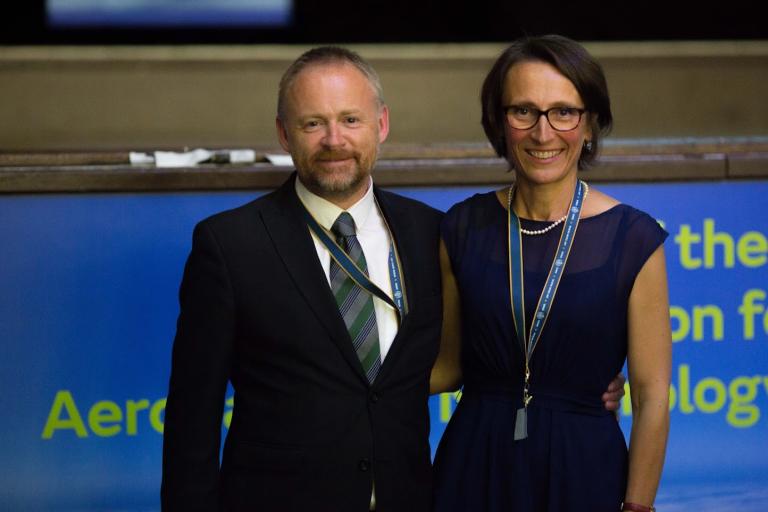
The 16th session of the CAeM (24 to 27 July 2018, Exeter, United Kingdom) elected Mr Ian Lisk (United Kingdom) as President and Ms Stephanie Desbios (France) as Vice-President of the Commission for Aeronautical Meteorology. This follows eight years of service as Vice-President of the Commision for Mr Lisk.
Previous presidents of CAeM:
| 1951-1959 | A.H. Nagle | United States |
| 1959-1964 | A. Silva de Sousa | Portugal |
| 1964-1967 | W.A. Dwyer | Australia |
| 1967-1971 | N.A. Lieurance | United States |
| 1971-1976 | P. Duverge | France |
| 1976-1982 | R.R. Dodds | Canada |
| 1982-1990 | J. Kastelein | Netherlands |
| 1990-1999 | C. Sprinkle | United States |
| 1999-2006 | N.D. Gordon | New Zealand |
| 2006-2010 | C. McLeod | Canada |
| 2010-2018 | C.M. Shun | Hong Kong, China |
| 2018- | I. Lisk | United Kingdom |
The members of CAeM can be found in the WMO contact manager. (Password protected)