Scaling Impact through Member-to-Member Cooperation – Key Takeaways from the Lunch Time Learning Session
Member-to-Member support allows National Meteorological and Hydrological Services (NMHSs) to share expertise and institutional experience, addressing immediate technical needs while strengthening services for the long term. A recent Technical Coordination Initiative learning session with Tanzania and Seychelles highlighted how peer cooperation can reinforce not only technical capacities, but also the strategic, institutional, and financial foundations needed for sustainable and effective NMHSs.
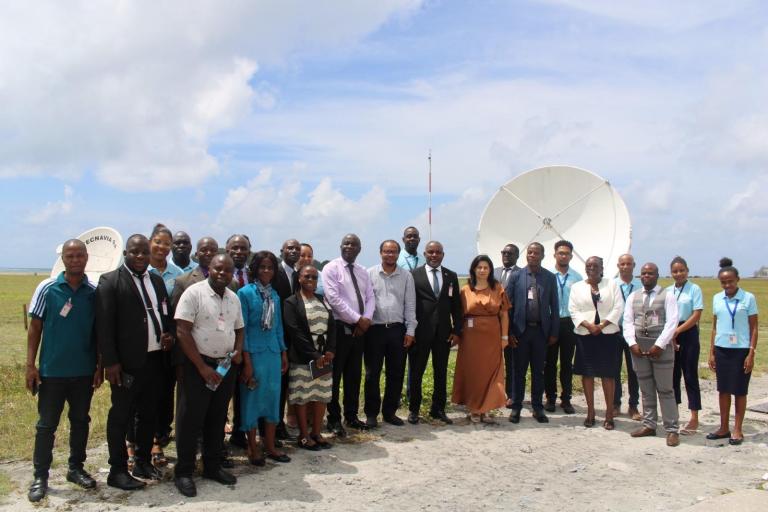
Member-to-member support enables National Meteorological and Hydrological Services (NMHSs) to draw on one another’s experience, expertise, and institutional strengths. It can address immediate technical needs, while also supporting the longer-term development of sustainable and effective national services.
This was the central message of a recent Technical Coordination Initiative learning session with the Permanent Representatives of Tanzania and Seychelles, with contributions from other Members, including Mozambique. Their experiences demonstrated that peer cooperation can support not only technical systems, but also the strategic, institutional and financial foundations that NMHSs need to deliver lasting impact.
1. Strong leadership and strategic planning must come first
Strong strategic frameworks are foundational for an effective NMHS. They establish institutional priorities and provide the basis for determining the resources, procedures, and operational arrangements needed to deliver them.
The Seychelles Meteorological Authority (SMA) demonstrated the value of linking its National Strategic Plan with business and human resources planning. Together, these instruments have helped SMA define its institutional direction, identify priority services and determine the workforce, competencies and resources required to deliver them.
A clear and costed set of priorities also enables an NMHS to communicate its work and areas for investment more effectively to governments and development partners, guide investments, inform partnerships, and ensure that projects contribute to a coherent national vision. It also enables good point of departure for informing Member to Member engagement and exchanges.
2. Strong institutional foundations sustain NMHS operations
An NMHS National Strategic Plan and workplan cannot be implemented in isolation. They must be supported by appropriate legislation, clear standard operating procedures and the inclusion of the NMHS in relevant technical, policy and operational decision-making spaces.
Tanzania demonstrated how these elements can work together. Legislation establishes the Tanzania Meteorological Authority (TMA) as the authoritative voice for weather forecasts and warnings, while its participation in the national Disaster Management Council connects its technical expertise with national preparedness and decision-making. Its legislative framework also provides options for mobilizing resources to support its operations.
TMA’s experience shows how strong institutional arrangements can translate an NMHS strategy into action. It also positions TMA to share practical lessons with other Members and support their own institutional development.
3. Members can learn from different stages of institutional development
Members at different stages of institutional and operational development. This creates valuable opportunities for learning and exchange.
An NMHS that has strengthened its legislation, introduced a Quality Management System, or developed a cost-recovery model can share practical experience with another Member pursuing the same objective. Such cooperation provides access to lessons that may not be captured in formal guidance.
The exchange should not be seen as a one-way relationship between a provider and a recipient. As Members strengthen their own capacities, they can apply their experience to support others. This creates a multiplier effect across the WMO community.
4. Cost recovery can be a game changer—but it takes time
Securing adequate and predictable resources is critical to the sustainability and impact of an NMHS. Cost recovery and tailored services for different sectors can help diversify revenue and reinforce the value of the institution, but these arrangements cannot be established overnight.
Successful cost recovery requires appropriate legislation, commercial and technical expertise, a credible Quality Management System, relevant staff competencies and, where appropriate, ISO certification. It also requires close connections with sectors and a clear understanding of the services they need.
The recent collaboration between TMA and SMA provided a practical example. Tanzania helped Seychelles strengthen its Quality Management System and develop the competencies needed to deliver reliable services and pursue cost-recovery opportunities. Having benefited from this cooperation, Seychelles is becoming better placed to share its own experience with other Members.
5. Stronger NMHSs benefit the entire community
Strong and well-positioned NMHSs are better able to fulfil their national mandates, provide authoritative services and contribute to technical and policy decisions. They can also build stronger relationships with governments, sectors and national partners, ensuring that weather, water and climate information informs preparedness, development and operational decision-making.
These national capacities also strengthen the wider WMO network. NMHSs with effective institutions, skilled personnel and sustainable operations are better able to contribute observations, data, expertise and services to regional and global systems. This improves the information available to all Members and reinforces regional and global forecasting capabilities.
Investing in an individual NMHS therefore generates benefits beyond one country. Stronger NMHSs can participate more fully in the WMO community, support other Members and reinforce the collective authoritative voice of WMO on weather, water and climate.
6. Coordination and positioning are needed at every level
Better coordination is needed at national, regional and global levels to ensure that NMHSs are included when discussions concern their mandates and areas of expertise.
At the national level, Seychelles highlighted the value of a central mechanism that could provide an overview of projects entering the country. Such a mechanism could identify duplication, align investments with national priorities and help ensure that resources address genuine gaps across the four pillars of Early Warnings for All.
At the regional and global levels, WMO also has an important role in positioning NMHSs and ensuring that development partners and international organizations engage them in relevant initiatives. External support should reinforce national systems and authoritative institutions rather than establish parallel arrangements.
7. Member-to-member support can take many forms
As emphasized by the Permanent Representative of Mozambique, Adérito Aramuge, member-to-member cooperation can take many forms, including institutional twinning, joint projects, expert exchanges, study visits, training, webinars, regional programmes and support from regional centres.
The WMO Regional Office for Africa has been working with Members and WMO colleagues to better understand how these different forms of cooperation operate across the continent and how they can respond to the varied needs and capacities of African NMHSs.
Different approaches serve different purposes. Webinars can rapidly share knowledge, while expert exchanges and study visits offer more tailored learning. Twinning arrangements, regional projects and support from regional centres can facilitate longer-term institutional development.
Using this full range of options allows cooperation to be adapted to Members’ priorities and resources. The objective should be support that is cost-effective, sustainable and long-lasting—building national capacity and relationships that endure beyond a single activity or project.
Turning collective experience into lasting impact
Member-to-member support is, by its nature, Member-driven. It begins with the specific priorities, circumstances and institutional needs of an NMHS and connects them with the practical experience of another Member that has faced similar challenges.
This is what makes peer support so valuable—and why it cannot be fully replaced by other mechanisms for delivering technical assistance. Members bring first-hand operational and institutional knowledge, an understanding of the realities faced by NMHSs, and experience in adapting solutions to different national contexts. These exchanges can create trusted relationships that endure well beyond a single activity or project.
Member-to-member support should therefore be actively promoted and leveraged. WMO looks forward to further enabling, scaling and sharing the excellent work of its Members through the different avenues available, including regional programmes, projects, the Voluntary Cooperation Programme, regional centres and other technical and institutional partnerships.
By creating more opportunities for Members to learn from and support one another, WMO can help turn individual experience into collective capacity and lasting impact.
- WMO Member:
- Seychelles ,
- United Republic of Tanzania
- Region:
- Region I: Africa