COP31 - State of Climate Update 2026 press conference statement
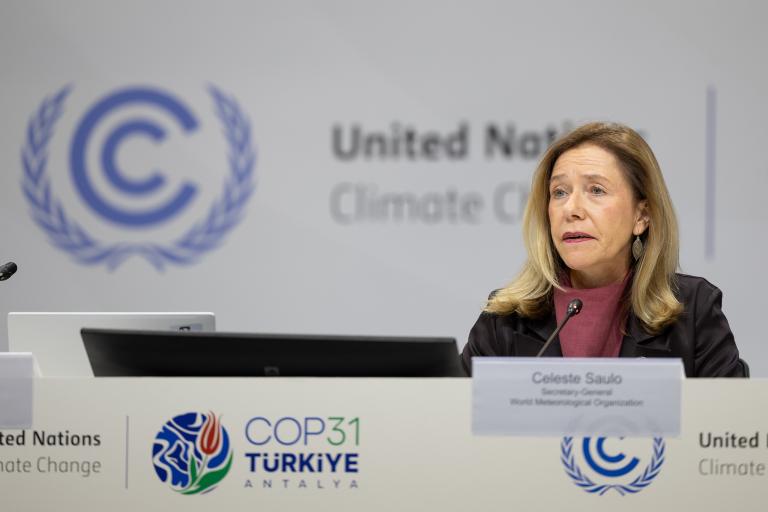
Thank you Simon Stiell for those opening remarks. My thanks to Alan Dangor of Wellcome for joining us today and for your vital support for action on climate and health.
Together we can save lives.
We have no time to lose.
The World Meteorological Organization is today releasing its State of the Climate Update 2026. It brings scientific evidence to the heart of our discussions at COP31.
The science is extremely robust.
Yet again we are reporting a series of broken records. And the current levels of greenhouse gases reveal that there is no end in sight.
The past 12 years have been the warmest on record. The past four years – including 2026 – are the top four.
From January to September 2026, the global average temperature was about 1.47 °C above the pre-industrial average. When we take into account the strong El Niño, temperatures are likely to rise further for 2026 as a whole.
We also know that El Niño is likely to have its greatest impact on global temperatures the year after its development. This is why 2024 was the warmest year on record, and why we should therefore prepare for another record-breaking year in 2027.
Indeed, this 2026/2027 El Niño is off the charts. It is different from any El Niño that we have monitored.
The World Meteorological Organization declares an El Niño when the sea surface temperature is 0.5°C above average in the Tropical Pacific – the epicentre of El Niño. We forecast that it may be nearly four times that level between November 2026 and January 2027.
So let me give you some more facts and figures:
- Ocean heat is the highest on record for the tenth consecutive year.
- Sea-surface temperatures hit monthly records during 2026.
- Sea level has also reached a record high, increasing risks for 900 million people living along low-lying coasts.
We are super-charging our weather.
And we see the impacts of this every day in our news headlines, on our economies and on our health.
Heatwaves, tropical cyclones, and rainstorms are intensifying faster than our historical baselines prepared us for.
The human and economic cost is unacceptably high.
In 2026, millions of people were exposed to unbearable heat, leading to tens of thousands of excess deaths in Europe alone. India and Pakistan and large parts of Asia and North America suffered dangerous heatwaves. And, as we head into the southern hemisphere summer, we will see more.
The catastrophe in China and Nepal showed the dangers of high-mountain disasters for downstream communities.
As COP31 convenes, there are devastating floods in parts of South America and Africa, and drought in countries in Asia and the Pacific and Central America.
I also stand here today with a message of hope.
Because together our collective efforts are yielding results.
The number of countries reporting multi-hazard early warning systems has increased from 56 in 2015 to 136 in 2025, a reminder that progress is possible when we act together.
At COP we will be assessing progress towards achieving Early Warnings for All. Delivering life-saving early warnings for all is not just a UN initiative. It is a response to an existential threat to the world. The question is not what we are going to do as a UN system, but what are we going to do collectively as humanity.
But early warnings are only as good as the observations and data that underpin them. The progress we are seeing today rests on decades of investment in the global observing system which helped up predict this El Niño so far ahead.
Our message to COP31 is that sustained observations from every part of the world are more important than ever.
We cannot afford to fly blind.
We need decisions at COP31 that are made with urgency and that deliver the funding that backs up this existential threat before us all.
I thank you very much.
The Press Conference is available here.
Statement by