SERCOM turns scientific and technical excellence into services
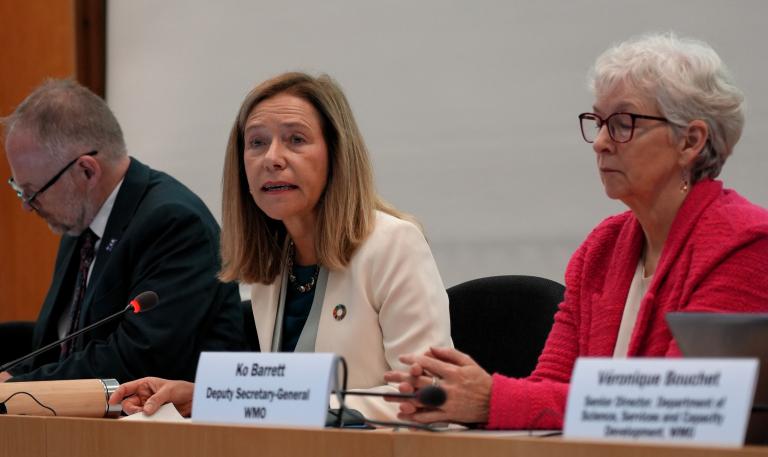
President of SERCOM, Vice-Presidents, distinguished delegates, experts, partners, colleagues from the Secretariat, ladies and gentlemen,
It is my pleasure today to welcome you and to open this fourth session of SERCOM.
We meet at a time when extreme weather and a strengthening El Niño make headline news almost every day: record-breaking heat, catastrophic floods, prolonged droughts, rapidly intensifying tropical cyclones, wildfires and dense haze, and marine heatwaves. The past eleven years have been the warmest in the 176-year observational record, and ocean heat content reached a new record high in 2025.
People do not experience these events through reports and statistics. They experience them through the loss of loved ones, flooded homes, failed harvests, disrupted supply chains, lack of water, choking air, and threats to their health and safety.
This is why SERCOM’s work is so critical. Services are the bridge between observations, research, prediction systems and infrastructure on one side, and the decisions of governments, businesses, communities and individuals on the other. SERCOM turns scientific and technical excellence into services that protect lives, livelihoods and development, and it must do so with urgency, focus and unity.
We must continue to place people at the centre of our work. We must ensure that investments in observing networks, science, data systems, numerical prediction, artificial intelligence and forecasting capabilities become practical benefits for our communities and for our planet.
This session comes at an important moment. We must align our Services Programme with WMO’s emerging strategic direction and concentrate our resources on the priorities where Members need us most.
At the same time, the ongoing discussions arising from the Joint Inspection Unit review remind us of the importance of focus, efficiency and impact across all WMO constituent bodies. Expectations continue to grow while resources remain finite. We must therefore ensure that our activities are strategically targeted, clearly aligned with Members’ needs, and deliver measurable value to those we serve.
Let me say why our normative work matters more today than at any point in our history. Today, almost anyone with open data, cloud computing and a machine-learning model can produce a global forecast, and some of these forecasts are very good. That is genuine progress, and much of it is built on observations and reanalyses that our Members have produced and shared for decades. But it changes what is scarce. The scarce thing is no longer a forecast. It is a forecast people can trust: produced to known standards, verified against observations, quality-controlled, traceable, and issued by an accountable, authoritative voice, above all when a warning must lead to action. Defining those standards, verification practices and competencies is exactly SERCOM’s job.
It is also where we began. More than 150 years ago, our predecessor, the International Meteorological Organization, was created with standardization as our founding act, and the WMO Convention names it among our core purposes. The tools have changed beyond recognition; the need has not. We must prepare for a world of many forecasters, so that our Members’ services remain the reference that governments, communities and markets rely on. This matters most in the most vulnerable regions, where trusted information makes the greatest difference.
I ask SERCOM-4 to deliver three outcomes.
- First, agree on a focused and realistic work programme for 2026–2027 and an efficient organization, aligned with Members’ priorities and available resources. As demands grow, our success will depend not only on what we choose to do, but on our ability to work differently. That means prioritizing strategically, collaborating effectively, and adapting with agility to a rapidly evolving operational and organizational environment.
- Second, continue to build a coherent framework for early warning services, combining sound regulations, practical guidance, capacity development and sustained implementation. As the Early Warnings for All initiative enters its fifth year, the focus has shifted from commitments to measurable outcomes: the communities protected, the warnings acted upon, and the lives and livelihoods saved.
- Third, embrace digital transformation to accelerate the evolution of marine, aviation and other weather- and climate-sensitive services. Advances in technology and artificial intelligence must translate into more timely, accessible and actionable information. The Technical Conference on Early Warning Services offers an opportunity to take stock of this evolution and accelerate practical delivery, and I urge you all to make full use of it.
The work done to align SERCOM and INFCOM documents provides a strong foundation. We should build on it so that infrastructure and services advance together across WMO’s technical commissions.
I also encourage you to ensure that SERCOM’s revised subsidiary structure is inclusive, efficient and equipped with the expertise needed for the next phase of delivery.
Friends and colleagues, the value of WMO science is realized when information becomes service, service becomes action, and action protects people. That way, the next record-breaking event will be met with warnings that are trusted and acted upon. Each of you has a vital role in this session: to bring expertise, define priorities, build consensus, and turn our collective decisions into results on the ground.
Thank you for your dedication to the work of WMO in the service of our Members.
Statement by