Finding Tomorrow's Earth Intelligence Leaders Today
The next generation of Earth intelligence leaders took centre stage at the 2026 Group on Earth Observations (GEO) Symposium, where young professionals, researchers, educators and senior experts came together to explore how to strengthen youth leadership in Earth observation and sustainable development.
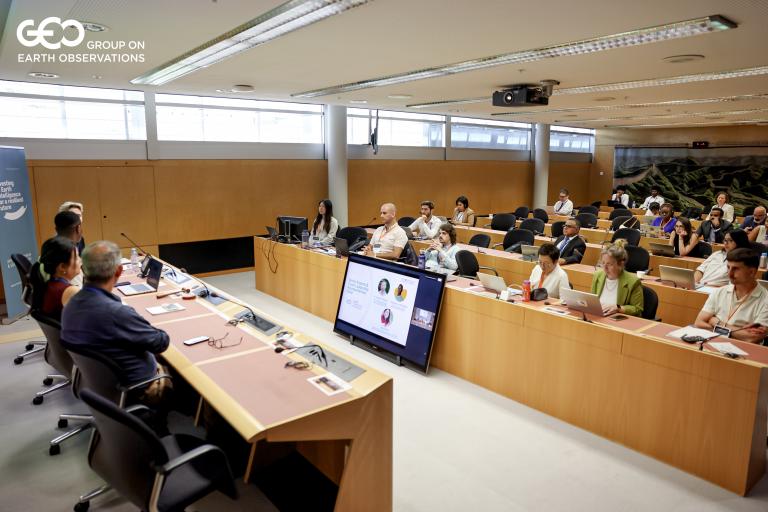
Held at World Meteorological Organization (WMO) headquarters in Geneva on 26 May, the Investing in Future Earth Intelligence Leaders community event also marked the launch of the GEO Youth Mentorship Programme and its Mentor-Mentee Matching Platform. The initiative aims to connect students and early-career professionals with experienced practitioners across the GEO community, helping them build skills, expand professional networks, and contribute to real-world challenges.
Discussions focused on how Earth intelligence, which brings together Earth observation, environmental science, artificial intelligence, data science, policy and communication, can support action on climate resilience, water sustainability, food security and ecosystem management.
Speakers also stressed that developing future leaders requires more than simply engaging young people. It means creating meaningful opportunities for them to contribute, collaborate and shape decisions.
A seat at the table
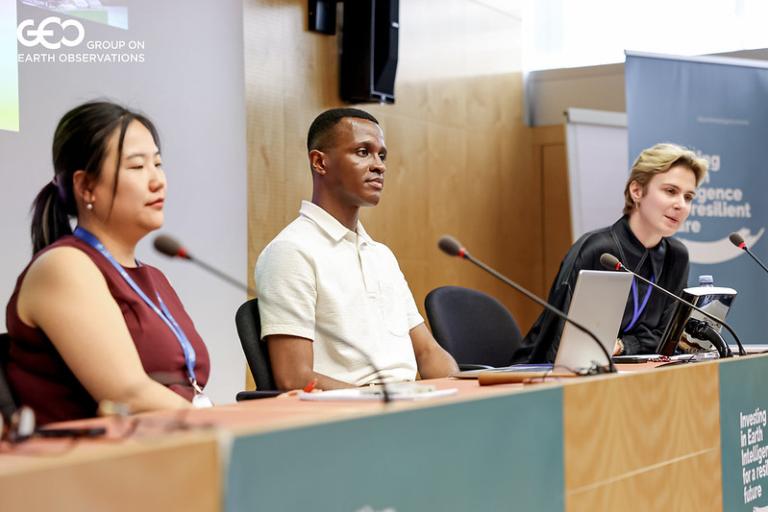
Representing WMO on the senior expert panel, Theo Wellington, WMO Youth Coordinator, highlighted why investing in young people is essential.
“If almost half of the world’s population is under 30, that is a very large group of stakeholders to ignore”.
Samuel Amos, GEO Secretariat Youth Engagement Focal Point, stressed that meaningful youth engagement requires more than simply inviting young people to participate. "There's a key difference between engaging youth and truly empowering them. Youth empowerment requires structured roles, from agenda-setting to implementation. Let’s continue advocating for youth as co-creators, not just participants.”
The discussions highlighted that young people are already making valuable contributions as scientists, researchers, communicators, and practitioners. Their perspectives and expertise can help address challenges ranging from climate change and disaster risk reduction to technological transformation.
Science, collaboration and new pathways
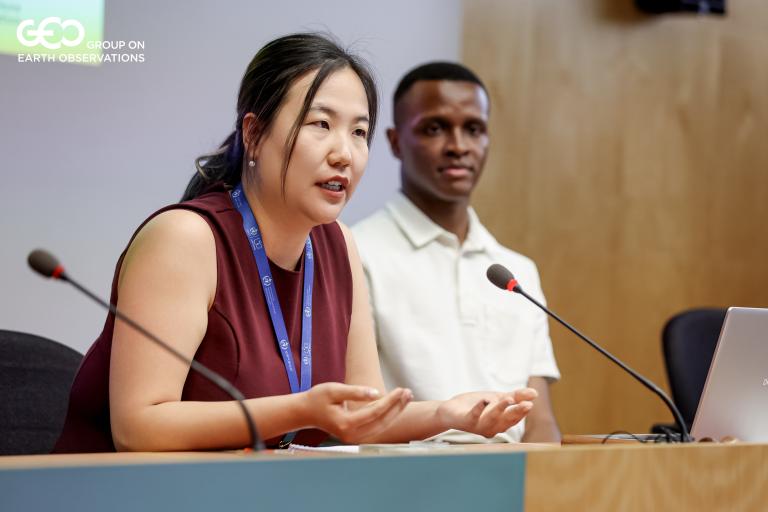
For Ran Zhang, Scientific Officer in WMO's Cryosphere Monitoring, Prediction, and Services Unit, and WMO Youth Focal Point, one of the event’s most encouraging outcomes was the level of commitment and talent shown by the next generation of scientists and professionals working on climate and environmental challenges.
“What gives me hope is the passion and sense of purpose I see in young scientists. They are dedicated to understanding our changing cryosphere, eager to keep learning, and courageous enough to pursue new opportunities and ideas. Just as importantly, they are highly collaborative and motivated by a desire to contribute to something larger than themselves."
Earth intelligence brings together fields ranging from environmental science and geospatial technologies to artificial intelligence, data science, policy and science communication. There is no single route into the field.
Marta Koch, Programme Co-Lead of the GEO Youth Community of Practice and Teaching Facilitator at Imperial College, encouraged young people not to wait until they feel fully qualified before contributing. She emphasized the value of interdisciplinary skills and focused on real-world challenges where they can make a difference.
"Whether your background is in environmental science, geospatial technologies, space security, AI, machine learning or data science, policy, science communication or community science, it is possible to start making meaningful contributions even as a student or early-career scientist or technical or policy professional. Do not wait until you feel fully qualified before contributing and focusing on scalable, real-world sustainable development challenges that matter to you."
Communities such as the WMO Youth Network and GEO Youth can help make these pathways more accessible by connecting young professionals with peers, experts, and opportunities for collaboration.
As the GEO community continues to expand its support for youth engagement, initiatives such as the GEO Youth Mentorship Programme aim to ensure that the next generation of Earth intelligence professionals has the skills, networks and opportunities to help address global challenges.
- Region:
- Region VI: Europe