

The Ozone Layer
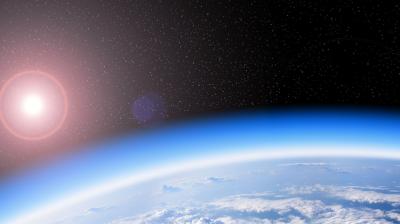
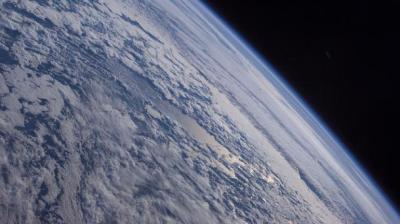
Most of the ozone present in the atmosphere resides in the stratosphere, around 10 to 50 kilometres above the Earth’s surface. This ozone layer blocks nearly all of the Sun’s dangerous ultraviolet (UV) radiation and protects life on Earth. Closer to the ground, however, ozone can be a harmful air pollutant that can affect human health, crops and ecosystems.
Overview
Ozone is a naturally occurring gas made up of three oxygen atoms (O3). Around 90% of atmospheric ozone is found in the stratosphere where it is continuously created and destroyed through natural photochemical processes and chemical reactions. Solar radiation breaks apart oxygen molecules (O2), allowing free oxygen atoms to combine with other oxygen molecules to form ozone. An ozone molecule can stay relatively long in the stratosphere before being destroyed through interactions with other molecules. It can therefore be transported over long distances by atmospheric circulation, from tropical regions, where ozone production is greatest, towards the poles.
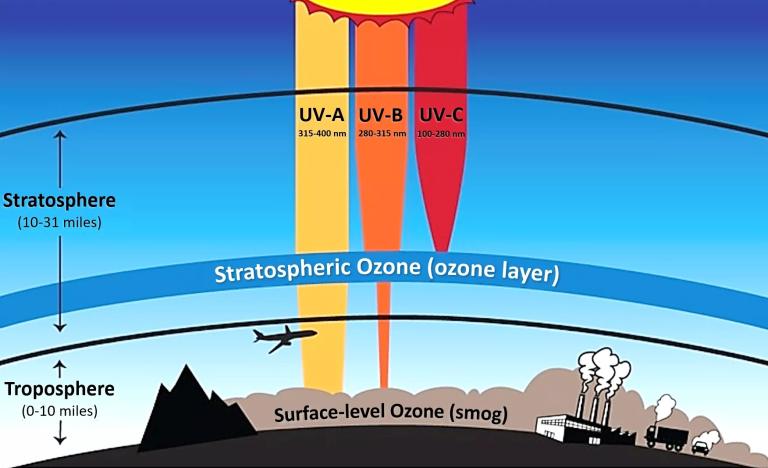
Despite its importance, the ozone layer is remarkably thin. If all the ozone in the stratosphere were brought down to the Earth’s surface, the resulting layer of pure ozone would be only approximately 3 millimetres thick. Yet, this thin layer is enough to absorb most of the Sun’s harmful ultraviolet (UV) radiation, including all UV-C radiation and most UV-B radiation. Without this protection, increased exposure to UV radiation would have serious consequences for human health, ecosystems, agriculture and biodiversity.
While the information found here relates primarily to stratospheric ozone, ozone is also naturally present in the troposphere, the lowest layer of the atmosphere. Unlike stratospheric ozone, which protects life on Earth, tropospheric ozone is a harmful air pollutant and greenhouse gas. It forms through chemical reactions between air pollutants, such as nitrogen oxides and volatile organic compounds, particularly in hot, sunny conditions. As a major component of photochemical smog, tropospheric ozone degrades air quality and affects human health. It also damages vegetation, reducing crop productivity and ecosystem resilience.
Impact
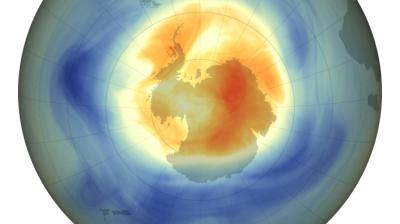
In the 1970s, scientists detected a decline in stratospheric ozone concentrations. This decline was most pronounced in the polar regions and, by the 1980s, a hole, known as the Antarctic Ozone Hole, recurred over Antarctica every year between September and November. Research demonstrated that this depletion was caused by human activities, which were increasing concentrations of chlorofluorocarbons (CFCs) and other halocarbons in the stratosphere.
These chemicals are collectively known as ozone-depleting substances (ODS). They contain chlorine and bromine, which destroy ozone by stripping away oxygen atoms from ozone molecules. A single atom of chlorine can destroy up to 100,000 ozone molecules. The accumulation of these reactions disrupts the equilibrium that maintains the ozone layer, causing ozone to be destroyed faster than it is created.
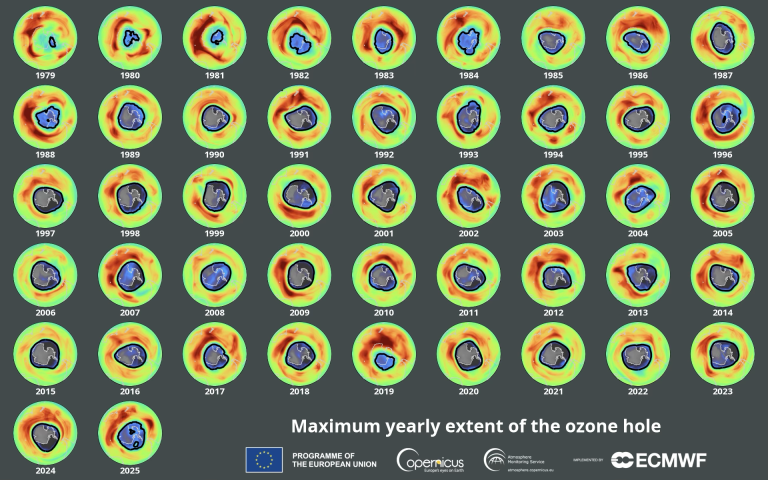
The discovery of ozone depletion raised serious concerns because depletion was not confined to the polar regions, allowing more UV radiation to reach the Earth’s surface across much of the globe. Increased UV exposure is associated with higher risks of skin cancer and cataracts, adverse effects on terrestrial and marine ecosystems and reduced agricultural productivity. These concerns drove countries to develop international treaties to address the issue collectively. The Vienna Convention for the Protection of the Ozone Layer was adopted in 1985, followed by the Montreal Protocol on Substances that Deplete the Ozone Layer in 1987. Together, these landmark agreements established a global framework for eliminating the production and consumption of ODS and are widely regarded as the most successful international environmental treaties ever implemented.
Unfortunately, the substances which replaced ODSs, Hydrofluorocarbons (HFCs), also had significant drawbacks. HFCs do not harm the ozone layer but are potent greenhouse gases. In 2016, the Kigali Amendment to the Montreal Protocol was adopted to phase down the use and production of these substances.
WMO's response
Long-term observations are essential for understanding changes in the ozone layer and assessing the effectiveness of international action. Measurements of stratospheric ozone began in the 1920s with the development of the Dobson spectrophotometer and were later complemented by Brewer spectrophotometers. These instruments have provided the consistent, high-quality observations that allow scientists to monitor ozone depletion and recovery trends over many decades. In 1957, during the International Geophysical Year, the World Meteorological Organization (WMO) established the Global Ozone Observing System to coordinate global ozone observations and promote international standards and measurement practices.
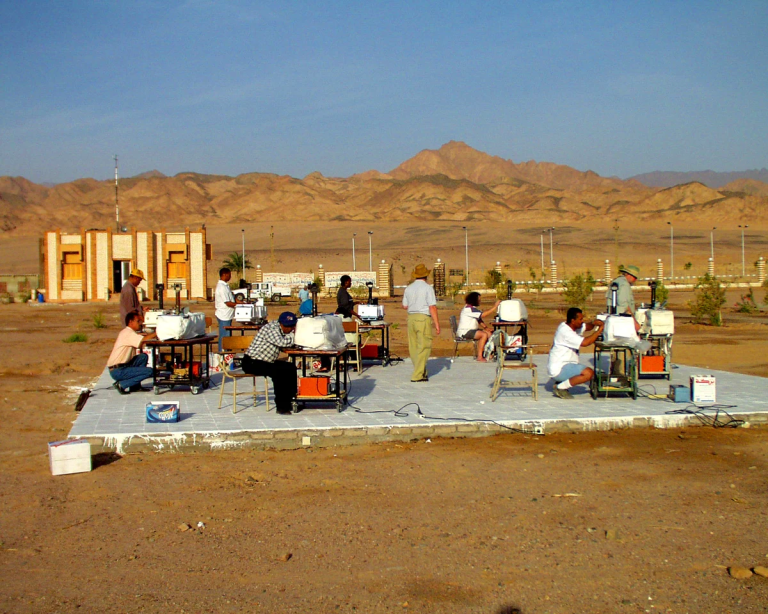
Today, through the Global Atmosphere Watch (GAW) programme, WMO coordinates a global network of ground-based observations operated by National Meteorological and Hydrological Services (NMHSs) and other partners. These observations are mainly provided by Dobson and Brewer spectrophotometers, which measure total column ozone, or the thickness of the ozone layer, and ozone soundings which collect information on the vertical distribution of ozone in the atmosphere. The ground-based observing system is complemented by satellite measurements, which help extend coverage to data-sparse regions.
This observing network operates within a quality system, internationally coordinated by WMO to ensure stratospheric ozone data is comparable, quality assured, and openly accessible. Trainings and intercomparison campaigns are regularly organized to maintain these standards across borders.
WMO also publishes the annual WMO UV and Ozone Bulletin, which provides updates on the state of the ozone layer, the Antarctic ozone hole and related scientific developments.
Thanks to collective global action under the Ozone Treaties, ODS emissions have declined substantially and the ozone layer is recovering. Continued monitoring remains essential, however, as natural events and emerging environmental pressures can influence the pace of recovery. Large volcanic eruptions, major wildfires, increases in satellite re-entries and interactions with climate change all have the potential to affect ozone levels.
Additionally, enhanced monitoring of controlled substances, particularly in under-sampled areas, is vital to better identify regional sources and verify compliance to the Montreal Protocol and its amendments. Maintaining a robust, globally coordinated observing system that meets Global Climate Observing System requirements is therefore critical for tracking future changes and supporting informed policy decisions.