The Association of the HydroMeteorological and Environmental Industry Turns 25
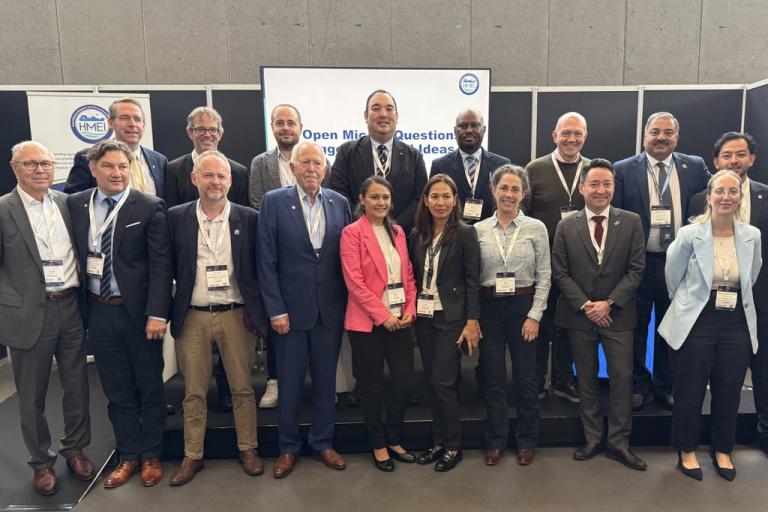
For 25 years, the Association of the HydroMeteorological and Environmental Industry (HMEI) has provided a link between the World Meteorological Organization (WMO) and the private companies that develop weather, water and climate technologies and services. Its collaboration with WMO has grown from consultation to practical work on standards, procurement, public-private engagement and emerging technologies.
A call for cooperation
In 2001, a small group of hydrometeorological equipment manufacturers met on the sidelines of the European Meteorological Society's Annual Meeting in Budapest and formally established HMEI. Its founding followed an initiative by then WMO Secretary-General Prof. G.O.P. Obasi to strengthen cooperation between WMO and the hydrometeorological equipment industry.
In January 2002, at an American Meteorological Society meeting in Florida, Prof. Obasi addressed the new Association's membership, and, in June that year, the 54th WMO Executive Council granted HMEI consultative status.
What began with roughly 12 member companies has grown into an association of more than 130 companies from over 30 countries, spanning manufacturers, software developers, and service providers across meteorology, hydrology, climate, and the wider environmental sciences. That growth tracked a deepening relationship with WMO.
Building a lasting partnership
In 2018, the WMO Executive Council (EC-70) elevated HMEI's status from “Consultative” to a formal “Working Arrangement”, one of only nine international non-governmental organizations to hold that designation with WMO.
The arrangement gave the two organizations a structured basis to collaborate on technical standards, project specifications and public-private partnerships, including the joint development, with World Bank support, of the first Generic Automatic Weather Station Tender Specifications (IOM-136), now a reference point for national meteorological services procuring observation network equipment worldwide.
That collaboration reached a new milestone in June 2024, when HMEI Chair Joshua Campbell and WMO Secretary-General Prof. Celeste Saulo signed the WMO-HMEI Code of Ethics at the EC-78 Plenary Session, formally adopted under Resolution 27 (6(2)/1). The Code sets out shared principles, including transparency, respect for the authority of National Meteorological and Hydrological Services, data sharing and safeguarding the public interest. These commitments now guide how public and private stakeholders across the weather, water, and climate enterprise engage with one another.
HMEI's collaboration with WMO also extends to two other WMO priorities, Early Warnings for All (EW4All) and artificial intelligence (AI) implementation. The Association initiated its new Digital Townhall Meetings in April 2026, opening a more direct channel between HMEI leadership and its global membership. In May 2026, HMEI also launched an AI Working Group to support the WMO Joint Advisory Group on Artificial Intelligence (JAG-AI).
Towards practical action
The past two years have brought further changes. Dr Alexander Karpov, HMEI's long-serving Executive Secretary, stepped down in August 2025. Marcus Meckelmann succeeded him in the role. Members approved a revised, more equitable four-tier membership fee structure in October 2025.
“HMEI's story has always been about turning shared priorities into practical outcomes”, said Joshua Campbell, HMEI Chair. “That's exactly where we need to keep pushing over the next 25 years. The Open Consultative Platform has given public and private actors a place to talk. Our job now is to help move it from dialogue into action-oriented partnerships: pilots, standards, and implementation pathways that create tangible value for WMO Members and for industry alike. We're focused on three things that reinforce each other: implementing AI responsibly, building lasting institutional capacity, and improving interoperability across the observing and data ecosystem, including through the Standardization of the First Mile data collection initiative. None of that works from Geneva alone. We also need to engage meaningfully with WMO Members through the Regional Associations, so the full potential of public-private engagement reaches the countries and communities that need it most”.
As HMEI marks its 25th anniversary, it is building on a long history of standards work and dialogue with a stronger focus on practical, regionally grounded partnerships. The Association is carrying that approach into its next chapter, with an emphasis on turning collaboration into concrete action for WMO Members and industry.