

Open-source Tools Help Small Services Make Better Use of Data
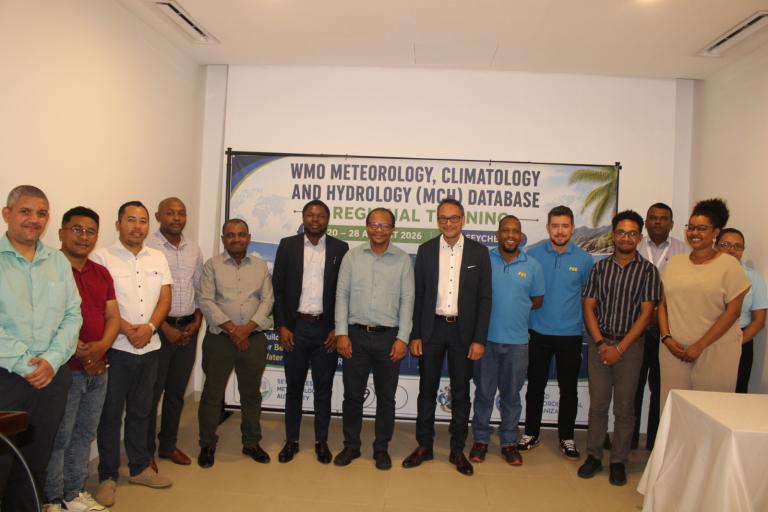
For years, some National Meteorological and Hydrological Services (NMHSs) in the South-West Indian Ocean (SWIO) had good data but lacked the tools to manage it properly. A regional training in Seychelles has helped change that, offering lessons for other small hydrometeorological services facing similar challenges.
Mohamed Bacar Mohamed Albirune knows the problem well. As IT Technical Director at Comoros' National Agency for Civil Aviation and Meteorology (ANACM), he oversees data from automatic stations, manual observers and cyclone monitoring, but none of it flows into one place. “ANACM does not currently have a standard database for the whole of its station network”, he explains. Rainfall, river level and storm data are available, but they are spread across spreadsheets, computers and paper records, making them difficult to use for decision-making.
His situation is not unusual. Many small NMHSs collect valuable data but lack a way to organize it. Commercial database systems are often too costly or too complex to maintain with limited technical staff. Without a shared system, climatologists, meteorologists and hydrologists spend too much time looking for data instead of analysing it. This also limits the services that can be provided to communities, such as early warning systems for floods and seasonal forecasts.
A free tool built for weather, climate and water data
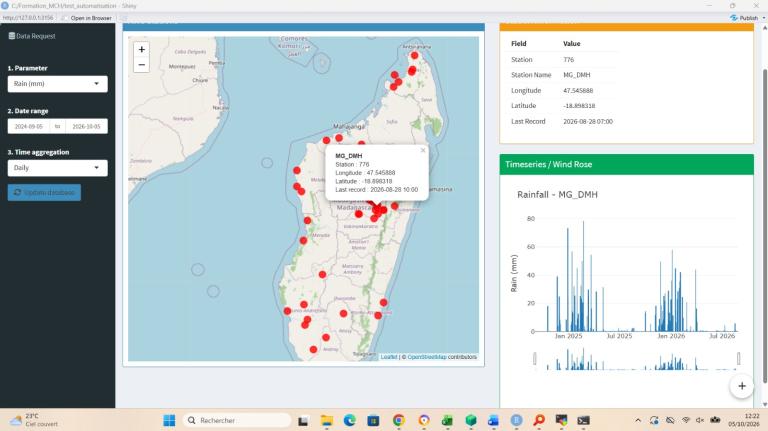
As part of the Early Warning System for Floods (EWS-F) project, the World Meteorological Organization (WMO) brought together technicians and engineers from Comoros, Madagascar, Mauritius and Seychelles for nine days in Seychelles in August 2026 to learn a different approach. MCH, short for Meteorology, Climatology and Hydrology, is a free open-source database management system built specifically for these types of data. Because it is open source, any national service can install it, adapt it and build on it without licensing costs, an important consideration for NMHSs with a limited budget.
The hands-on training, using real station data instead of generic examples, was appreciated by participants. “The trainers were flexible and attentive to participants' needs, ensuring that participants with different levels of experience could follow the training effectively”, said a climate scientist from the Seychelles Meteorological Authority. A Mauritian engineer said the system is already “excellent for managing the database and producing products that were not previously available”, including hydrological summaries and climate indicators.
Training is only the beginning
For Albirune, the workshop turned a difficult challenge into a clear plan. “This training has helped me look ahead”, he says. “I am confident that, together, we can meet these challenges”. Comoros is now preparing a small pilot project, starting with its automatic weather stations before expanding MCH to the full network.
Software alone is not enough to address data-related problems; ongoing support is essential. Participants strongly recommended mentoring sessions and the development of a regional community where users could collaboratively find solutions to their challenges.
This training is valuable beyond these four countries. Simple, open, and free data tools can only be truly useful if services have the resources and skills to continue using them. That means continued mentoring, technical support and opportunities for users to share solutions as they put the tools into practice.
- WMO Member:
- Madagascar ,
- Comoros ,
- Mauritius ,
- Seychelles
- Region:
- Region I: Africa