European State of the Climate 2025: record heatwaves from the Mediterranean to the Arctic, while glaciers shrink and snow cover declines
ECMWF and WMO report highlights impacts of climate change on people and biodiversity across the fastest-warming continent
- Heatwaves extend from the Arctic to the Mediterranean
- Sea surface temperature is highest on record
- Wildfires burnt the largest area on record.
- 70% of rivers had below-average annual flows
- Europe acts on climate and biodiversity
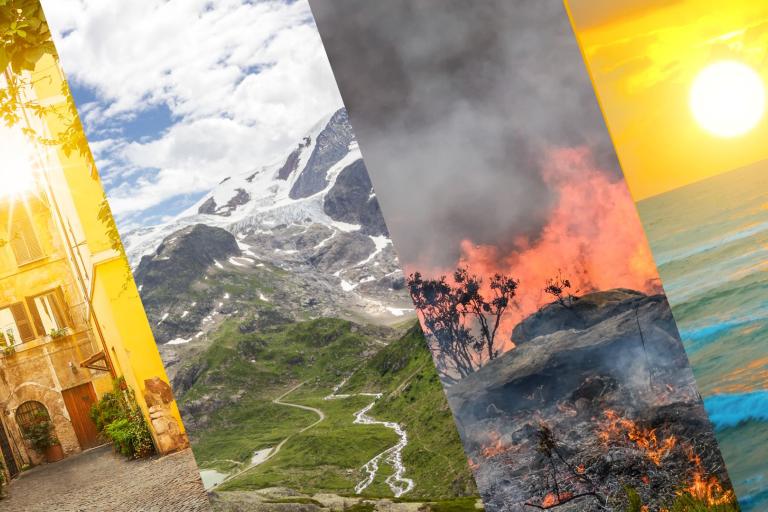
Rapid warming in Europe is reducing snow and ice cover, while dangerously high air temperatures, drought, heatwaves and record ocean temperatures are affecting regions from the Arctic to the Mediterranean. Europe, along with many other regions of the globe, is exposed to increasing impacts – from record heatwaves on land and at sea, to devastating wildfires, and continuing biodiversity loss – with consequences for societies and ecosystems across Europe.
The findings are released today within the European State of the Climate (ESOTC) 2025 report, produced by the European Centre for Medium-Range Weather Forecasts (ECMWF), which implements the Copernicus Climate Change Service, and the World Meteorological Organization (WMO). The report brings together the work of around 100 scientific contributors and provides a comprehensive overview of key changes in climate indicators for the world’s fastest warming continent, including cold environments, marine ecosystems, rivers and lakes, wildfire risk, and more. A wide range of graphics and visuals highlighting key findings from the data are being made available.
Report key findings
- At least 95% of Europe experienced above-average annual temperatures in 2025.
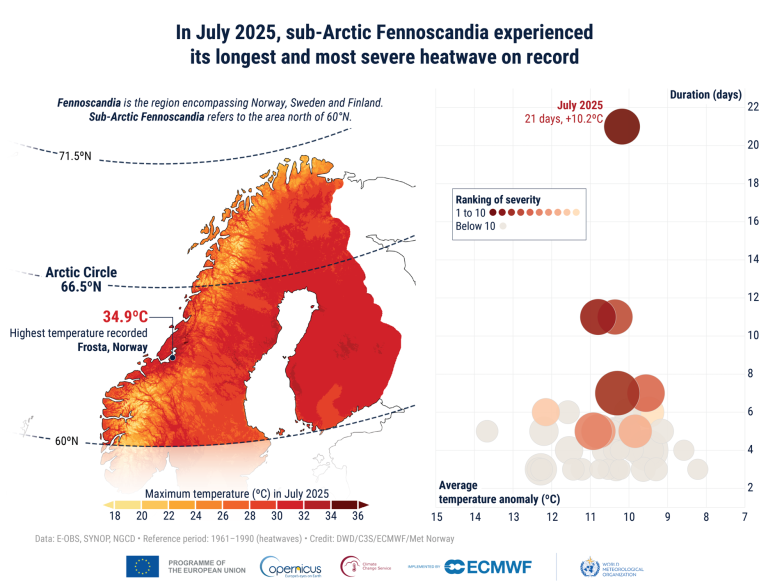
- A record three-week heatwave affected sub-Arctic Fennoscandia, with temperatures near to and within the Arctic Circle exceeding 30°C.
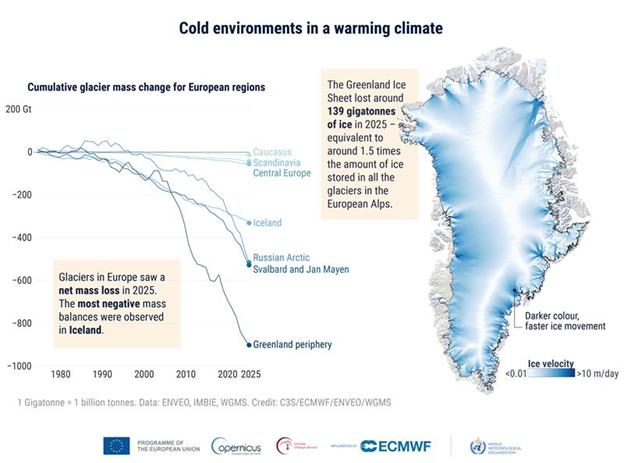
- Glaciers in all European regions saw a net mass loss, with Iceland recording its second-largest glacier loss on record; snow cover was 31% below average; the Greenland Ice Sheet lost 139 gigatonnes (139 billion tonnes) of ice.
- The annual sea surface temperature for the European region was the highest on record, and 86% of the region experienced at least ‘strong’ marine heatwaves.
- Wildfires burnt around 1,034,550 hectares, the largest area on record.
- River flows were below average for 11 months of the year across Europe, with 70% of rivers seeing below-average annual flows.
- Storms and flooding affected thousands across Europe, though extreme rainfall and flooding were less widespread than in recent years.
- Renewables supplied nearly half (46.4%) of Europe’s electricity in 2025, with solar power reaching a new contribution record of 12.5%.
- Biodiversity is vital for a sustainable future, but climate change is a major cause of its degradation. Climate change and biodiversity are strongly connected within European policy and frameworks.
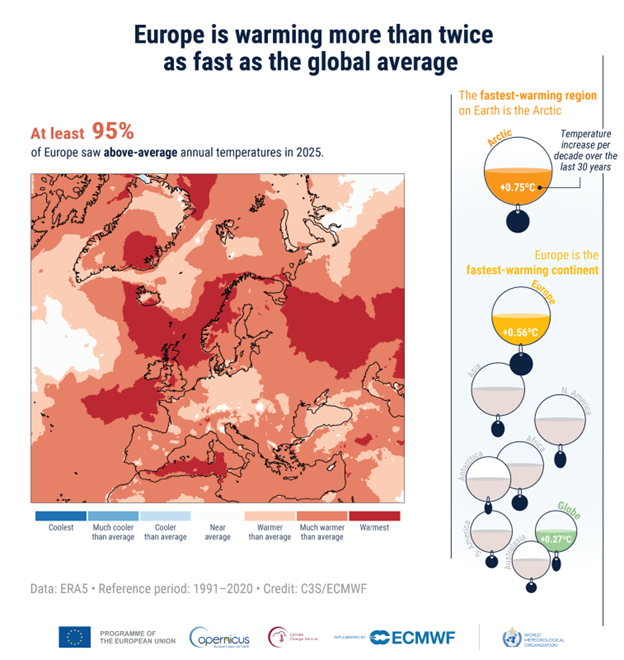
Florian Pappenberger, Director-General of the European Centre for Medium-Range Weather Forecasts, said: “Europe is the fastest-warming continent, and the impacts are already severe. Almost the whole region has seen above-average annual temperatures. In 2025, sub‑Arctic Norway, Sweden and Finland recorded their worst heatwave on record with 21 straight days and temperatures exceeding 30°C within the Arctic Circle itself. The 2025 report offers clear, actionable insights to support policy decisions and help the public better understand the changing climate we live in”.
Celeste Saulo, Secretary-General of the World Meteorological Organization, said: “The WMO State of the Climate has revealed the imbalance of energy on our planet, and the European State of the Climate produced jointly by WMO and ECMWF reflects the impacts for Europe. Our joint effort to produce the ESOTC reflects how climate change is impacting biodiversity and the bold initiatives taken by European policy makers to protect and restore it.”
Rapid changes impact Europe’s colder regions
The report shows a continuing trend of rapid warming across Europe’s coldest regions –including in the Arctic and the Alps, where snow and ice play a critical role in slowing climate change by reflecting sunlight back into space (the albedo effect).
At least 95% of Europe experienced above-average annual temperatures in 2025, while the area of Europe experiencing winter days with freezing temperatures is shrinking. Sub-Arctic Fennoscandia saw its longest heatwave on record in July, spanning three weeks. During that period, temperatures close to and within the Arctic Circle reached and exceeded 30°C, peaking at 34.9°C in Frosta, Norway. Meanwhile, Europe as a whole saw a record low number of cold stress days, with 90% of the continent experiencing fewer days than average with at least ‘strong’ cold stress. Minimum temperatures remained above average for most of the year.
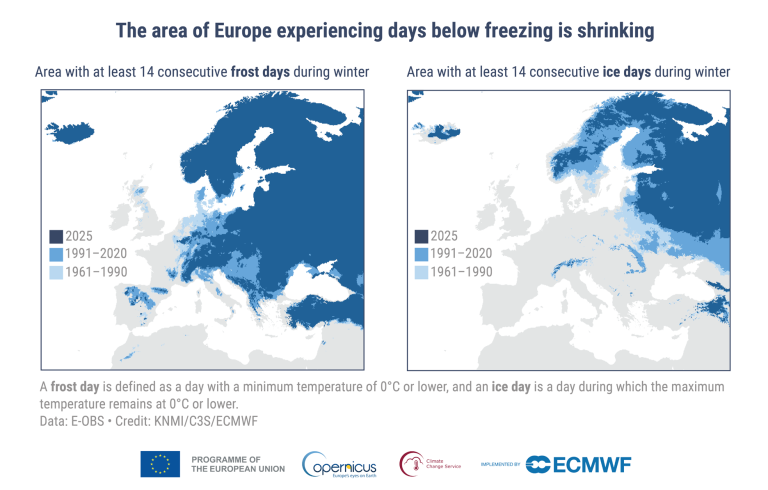
Above-average temperature and below-average precipitation led to a significant loss of snow and ice cover. In March 2025, the snow-covered area in Europe was about 1.32 million square kilometres (31%) below average – equivalent to the combined area of France, Italy, Germany, Switzerland, and Austria. This marked the third lowest snow extent since records began in 1983. Glaciers also experienced a net mass loss, with Iceland recording its second-largest glacier mass loss on record. Additionally, the Greenland Ice Sheet lost 139 gigatonnes (139 billion tonnes) of ice – around 1.5 times the volume stored in all glaciers in the European Alps. This ice loss contributes to rising global sea levels, with every centimetre increase exposing an additional 6 million people to coastal flooding.
Samantha Burgess, Strategic Lead for Climate at ECMWF, said: “The ESOTC 2025 paints a stark picture: the pace of climate change demands more urgent action. With rising temperatures, and widespread wildfires and drought, the evidence is unequivocal; climate change is not a future threat, it is our present reality. In confronting the impact on biodiversity loss, we need to match the speed of adaptation happening in the clean energy transition and at the same time, ensure robust science continues to underpin our policies and decisions.”
Record marine heat and ocean warming
The global ocean has absorbed about 90% of the excess heat caused by human-induced greenhouse gas emissions. In 2025, the European ocean region experienced its highest annual sea surface temperature on record, marking the fourth consecutive year of record warmth. This long-term trend negatively affects biodiversity, species, and habitats. Marine heatwaves can also coincide with heatwaves over land – contributing to more extreme temperatures and humidity, including overnight, which can slow people’s recovery from heat stress and disrupt sleep.
Marine heatwaves were widespread in 2025, affecting 86% of Europe’s ocean region. They were also more intense, with 36% of the region experiencing ‘severe’ or ‘extreme’ conditions – the highest proportion on record.
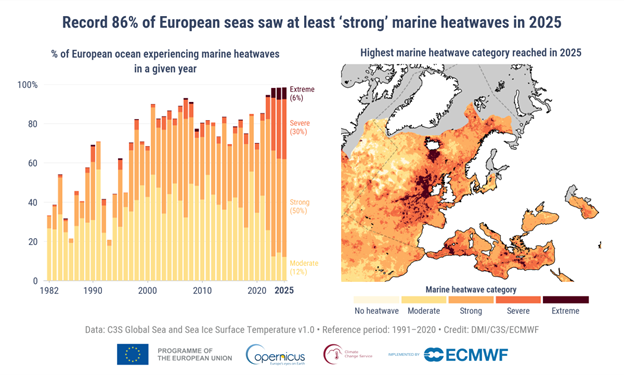
The entire Mediterranean Sea has experienced at least one day with ‘strong’ marine heatwave conditions in each of the past three years, and in 2025 the annual average sea surface temperature was the second highest ever observed. ‘Severe’ marine heatwave conditions also occurred in the Norwegian Sea – which spans northern Europe and the Arctic – coinciding with the record heatwave over sub-Arctic Fennoscandia and highlighting the geographical spread of ocean warming across Europe.
Mauro Facchini, Head of Copernicus Unit at the European Commission, said: “The European State of the Climate 2025 report demonstrates once more the value of our joint efforts to have a world-class European Earth observation system. Maintaining our own state-of-the-art, reliable data records of our Earth system is vital for making informed policy decisions in our rapidly changing climate. Copernicus is pivotal to help us preserve our sovereignty, our environment, food systems, safety, and economy.”
Climate conditions place pressure on Europe’s water¨
Across Europe, around 70% of rivers experienced below-average flows, while it was one of the three driest years for soil moisture since 1992. In May, around half of Europe (53%) was affected by drought conditions. These patterns reflect a combination of factors including atmospheric circulation and rainfall variability, alongside longer-term climate trends.
Dušan Chrenek, Principal Adviser for Digital Green Transition at DG Clima, said: “The climate change signal remains unequivocal across Europe, and the European State of the Climate 2025 report is a stark reminder that we must sustain and accelerate both adaptation and mitigation efforts. This edition provides compelling evidence of the profound impacts of climate change on intensity of extreme weather events, biodiversity and economy, while reinforcing Europe’s strategic ambition to further strengthen its Earth observation capabilities by harnessing cutting-edge technologies.”
Increasing temperatures and intensifying wildfires
Across Europe, 2025 saw widespread warm conditions – with above-average temperatures recorded across at least 95% of the continent. Heatwaves affected large parts of Europe, from the Mediterranean to the Arctic, including Europe’s second most severe heatwave on record and sub-Arctic Fennoscandia’s longest and most severe heatwave, in July. Much of Europe also experienced more days than average with at least ‘strong’ heat stress, with southern and eastern Spain recording up to 50 more days than average with ‘feels-like’ temperatures above 32ºC.
Hot and dry conditions contributed to record wildfire activity across Europe. In total, a record area of around 1,034,000 hectares burnt across Europe – an area larger than Cyprus – with wildfire emissions reaching their highest levels on record. Spain was particularly severely impacted and accounted for around half of the emissions. Alongside Spain, Cyprus, the United Kingdom, the Netherlands, and Germany recorded their highest wildfire emissions on record. Wildfires also pose a significant risk to biodiversity and peatland wildfires can release large stores of carbon, further amplifying climate change. The European Commission has identified rising wildfire risk as a key priority, as projections by the Intergovernmental Panel on Climate Change’s Sixth Assessment Report show that wildfire threats are likely to increase across all regions of Europe.
Climate impacts increasingly affecting biodiversity
Numerous extreme events in 2025 – including drought, wildfires, and land and marine heatwaves – impacted biodiversity in marine and terrestrial ecosystems. Additionally, nature is under increased stress due to shrinking and shifting habitats, disruption of seasonal patterns due to warmer temperatures, and changes in precipitation. The report outlines concrete examples of climate change impacts on sensitive ecosystems, such as the impacts of marine heatwaves on seagrass meadows in the Mediterranean Sea, and peatland wildfires. Environmental governance in Europe has increasingly recognised the close links between climate and biodiversity, with coordinated ‘nature-climate’ approaches designed to strengthen ecosystem resilience.
The European Union has committed to legally binding targets to restore ecosystems at scale, including at least 20% of land and sea areas by 2030 and all ecosystems in need by 2050. This work is also underpinned by the European Green Deal and EU Climate Law, which embed biodiversity protection within wider climate strategies. Additionally, nature-based solutions such as restoring seagrass meadows are being recognised for their role in supporting biodiversity, storing carbon, and strengthening coastal resilience. While these steps represent important action, progress in Europe must accelerate to do more, and do better, to protect nature and biodiversity.
Notes to Editors

About Copernicus and ECMWF
Copernicus is the Earth observation component of the European Union’s Space programme, looking at our planet and its environment to benefit all European citizens. The programme is coordinated and managed by the European Commission and implemented in partnership with the Member States and European organisations.
The European Centre for Medium-Range Weather Forecasts (ECMWF) is both a research institute and a 24/7 operational service, producing global numerical weather predictions and other data for our Member and Co-operating States and the broader community. It operates a world-class supercomputer facility for weather forecasting and holds one of the largest meteorological data archives.
ECMWF is a key player in Copernicus, the Earth Observation component of the European Union’s Space programme, by implementing quality-assured information on climate change (Copernicus Climate Change Service), atmospheric composition (Copernicus Atmosphere Monitoring Service), and contributing to information on flooding and fire danger (Copernicus Emergency Management Service). Together with ESA and EUMETSAT, ECMWF also delivers the EU’s Destination Earth initiative, which is developing prototype digital twins of the Earth.
More information on Copernicus and ECMWF
Bluesky: @copernicusecmwf.bsky.social @ecmwf.bsky.social
Instagram: @Copernicusecmwf @Copernicus_eu @ecmwf.official
LinkedIn: @CopernicusECMWF
About WMO
WMO is the United Nations system's authoritative voice on the state and behaviour of the Earth's atmosphere, its interaction with the land and oceans, the weather and climate it produces and the resulting distribution of water resources.
As weather, climate and the water cycle know no national boundaries, international cooperation at a global scale is essential for the development of meteorology and operational hydrology as well as to reap the benefits from their application. WMO provides the framework for such international cooperation for its 193 Member States and Territories.
WMO’s mandate relates to the areas of meteorology (weather and climate), operational hydrology and related geophysical sciences. WMO has a powerful role in contributing to the safety and welfare of humanity by fostering collaboration between its Members' National Meteorological and Hydrological Services (NMHSs) and advancing the application of meteorology and hydrology in many societal and economic areas.
WMO regulates and facilitates free and unrestricted exchange of data and information, products, and services in real- or near-real time. This is critical for applications relating to the safety and security of society, social and economic welfare, and the protection of the environment. WMO standards and policies contribute to policy formulation in these areas at national and regional levels.
The Organization plays a leading role in international efforts to monitor and protect the climate and the environment. In collaboration with other UN agencies and NMHSs, WMO supports the implementation of UNFCCC and a number of environmental conventions and is instrumental in providing advice and assessments to governments on related matters. These activities contribute towards ensuring the sustainable development and well-being of nations.
Media contacts
ECMWF/Copernicus media relations team
European Centre for Medium-Range Weather Forecasts (ECMWF)
Reading, UK | Bologna, Italy | Bonn, Germany
Email: copernicus-press ecmwf [dot] int (copernicus-press[at]ecmwf[dot]int)
World Meteorological Organization (WMO)
Clare Nullis, Media Officer and Spokesperson,
Geneva, Switzerland
Email: cnulliswmo [dot] int (cnullis[at]wmo[dot]int)
Mobile: +41 79 709 13 97
The World Meteorological Organization is the United Nations System’s authoritative voice on Weather, Climate and Water.
For further information, please contact:
- Clare Nullis WMO media officer cnullis@wmo.int +41 79 709 13 97
- Global Communication and Engagement Media Contact media@wmo.int
- Region:
- Region VI: Europe