

From Global Ambition into National Action: Take Aways from 35 EW4All Roadmaps
Introduction
More than 50 countries are advancing the rollout of the EW4All initiative, taking steps towards universal coverage of multi-hazard early warning systems (MHEWS).
A central feature of this progress has been the development of national MHEWS roadmaps. The roadmaps bring together the findings of national MHEWS assessments, helping to identify key gaps and priorities across the four MHEWS pillars and critical inter-pillar elements. These priorities are then translated into costed, time-bound actions for implementation. This sets out the national vision for universal coverage.
WMO projects have supported this process where needed by helping to fund national assessments, convene stakeholders, and facilitate roadmap development and validation, while also mobilizing technical assistance and investment for implementation.
Across the more than 50 countries rolling out EW4All, implementation is progressing at different stages from roadmap development, to national validation, and finally to full implementation. WMO has analysed 35 government-validated MHEWS roadmaps, showing how global ambition is translating into national action.
Key findings
The 35 countries included in the analysis represent approximately 960 million people, including 339 million children (ages 0-14) and 128 million youth (ages 18-24). This represents a significant portion of the global population across 5 geographical regions, covering some of the areas most vulnerable to the impacts of climate change, from Fragile and Conflict-affected Situations (FCVs) to Small Island Developing States (SIDS), and Least Developed Countries (LDCs).
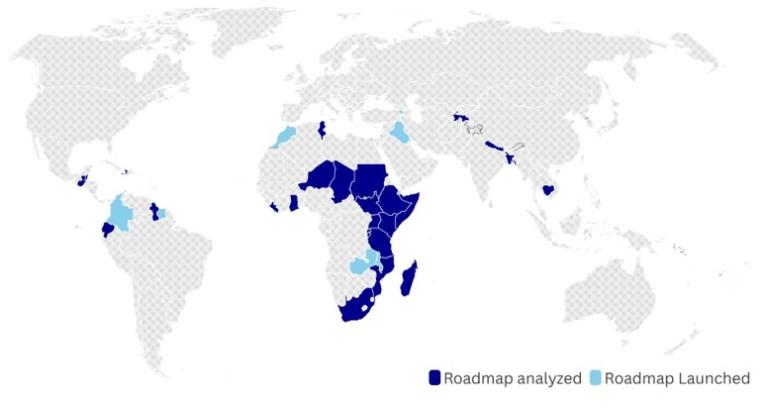
Figure 1. 50 countries that have launched the EW4All Roadmap with support from WMO and the 35 roadmaps analyzed. Source: WMO, 13 August 2026.
This reach is significant not only in terms of the number of countries and people covered, but also because EW4All is deemed contextually relevant across diverse national contexts, including settings where the various contexts where the institutional, technical, and financial capacity to establish and sustain EWS varies considerably.
- Delivering EW4All requires substantial, sustained, and coordinated investment
The roadmaps make it clear that achieving EW4All requires investment across the entire value cycle, including investments in key inter-pillar elements, such as governance, coordination, institutional strengthening, monitoring and evaluation, data and information sharing, among others. This points towards a more integrated approach.
Among the 20 roadmaps that provided clear budget allocations, the total identified investment requirement amounted to approximately USD 1.38 billion, equivalent to an average of USD 69 million per country. While the investment needs and priorities vary considerably across countries, the overall scale and degree of integrated effort demonstrate that MHEWS cannot be achieved through fragmented, short-term interventions alone.
Not all countries have the same needs. However, there is evidence that there are greater needs in LDCs, SIDS, and FCV contexts. LDCs often face significant foundational and system-building needs; FCV contexts may require particularly strong investment in preparedness, response, and continuity of services; SIDS budget requirements cover the whole value cycle; while middle-income countries increasingly focus on modernization, innovation, and strengthening existing systems.
- National ownership is a defining strength
A strong feature across the roadmaps is their national ownership and alignment with existing national priorities and frameworks.
Roadmaps are developed and validated through national processes and are endorsed at high political levels, including by Presidents and Prime Ministers, Cabinets and Councils of Ministers, and relevant Ministers. In many countries, endorsement extends across multiple ministries, reflecting the inherently inter-sectoral nature of MHEWS.
The roadmaps are also being connected to wider national commitments, including Sendai Framework commitments, National Risk Management Polices, National Adaptation Plans, Nationally Determined Contributions, and Sustainable Development Goals. Regional mechanisms provide an additional layer of alignment.
Accordingly, findings show the broad range of national implementation actors, including National Meteorological and Hydrological Services and National Disaster Management Authorities, ICT ministries and regulators, telecommunication operators, sectoral line ministries, private sector, civil society, and local communities.
This national ownership creates a strong foundation for implementation and provides partners with a clear framework through which external support can be aligned with nationally identified priorities.
- A multi-hazard approach is driving broader collaboration
The range of hazard prioritization demonstrates the comprehensive approach promoted and the importance of collaboration. Sixteen different hazards are prioritized in the roadmaps analysed, including hydrometeorological hazards such as floods, drought and storms; geological hazards such as earthquakes; and non-natural hazards such as terrorism and technological hazards. This breadth shows how the roadmap framework can enable countries to identify and plan around principal hazards, while bringing together and engaging the relevant sectors, disciplines, and institutions in partnerships around a common framework for coordinated action. The findings reinforce the importance of investing in comprehensive MHEWS, broadening the tent of partners, and strengthening collaboration across the entire value cycle. EW4All is helping foster these partnerships and creating the frameworks for sustained and strengthened joint action. Such collaborations often require years to reach full maturity and must occur at local, national, regional, and global levels to be truly effective.
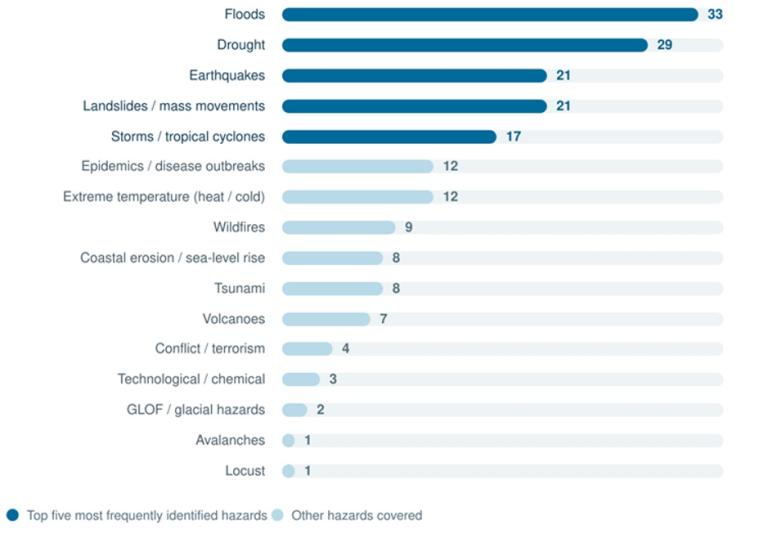
Figure 2. Hazards identified from 35 analysed EW4All Roadmaps and their frequency. Source: WMO, 13 August 2026.
- Roadmaps reveal a clear opportunity to align and scale support around national priorities
The analysis suggests that the next challenge is not a lack of identified priorities. Rather, it is ensuring that the significant needs identified through national processes are matched with coordinated technical assistance, predictable financing, and implementation partnerships.
The roadmaps and other existing national strategies can therefore serve as a common reference point for moving from individual projects towards complementary, sequenced and longer-term investment programmes, while maintaining national leadership and avoiding duplication and fragmentation.
In addition, the roadmaps show that there is a rich mix of existing, planned, and potential external partners and financing sources, including the United Nations (UN), international intergovernmental organizations (IGOs), multilateral development banks (MDBs), regional bodies and mechanisms, bilateral donors, and global funding instruments such as the Climate Risk and Early Warning Systems (CREWS) initiative, the Systematic Observations Financing Facility (SOFF), and the Green Climate Fund (GCF). The roadmaps can help bring these efforts together and foster greater coordination among partners.
Regional Framing
National EW4All roadmaps are reinforced by regional and subregional political commitments, strategies and programmes that foster cooperation, align priorities and support implementation.
In Africa , EW4All implementation is guided by the regional roadmap and builds on existing frameworks, including the Multi-Hazard Early Warning and Early Action Plan for Africa, the African Ministerial Conference on Meteorology (AMCOMET) Strategy on Meteorology, and the Africa Multi-Hazard Early Warning and Early Action System (AMHEWAS). Sub-regional frameworks through the continent’s economic communities, including ECOWAS, ECCAS, and SADC also aid in strengthening the efforts of states in building early warning systems.
In the Americas, the WMO Regional Association III (South America) Action Plan provides a framework for advancing EW4All priorities, while countries in the Caribbean are guided by the Strategic Roadmap for Advancing Multi-hazard Impact-based Early Warning Systems and Services, agreed in 2021.
Across Asia and the South-West Pacific, the Regional Strategy to Achieve EW4All by 2027, adopted in 2023 by the United Nations Economic and Social Commission for Asia and the Pacific (ESCAP), provides a common framework for regional action. EW4All priorities, particularly those related to Pillar 2, are also integrated into the work programmes of WMO Regional Associations II (Asia) and V (South-West Pacific).
In Southeast Asia, efforts are underway to develop an EW4All regional roadmap for the Association of Southeast Asian Nations (ASEAN), aligned with the ASEAN Agreement on Disaster Management and Emergency Response (AADMER) Work Programme 2026–2030. This work builds on a regional assessment of multi-hazard early warning systems and complements the ASEAN Anticipatory Action Framework. In Central Asia, countries are advancing regional cooperation on early warning systems and have called for international support to establish a regional early warning mechanism.
In the Pacific, regional efforts are aligned with the 2050 Strategy for the Blue Pacific Continent, the Framework for Resilient Development in the Pacific, and the Pacific Islands Meteorological Strategy. The Weather Ready Pacific (WRP) Programme provides an important regional mechanism for strengthening meteorological and early warning services and advancing EW4All implementation across Pacific Island countries and territories.
In Europe, EW4All objectives are supported by established regional cooperation and disaster risk management frameworks, including the European Union Disaster Resilience Goals, which emphasize strengthening risk assessment, preparedness, early warning and response capacities.
Conclusion
The EW4All roadmaps demonstrate significant progress in translating a global commitment into nationally owned, integrated, and actionable pathways for strengthening early warning systems. They reach countries across most regions and development contexts, address a broad range of hazards, and bring together the technical, institutional, and financial dimensions required for effective MHEWS.
The foundations are in place, now they must be delivered. EW4All has made significant progress in establishing integrated, end-to-end national strategies. The next phase requires scaled up and coordinated technical, operational, and financial support to translate these plans into lasting capacity and tangible protection for people at risk.
The opportunity now is to use the roadmaps as a common framework: aligning partners and financing behind nationally identified priorities, strengthening collaboration across sectors and institutions, and supporting countries to move from plans to implementation.
Success of the EW4All will not be measured in the number of roadmaps, but their translation into timely, accessible, and actionable warnings that reach everyone, especially the most vulnerable. Sustaining the political commitment, mobilization of resources, and technical support to accelerate implementation will be critical going forward.
Footnotes:
- Project-supported countries: Chad, The Gambia, Mozambique, Sao Tome and Principe, Uganda, Tanzania, South Sudan, Bangladesh, Cambodia, DPR Lao, Haiti, Niger, Belize, Guyana, among others
The 35 countries of this analysis include: Antigua and Barbuda, Bangladesh, Barbados, Belize, Burundi, Cambodia, Chad, Ecuador, Ethiopia, Gambia, Ghana, Guatemala, Guyana, Haiti, Kenya, Lao PDR, Liberia, Madagascar, Maldives, Mozambique, Nepal, Niger, Rwanda, Samoa, São Tomé and Príncipe, Seychelles, Solomon Islands, Somalia, South Africa, South Sudan, Sudan, Tajikistan, Tanzania, Tunisia, and Uganda.