From dialogue to action-oriented partnerships: OCP-HL-7 report now available
- Author(s):
- Private Sector and Philanthropic Engagement (PSPE) Unit
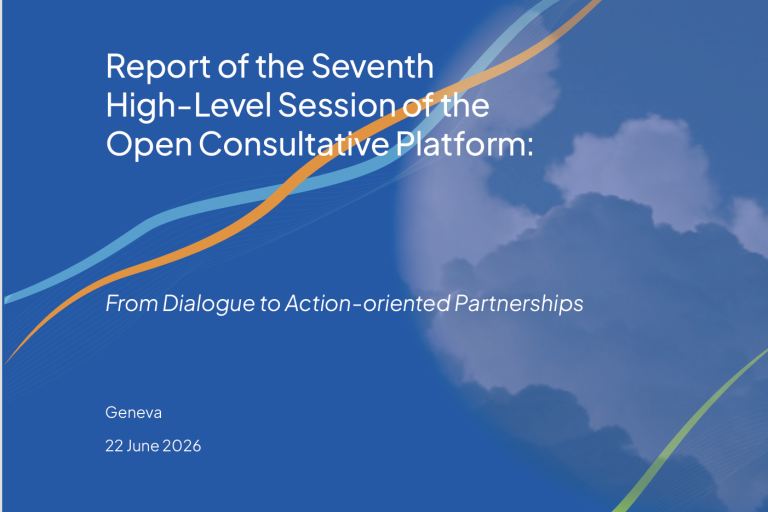
Following our OCP-HL-7 announcement “WMO marks a new chapter in public-private engagement”, WMO has published the report of the Seventh High-Level Session of the Open Consultative Platform (OCP-HL-7), held in Geneva on 22 June 2026 in the margins of the eightieth session of the Executive Council.
About the report
The report combines the pre-session survey results with the discussions held around six World Café tables. It sorts each point into areas of broad alignment, differing perspectives and individual observations. In her foreword, Secretary-General Prof. Celeste Saulo describes it as “offered not as a conclusion, but as a foundation”.
The report in brief
The report combines a pre-session survey of Executive Council members and private sector organizations with the discussions held around six World Café tables. It is organized around four themes:
- Priority areas for collaboration. Observations, data sharing and infrastructure are the shared foundation. AI is recognized as an important enabler that needs appropriate governance.
- Barriers to engagement. Unclear roles and the lack of structured engagement mechanisms were the barriers most often cited. Members also differ widely in their capacity to engage with private sector actors.
- WMO’s role in facilitate Public-Private Engagement. Participants most valued WMO’s convening power, scientific authority and standard-setting mandate, and called for practical guidance on how to engage.
- Preferred engagement mechanisms. Participants favoured concrete pilot projects and a more action-oriented, regionally anchored OCP. The report records both areas of broad agreement and areas where perspectives differed. Its annexes contain the full survey results and detailed discussion points.
Conclusions
The report draws five cross-cutting conclusions:
- A shared vision must come before the design of engagement mechanisms.
- Trust is built through action.
- WMO’s added value lies in its credibility, convening power and scientific authority.
- Data governance remains an open question.
- Institutional relationships, not only personal ones, should underpin partnerships.
The report also stresses that the differing capacities of Members must shape how future mechanisms are designed.
What comes next
WMO will launch an inter-sessional process to turn the findings into recommendations. The Secretariat will consult Technical Commissions, Regional Associations and other relevant bodies, and will draw on regional and thematic engagement sessions. Recommendations will be put to Members for consideration at the Twentieth World Meteorological Congress (Cg-20) in 2027.
For more information, contact: ppe wmo [dot] int (ppe[at]wmo[dot]int)