
Radio Spectrum for Meteorology
Secretary-General of the International Telecommunication Union (ITU);
Distinguished delegates; colleagues and friends.
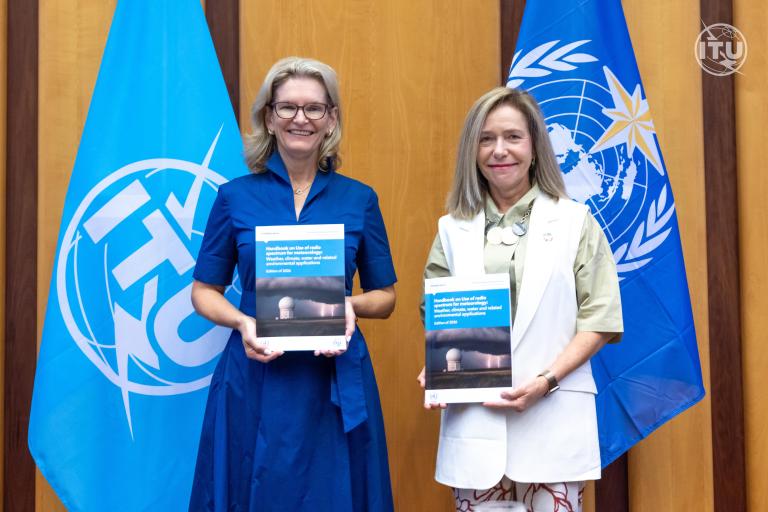
Good morning, and welcome to Geneva. It is a privilege to open this Global Seminar with you, and to launch the new joint ITU–WMO Handbook, “Use of Radio Spectrum for Meteorology: Weather, Climate, Water and related Environmental Applications”.
The radio-frequency spectrum is a finite natural resource. Meteorology depends on specific bands — determined not by choice, but by the physical properties of the atmosphere itself: they enable observations that no other frequencies can provide.
Let me give you an example.
A storm reveals itself first in the faint natural signals it emits – and in the echoes returned by the signals we send to probe it. Weather satellites, radars and sensors read those signals to detect and track the storm long before it strikes. And that depends on protected frequencies.
Excellencies,
More than half of all disasters today are weather-, climate- or water-related — and every warning against them depends on protected spectrum.
But the clouds are gathering over these warnings: Interference is working its way into the satellite measurements of sea surface temperature that drive tropical cyclone forecasts and climate records. Because the natural signal is so faint, interference too weak to detect can pass unnoticed into our weather and climate data.
Some observations, once lost, can never be recovered: their frequencies are fixed by the laws of physics.
So let me be clear about what we propose.
Our position paper on the World Radiocommunication Conference 2027 agenda sets out the priorities of the meteorological community. That is a shared responsibility: of WMO, of ITU, and of every administration represented here.
As we move towards the World Radiocommunication Conference 2027 and beyond, WMO and ITU will deepen our partnership.
We need to ensure that technical studies fully reflect the meteorological and Earth-observation bands, and — through seminars like this one — provide support to meteorological requirements in national positions.
Protecting this spectrum is in every country's own interest — as the WMO position paper shows, agenda item by agenda item.
ITU’s own membership has twice affirmed the value of this spectrum — in Resolutions 673 and 675. Let us now turn that principle into protection.
The Handbook we launch today puts this into action. It sets out the frequencies our observing systems rely on, why they must be protected, and how to guard them against interference.
As we prepare for World Radiocommunication Conference 2027, I encourage you to use this handbook — and, within each country, to bring your meteorological and radiocommunication communities closer together.
Spectrum knows no borders. We cannot see it — but we see its value every day, in every forecast and every warning.
Protect the spectrum that lets us observe the atmosphere, and we protect lives.
I thank you.
Statement by