
Using Probabilities to Improve Tropical Cyclone Preparedness
When Typhoon Haiyan struck the Philippines in 2013, killing more than 6,000 people, it laid bare a painful gap: forecasters could model a storm's likely path, but translating that into timely, actionable guidance for specific coastal communities remained out of reach. More than a decade later, that gap is narrowing but unevenly, and not nearly fast enough.
In May 2026, the World Weather Research Programme convened a global online workshop on tropical cyclone probabilistic forecasting. The event drew nearly 700 registrations from more than 80 countries, a strong signal that the community recognises the urgency. What it found was a field in transition: the science is strong, but its translation into operational and public-facing tools remains challenging.
Are forecasts reaching the people?
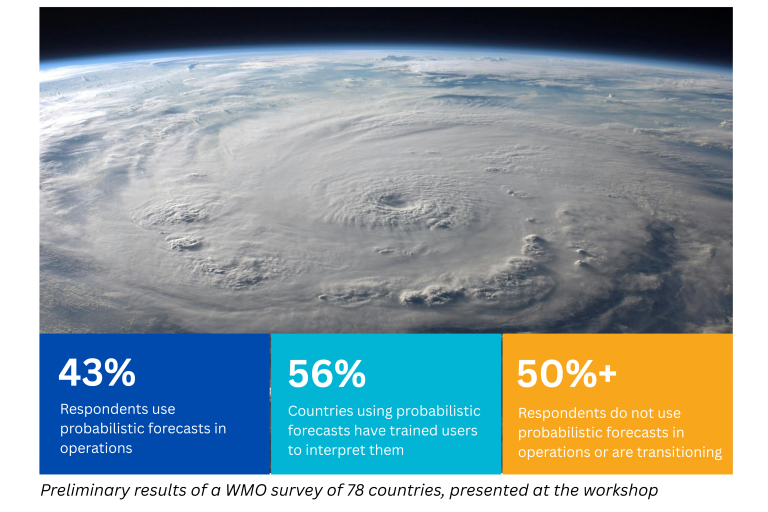
Preliminary results of a WMO survey of 78 countries, presented at the workshop, found that only 43% of respondents currently use probabilistic forecasts in operations. More than half are either not using them at all, or still in transition. The barrier is rarely technology alone but rather the training, communication, and the challenging work of making uncertainty useful. As per the survey, only 56% of countries already using these products have trained users to interpret them, and fewer than half incorporate uncertainty information in public warnings.
Decisions that can save lives
The workshop made clear that the same probabilistic information can serve very different purposes depending on who is using it. In Western Australia, offshore oil and gas operators use probabilistic wind and sea-state guidance to decide when to de-staff platforms or move vessels. In these cases, even a low-probability, high-impact scenario can justify a multi-million-dollar safety decision. Emergency services, by contrast, use this information to focus on public safety concerns such as when the earliest destructive winds could reach a community.
The Philippines' meteorological agency PAGASA offers one of the clearest examples of this user-centred approach in practice, having transitioned to probabilistic storm surge forecasts paired with impact matrices that help local governments understand which areas may flood and when, directly addressing the gap exposed by Haiyan.
The role of AI
AI-based weather models are adding new capabilities at speed. The Hong Kong Observatory cut tropical cyclone track forecast errors by more than 30% at four- and five-day lead times after introducing AI guidance operationally in 2025.
However, more information does not automatically mean better decisions. For instance, thousand-member ensembles can produce more uncertainty than any forecaster can easily process, and the "black box" nature of AI models makes forecast changes harder to explain. Moreover, for smaller national meteorological services, rapid technological progress risks widening existing capacity gaps. It was noted that AI makes human expertise more important, not less. Forecasters still need to judge model output, translate uncertainty into actionable guidance, and communicate clearly with disaster managers, skills that must be cultivated across all services, not just the best-resourced ones.
How WWRP is engaging?
The workshop was organised by WWRP's Working Group on Tropical Meteorology Research (WGTMR), in conjunction with the Working Group on Predictability, Dynamics and Ensemble Forecasting (PDEF). It reflects WWRP's core mandate bridging scientific advances in weather research with operational and societal impact.
The WG TMR’s mandate is to advance research on tropical weather systems and accelerate the uptake of that science into forecasting operations, with a particular focus on the high-impact regions most exposed to tropical cyclone risk. The WG PDEF aims to improve weather forecast accuracy by advancing dynamical meteorology and predictability research, helping turn scientific insights into operational tools that better capture and communicate forecast uncertainty. By convening scientists, operational meteorologists, emergency managers and early career researchers, these groups work to close the gap between what science can produce and what communities on the ground receive.
Participants called for hands-on training, multilingual e-learning, and peer-to-peer mentoring between services facing similar hazards. The kinds of activities that WWRP is well places to coordinate across its international network.