

WIS2 Operational Newsletter (No.3)
WIS2 Operational Newsletter (Issue-No.3)
This newsletter includes the following four updates:
1. WIS2 implementation progress overview
2. New WIS2 downloader now available (Version: v1.0.0b1+rc4)
3. WIS2 cookbook 2nd release (Version: 1.1.0)
4. Recent amendments to publications adopted through the WMO fast-track approval procedures
1. WIS2 implementation progress overview
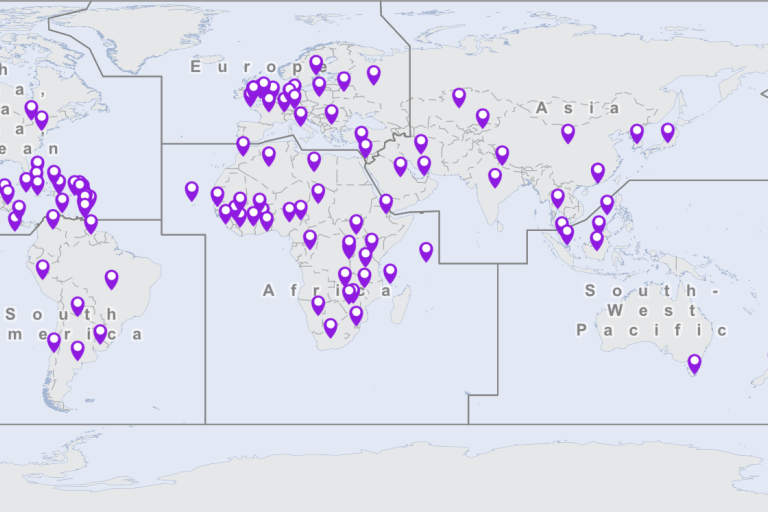
As of 30 June 2026, there are 116 operational WIS2 nodes, representing 92 WMO Members, indicating that 48% of WMO Members have now implemented WIS2 for data sharing. This reflects continued global expansion following the pilot phase (2022-2023), pre-operational phase (2024), and the operational rollout starting January 2025.
Since the last WIS2 operational newsletter (2025-No.2), 21 new WIS2 nodes have been declared operational (see Fig1 and table 2). These include:
- Nodes associated with 14 existing NCs
- Nodes associated with 3 existing DCPCs and 4 new DCPCs
WIS2 Implementation continues to be largely supported by the wis2box-software, which is used by 89 operational nodes, 76% of the 116 operational nodes.
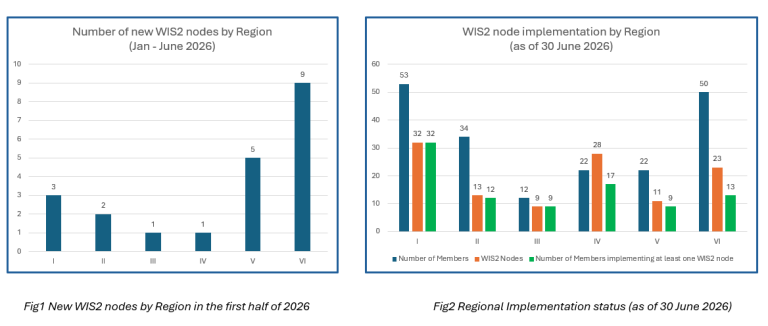
Implementation progress varies across Regions see Fig2 and table 1).
- Regions III and IV continue to have the highest rate of National Centres having implemented a WIS2 Node. In Region III, 9 of 12 Members (75%) in Regions III have implemented at least one WIS2 node, while in Region IV, 17 of 22 Members have done so (77%).
- Region IV includes national WIS2 Nodes for countries that are part of British Caribbean Territories (BCT) and Caribbean Meteorological Organization (CMO), but which are not independent WMO Members, resulting in a higher number nodes than Members.
- Region VI shows strong expansion at the DCPC level, while Member-level implementation remains comparatively low (26%). In the first half in 2026, Region VI recorded the largest increase in operational nodes, accounting for 9 of the 21 new deployments, with 7 linked to DCPCs.
Table 1 Implementation rate by Region
| Region | I | II | III | IV | V | VI | Total |
| Number of Members | 53 | 34 | 12 | 22 | 22 | 50 | 193 |
| Number of WIS2 Nodes | 32 | 13 | 9 | 28 | 11 | 23 | 116 |
| WIS2 Nodes associated to NCs | 32 | 12 | 9 | 25 | 10 | 13 | 101 |
| WIS2 Nodes associated to DCPCs | 0 | 1 | 0 | 3 | 1 | 10 | 15 |
| Implementation Rate (% of Members with at least one WIS2 Node) | 60% (32/53) | 35% (12/34) | 75% (9/12) | 77% (17/22) | 41% (9/22) | 26% (13/50) | 48% (92/193) |
To support consistent implementation, a standardized WIS2 Node assessment process is now in place. Assessment is conducted by Principal GISCs using the WIS2 dev test environment to verify if it is WIS2 compliant prior to operational onboarding.
To date, 12 of 15 GISCs have completed assessments, including: Beijing, Brasília, Casablanca, Exeter, Jeddah, Melbourne , Moscow, Offenbach, Pretoria, Tokyo, Toulouse, and Washington.
Table 2 New WIS2 nodes declared operational between January and June 2026
| WMO Member / Contributing Organization | Region | WIS Centre Type | Centre ID |
| Nepal | II | NC | np-nepalmet |
| Philippines | V | NC | ph-pagasa |
| Russian Federation | VI | NC | ru-roshydromet |
| United Kingdom of Great Britain and Northern Ireland | VI | DCPC | uk-metoffice-wmc |
| Australia | V | NC | au-imos |
| Djibouti | I | NC | dj-anm |
| United Arab Emirates | II | NC | ae-ncm |
| Cabo Verde | I | NC | cv-inmg |
| Comoros | I | NC | km-anacm |
| Mexico | IV | NC | mx-smn |
| Ifremer | VI | DCPC (Pre-approval)* | fr-ifremer-argo |
| Belgium | VI | NC | be-rmib |
| United Kingdom of Great Britain and Northern Ireland | VI | DCPC | uk-bas |
| United Kingdom of Great Britain and Northern Ireland | VI | DCPC | uk-metoffice-globalwave |
| EUMETNET | VI | DCPC (tbc)** | eu-eumetnet-amdar |
| EUMETNET | VI | DCPC (tbc)** | eu-eumetnet-gnss |
| EUMETNET | VI | DCPC (tbc)** | eu-eumetnet-profiles |
| Cook Islands | V | NC | ck-metservice |
| Niue | V | NC | nu-metservice |
| Paraguay | III | NC | py-dinac-dmh |
| Tokelau | V | NC | tk-metservice |
Note:DCPC (Pre-approval) *: P/INFCOM approved DCPC application, pending official endorsement at INFCOM-4
DCPC (tbc) **: pending approval by P/INFCOM for DCPC application
2. New WIS2 downloader now available (Version: v1.0.0b1+rc4)
To help WIS2 users access and download data from WIS2 more easily, a new WIS2 Downloader has been developed and is now available as a standalone application in the repository:
https://github.com/World-Meteorological-Organization/wis2downloader
This new WIS2 Downloader project will provide enhanced resiliency and ease of use by introducing multiples features such as multiple broker subscriptions, deduplication, filtering, and a UI with discovery capabilities.
The Docker stack provided by this repository should be installed on a separate instance from the one hosting wis2box. To download data from WIS2, you do not need a server for which HTTP traffic is routed to the public Internet.
For more information, please see the documentation provided at:
https://world-meteorological-organization.github.io/wis2downloader/
3. WIS2 cookbook 2nd release (Version: 1.1.0)
The latest release of the WIS2 Cookbook was published on 11 June 2026. It builds on the initial 1.0.0 release by providing additional guidance and new recipes to support Member implementation of WIS2, with new releases targeted every 6 months to reflect ongoing community feedback and development.
This new release includes the following updates on additional guidance for data publishers:
- A new recipe illustrating Publishing a WMO Core Metadata Profile record with data provenance.
- A new recipe demonstrating Publishing a WMO Core Metadata Profile record referencing WIGOS stations and networks.
- An update to the Advertising client side filters for data subscriptions in WCMP2 and WNM recipe reflecting the updated official element names to be used in WCMP2.
Click here to access the 1.1.0 release of WIS2 Cookbook
4. Recent amendments to publications adopted through the WMO fast-track approval procedures
The Guide to WIS (WMO-No. 1061), the Provisions for the transition from WIS 1.0 and GTS to WIS 2.0 (WMO-No. 1323), and the technical specifications contained in the Manual on WIS (WMO-No. 1060) and the Manual on Codes (WMO-No. 306) have been amended through the WMO fast-track approval procedure.
The amendments introduce 73 new topics in the atmospheric-composition, cryosphere, hydrology, weather, and space-weather disciplines. For example,
• atmospheric-composition/advisories-warnings/sand-and-dust
• atmospheric-composition/observations/gases/greenhouse-gases
• climate/surface-based-observations/daily
• cryosphere/surface-based-observations/frozen-ground
• cryosphere/space-based-observations/glacier-ice-sheet-ice-shelves
• hydrology/surface-based-observations/water-quantity/lake
• ocean/surface-based-observations/drifting-buoys
• weather/maritime-safety-information/sea-ice-information
• weather/space-based-observations/tianmu-1/tgnos-m
• space-weather/space-based-observations/solar-orbiter/swa
Recent amendments to the WCMP2 and WNM, since the last publication date, include but are not limited to:
Guidance on how to describe client-side filters in discovery metadata and notification messages
New contact role "publisher " to support data citation
Improvements on how to document publication time and updates for the same notification message
All amendments that are approved or under an approval process through fast-track are available on the following community pages until they are included in a new edition of the relevant publication in the WMO Library.
- About the Manual on WIS2, Volume II
- About the Guide to WIS2, Volume II
- About the WIS2 transition guide
- About the Manual on Codes Volume I.2
- About the Manual on Codes, Volume I.3